A child can recite “1, 2, 3…” all the way to 20 and still be unsure how many blocks are on the rug. Knowing how to recognize that difference helps you plan more meaningful math experiences; Early Mathematics Through Play Buy Now $24.00 offers practical strategies for building number sense through routines, exploration, and hands-on learning. For focused ideas on integrating early math into classroom teaching, you can also explore Math Foundations in Early Childhood  Buy Now $16.00 as you read on.
Why is reciting numbers different from understanding quantity?
Rote counting—saying number words in a familiar sequence—is a useful early skill, but it is not proof that a child understands what those words represent. A preschooler may confidently say “one” through “twenty” during a song yet struggle to count a scattered group of objects, give a friend exactly five cars, or answer “How many altogether?” after counting.
Meaningful counting coordinates several ideas. A child learns to say number words in stable order, assign one word to one object, and understand that the final number word names the total. Children also gradually discover that rearranging a group does not change its amount, that objects can be counted in any order, and that different kinds of things can belong to one counted set. These related principles develop over time, not all at once.
This distinction matters because a number recital can look like mastery when it is only one piece of the learning. As Young Mathematicians’ overview of counting and cardinality explains, number-sequence knowledge, one-to-one correspondence, cardinality, and numeral connections are related but distinct.
- Notice whether the child touches or moves each object once.
- After counting, ask whether the child can state the total without starting over.
- Invite the child to make or find a matching amount in another way.
These observations are clues for planning—not reasons to label a child’s ability. A child’s response can vary with attention, language, experience, motor skills, and the materials used.
What ideas help children understand a number such as 20?
Understanding 20 is not simply memorizing its name or recognizing the written numeral. Children benefit from connecting number words, objects, visual patterns, symbols, and real problems. The following concepts help providers understand what a child may be learning:
- Stable order: number words follow a consistent sequence.
- One-to-one correspondence: each object receives one number word, and each word is used for one object.
- Cardinality: the last number word said tells how many objects are in the set altogether.
- Order irrelevance: counting the same objects in a different order gives the same total.
- Abstraction: unlike objects can be counted together as one collection.
For example, a child may count six cubes accurately but then recount when asked how many there are. That can indicate that the child is still connecting the count with the total. Model the connection clearly: “One, two, three, four, five, six. There are six cubes altogether.” Then let the child build six with fingers, counters, or another familiar material.
Later, children connect collections to written numerals and relationships among numbers. The symbol “20” becomes more meaningful when the child can build a group of 20, recognize it as two groups of 10, or explain that it is one more than 19. Number understanding develops through repeated connections, rather than from a single performance.
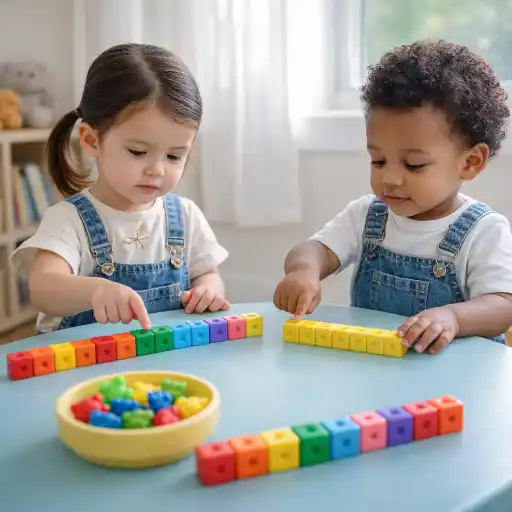
How can providers observe understanding during everyday play?
Assessment can be woven into ordinary classroom moments. Instead of repeatedly asking children to count aloud, vary the purpose and arrangement of the materials. Keep the interaction brief and warm; the goal is to learn how a child is thinking, not to create a test.
Try invitations such as:
- “Can you count these buttons and tell me how many there are altogether?”
- “Could you bring the puppet exactly five crackers?”
- “Can you show eight with your fingers, blocks, or dots?”
- “These two groups look different. Which has more, or do they have the same amount?”
- “I moved the counters. Did the amount change? How do you know?”
Observe strategies as well as answers. Does the child line items up, move counted objects aside, point, group items visually, or recount after a rearrangement? Each behavior gives useful information. A simple note might read: “Counted seven bears one by one and identified the total; recounted after the bears were spread out.” That record can guide the next activity without turning one moment into a fixed judgment.
Use questions that welcome demonstration, pointing, gestures, or words in a child’s home language. A child may understand the quantity even while still learning the English number word. Responsive observation is more informative and inclusive than relying on a single spoken answer.
Which playful experiences build quantity understanding?
Children develop number sense when counting serves a purpose. Everyday routines and play offer natural reasons to figure out how many, compare collections, and represent an amount. The Stanford DREME resource on counting development emphasizes that meaningful, varied experiences help children move beyond reciting number words.
- 🍎 Snack distribution: Invite children to place one item at each setting and check whether everyone has one.
- Block building: Compare two towers and ask how many blocks are needed to make them the same height.
- Dice and dot cards: Roll a die, build the matching set, and talk about how the dots are grouped.
- Outdoor collections: Count leaves or stones arranged in a row, a cluster, and a scattered group.
- Movement games: Count jumps or claps, then try starting from a number other than one when children are ready.
- Fingers and ten-frames: Show small quantities in more than one way, such as five and three making eight.
Subitizing—recognizing a small quantity without counting each object—can help children notice groups within larger numbers. For instance, seeing eight as five and three supports flexible thinking. Invite children to explain what they notice, but do not make speed the goal. Keep materials safe and suitable for the children’s ages, and supervise manipulatives closely.
What common counting misconceptions should providers avoid?
A frequent misconception is treating a fluent count to 20 as evidence that quantity understanding is complete. Pair number words with objects and meaningful questions so children can connect the sequence with what it represents. Another pitfall is using only neat rows: children also need to explore scattered collections and rearranged sets to learn that amount is not defined by position.
It can also be tempting to correct a child immediately. Pause first and ask, “Show me how you counted,” or “How did you figure that out?” The response may reveal whether the child is working on the number sequence, tracking objects, understanding the total, or interpreting the question. Then choose one manageable next step.
- Start with a quantity the child can explore successfully, and extend gradually.
- Use clear, repeated math words such as more, fewer, same, and altogether.
- Offer accessible materials and response options, including pointing, arranging, or using fingers.
- Use familiar cultural materials and home-language number words when possible.
- Connect numerals to quantities rather than emphasizing numeral writing alone.
For teaching teams, a short reflection can strengthen practice: choose one counting routine, notice what teachers ask children to do, and discuss whether children had a chance to explain their thinking. State requirements vary - check your state licensing agency when confirming training or documentation expectations.
Conclusion: What should providers remember about counting to 20?
Counting to 20 is a valuable accomplishment, but it does not by itself show that a child understands 20 objects or the quantity the numeral represents. Children build that understanding by coordinating number words with objects, recognizing the total, comparing groups, noticing patterns, and connecting quantities with symbols.
Use purposeful play and familiar routines to observe what children can do. Offer varied arrangements, hands-on materials, time to think, and supportive questions such as “How many altogether?” and “How do you know?” Then use what you notice to plan a reasonable next challenge. The central takeaway is simple: meaningful math is not just saying the numbers—it is helping children use numbers to describe, represent, and reason about the world.
Explore five relevant English-language courses:
- CDA Certification en Español: Recursos y Consejos para Educadores Bilingües
- Regulaciones de Licenciamiento de Cuidado Infantil en California para Centros y Hogares de Cuidado Infantil Familiar
- Teaching Math to Young Children: Why Counting to 20 Doesn’t Mean They Understand 20
- How Does Counting Shapes Build Early Number Sense Through Play?
- How Can You Teach Numbers to Ten with Ten-Frames and Visual Models?
- How Can Child Care Providers Extend Ten-Frame Learning from 11 to 20?
- How Can Child Care Providers Make Counting and Simple Operations Playful?
- How Can Providers Build Addition Understanding Before Written Problems?
- How Can Visual Feedback Support Multiplication Fluency?
- Why Can a Child Compare Two Piles but Struggle with Greater-Than Symbols?
- A Child Counts Correctly but Cannot Show the Quantity: What Comes Next?
- How Can Preschoolers Learn to Recognize Small Quantities Without Counting?
- How Can Preschoolers Learn More, Fewer, and Equal Without Rushing Into Numbers?
- How Can Preschoolers Recognize Small Quantities Without Counting Every Object?
- How Can Setting a Pretend Table Teach Children Whether There Is Enough for Everyone?
- How Can a Squirrel Story Help Preschoolers Discover Subtraction?
- Why Is Counting to 20 Not the Same as Understanding Quantity?
- How Can Preschool Teachers Build Number Sense Before Introducing Worksheets?
- What Should Preschoolers Understand About Numbers Before Kindergarten?
- Why Can Children Count to 20 but Still Struggle to Understand Quantity?
