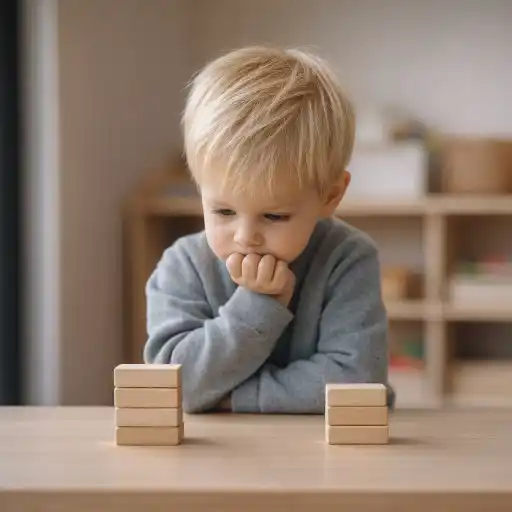
A child who can tell you which pile has more but hesitates at “7 > 4” is not necessarily confused about quantity—the challenge may be connecting a concrete idea to an abstract symbol. Strengthen that bridge with practical, play-based approaches, and explore No Such Thing as Boring Math  Buy Now $24.00 for a deeper look at using exploration and intentional play to support children’s mathematical thinking.
Why is comparing real piles easier than reading symbols?
Two piles offer information children can see and act on. They can match objects one by one, count each group, or notice that a row has pieces left over. A comparison such as 7 > 4 removes those visible objects and asks the child to interpret numerals, understand the relationship between their quantities, recall what the symbols mean, and read the expression in the expected direction—all at once.
These are related but distinct accomplishments. A child may recognize that one collection contains more without yet understanding that the numeral 7 represents seven objects or that “greater than” describes the relationship between 7 and 4. Children can also recite the number sequence before consistently connecting number words with exact quantities. Research on early comparison describes how children gradually coordinate cardinality, relative magnitude, and number order.
This gap is useful information, not a reason to label a child as weak in math. It tells us where instruction can help: make the relationship visible, name it clearly, then connect it to written notation. Comparison develops through repeated experiences, and children may need different amounts of time and support to make that connection.
What mathematical understanding must come before the symbols?
Before expecting children to choose >, <, or =, check whether they can explain what the quantities mean. They need to connect number words and numerals to how many objects are in a group, and understand that a later counting number represents a greater quantity. One-to-one matching can support this insight: pair objects from each pile, then notice which set has an unmatched item. NCETM describes a progression from comparing collections to talking about which has more, and then comparing the numbers that represent them.
Equality deserves particular attention. Children need experiences showing that two groups can have the same number even when the objects or arrangements look different. Matching each object to one in the other group can make “equal” tangible. Once children can compare groups and describe them using words such as more, fewer, same, greater, and less, symbols can record that reasoning.
Use an informal readiness check during play:
- Can the child count each group accurately and say how many are in each?
- Can the child identify which has more, fewer, or the same?
- Can the child explain or show how they know?
- Can the child connect a written numeral to a matching quantity?
If a skill is still emerging, return to objects, conversation, and visual models rather than repeating symbol worksheets.
How can providers build a bridge from objects to comparison symbols?
Teach in a sequence that lets children connect each representation. Start with two small collections of counters, blocks, or classroom objects. Invite the child to predict which has more, then check by matching or counting. Say the comparison aloud: “This group has seven. That group has four. Seven is greater than four.” Next, place numeral cards beside the collections and ask the child to match each number to its group. Only then introduce the symbol between the numerals.
A number line can help make magnitude visible: the number farther to the right represents the greater value. A ten-frame or a pair of towers can also show the difference concretely. Keep the comparison language central; a visual memory aid may help with symbol direction, but it should support—not replace—the child’s understanding of the relationship. As teaching guidance on visual approaches emphasizes, the aim is for children to understand and read a comparison, not merely place a symbol in the expected direction.
Try this brief routine:
- Build two quantities using objects.
- Count or match them and describe the relationship aloud.
- Label each group with its numeral.
- Choose and place the appropriate symbol.
- Read the full statement together, such as “7 is greater than 4.”
Keep the numbers manageable and adjust the materials to the child’s attention, motor skills, language, and confidence.
How can task cards support practice without turning math into memorization?
Once children have explored comparisons with objects and can discuss number relationships, short, varied practice can help them connect that understanding to notation. ChildCareEd’s Task Cards - Greater/Less Than Buy Now $2.49 resource includes 24 cards, a recording sheet, and an answer key. Children decide whether to write greater than, less than, or equal to for number pairs. The cards can be used at a center, in a small group, or as a “write the room” activity.
Keep the cards connected to reasoning rather than speed. Before a child records a symbol, ask them to read the numbers, explain which is larger or whether they are equal, or model the pair with counters. If an answer is incorrect, invite the child to show how they decided and check it with a number line or objects. A written response is one piece of evidence; a child’s explanation often reveals more about what they understand.
To make this resource more accessible and engaging:
- Begin with a few cards and revisit them after concrete practice.
- Provide counters or a number line nearby as optional supports.
- Let children work with a partner and explain their choices to each other.
- Include equal comparisons so children practice all three relationships.
- Notice patterns in errors, such as reversing the symbol or misreading a numeral.
For a broader approach to playful math instruction, providers can also explore Early Mathematics Through Play Buy Now $24.00.
What common teaching pitfalls should providers avoid?
A common pitfall is introducing the symbol before a child understands the comparison it represents. When children are asked to memorize which way a sign points without talking about quantity, they may reproduce a pattern but struggle to explain or transfer the idea. Another pitfall is assuming that quick visual judgment is enough. Close quantities, scattered arrangements, and objects of different sizes can make comparison harder; counting or matching gives children a dependable way to check.
Avoid treating an incorrect symbol as carelessness. The difficulty might involve recognizing a numeral, understanding the words “greater” and “less,” tracking objects while counting, or remembering the comparison direction. Ask, “Show me how you know,” and observe the child’s strategy before deciding what support to offer.
Helpful practices include:
- Use “more” and “fewer” with countable sets, and connect these words to number comparisons.
- Vary the objects and their arrangement so children focus on quantity, not size or spacing.
- Invite children to say the comparison aloud before writing it.
- Use playful cues only as memory supports, not as substitutes for understanding.
- Offer repeated opportunities without pressuring every child to progress at the same pace.
Remember that spoken mathematical vocabulary may also be developing, especially for children learning more than one language. Accept pointing, gesture, home-language explanations, and object models as meaningful evidence of reasoning while you continue to model the English terms.
Conclusion: How can we help children connect piles to symbols?
A child who can compare two piles has already built an important foundation. The next step is not to rush through symbols, but to connect visible quantities to counting, number words, numerals, comparison language, and finally notation. Children benefit when adults make that progression explicit and give them time to explain how they know.
In practice, this means offering hands-on comparisons, modeling words such as greater, less, and equal, and introducing symbols as a concise way to record relationships children can already describe. Use task cards for focused practice when children are ready, and keep counters, ten-frames, or number lines available as supports. The goal is not simply a correctly facing symbol—it is a child who can make sense of the comparison and communicate the reasoning behind it.
For additional professional learning, No Such Thing as Boring Math Buy Now $24.00 explores planned play and mathematical learning, while Math Foundations in Early Childhood Buy Now $16.00 focuses on hands-on strategies for an engaging math environment. You can also explore Letter & Number Planning in Child Care Buy Now $24.00 and Enhancing STEM Education for Infants and Toddlers Buy Now $16.00. Course details and applicable training requirements should be reviewed for your program; state requirements vary - check your state licensing agency.
- 45 Hour Child Growth and Development
- 45 Hour Preschool Methods and Materials
- 45 Hour Infant and Toddler Methods and Materials
- CDA Bridge Bundle: Preschool
- CDA Bridge Bundle: Family Child Care
- CDA Bridge Bundle: Family Child Care without Portfolio Review
- CDA Bridge Bundle: Infant/Toddler
- Texas Director Credential
- CDA Certification en Español: Recursos y Consejos para Educadores Bilingües
- 💛🧩 ¿Cómo puedo hacer que mi enseñanza sea inclusiva para los niños con autismo?
- 👶 ¿Cuáles son las proporciones y grupos requeridos en Dakota del Norte? 🏫
- 🚨 Reporte Obligatorio en Nevada
- Cómo Empezar una Guardería en Casa: Requisitos y Pasos
- Proporciones de Cuidado Infantil y Tamaños de Grupo por Edad en Maryland (Guía Rápida para Centros y Hogares)
- Proporciones de Cuidado Infantil y Tamaños de Grupo por Edad en Nueva Jersey (Guía Rápida para Centros y Hogares)
- Proporciones de Cuidado Infantil y Tamaños de Grupo por Edad en Virginia (Guía Rápida para Centros y Hogares)
- Cómo Trabajar en el Cuidado Infantil en Wisconsin: Requisitos y Pasos
- Celebrando la amistad en el cuidado infantil durante el Día de los Mejores Amigos
- Cómo simplificar la capacitación para sus empleados de daycare
- Preschool Visual Schedule: What to Do When Kids Stop Looking at It
- Teaching Math to Young Children: Why Counting to 20 Doesn’t Mean They Understand 20
- Proporciones para guarderías en casa bajo el Título 22: Cómo la mezcla de edades cambia su capacidad en California
- Learning Through Choice: Why Do Classroom Choice Boards Work?
- How Do Memory and Matching Games Support Visual Discrimination?
- How Can Visual-Motor Practice Strengthen Alphabet Order?
- How Can You Use a Hundreds Chart Beyond Rote Counting?
- Why Can a Child Compare Two Piles but Struggle with Greater-Than Symbols?
