Helping young children connect numerals with quantities requires more than reciting a number sequence—it requires seeing, building, and explaining amounts. The Early Mathematics Through Play Buy Now $24.00 course can strengthen your understanding of play-based number sense while this guide gives you practical ways to use ten-frames, manipulatives, and visual models in your classroom.
Why do ten-frames matter for early number sense?
A ten-frame is a rectangular organizer with two rows of five spaces. Each space represents one unit, allowing children to connect number words, quantities, and written numerals. Unlike an unstructured pile of counters, a ten-frame makes the quantity visible and stable.
This structure supports several important ideas. Children practice one-to-one correspondence as they place one counter in each space, cardinality as they identify how many counters are present, and comparison as they notice which frame has more or fewer. The visual organization also introduces the idea that numbers can be composed of parts. For example, seven can appear as five and two, while ten appears as a complete frame.
Visual models are especially valuable because children do not all enter mathematics through the same pathway. Some learners benefit from touch and movement, some from spatial arrangements, and others from spoken explanation. Combining these pathways creates more opportunities for meaningful participation.
- Ten-frames organize quantities so children can see relationships.
- They connect concrete objects with abstract numerals.
- They support comparison, composition, and early operations.
- They provide a consistent visual reference for repeated practice.
Research-informed guidance on counting emphasizes that children need more than rote sequence knowledge. They must coordinate number words with objects and understand that the final number names the whole set. A ten-frame offers a practical bridge between those concepts.
How should you introduce numbers one through ten with a ten-frame?
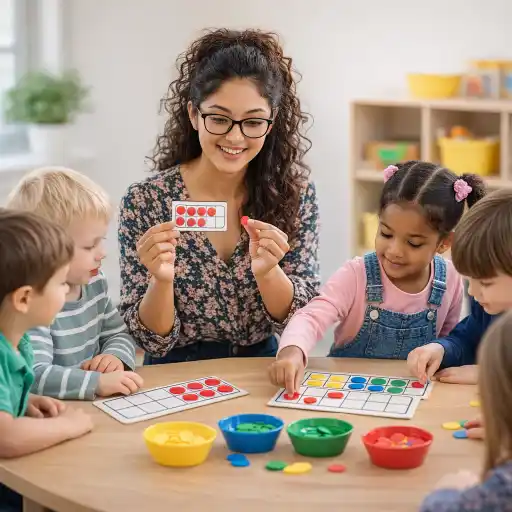
Begin with real objects before asking children to work independently on a paper task. Present a large ten-frame and a small collection of counters. Model slowly: “I have four counters. I place one counter in each space while I count: one, two, three, four.” Then ask, “How many counters are there altogether?”
Invite children to build numbers in several ways. Give a child a numeral card, such as 6, and ask the child to place six counters on the frame. Next, show a filled frame and ask the child to identify the number. Finally, say a number aloud and invite the child to represent it without a numeral card.
Use consistent language, but avoid turning every interaction into a quiz. Describe what children are doing and encourage explanation:
- “You filled five spaces. What do you notice?”
- “How many more would make ten?”
- “Can you show six another way?”
- “Which frame has more? How do you know?”
For children who are beginning to count, work with numbers one through three and use larger counters. Gradually extend to five and then ten. Children who are ready for a challenge can build a number, remove one counter, and describe what changed.
The goal is not speed. The goal is flexible understanding: children should connect the spoken number, the written symbol, the collection, and the visual arrangement.
How can the “Show the Number” worksheet strengthen hands-on learning?
The Ten-Frames: Show the Number (1-10) Practice Worksheet Buy Now $1.49 is a two-page printable resource designed for preschool, kindergarten, and fifth-year early learners. Children draw dots to represent numbers one through ten, and an answer key is included. The resource is available as a one-time licensed PDF with lifetime download access.
 Use the worksheet as a representation or reflection tool—not as a replacement for active learning. Before children complete a page, provide counters, buttons, linking cubes, or playdough pieces so they can construct each quantity. Afterward, ask them to compare the drawn frame with the physical model.
A simple instructional sequence is:
- Build the quantity with manipulatives.
- Place the corresponding numeral beside the model.
- Discuss how the quantity looks on the ten-frame.
- Draw dots on the worksheet.
- Explain the representation to a peer or adult.
Children may not make identical marks, and that is acceptable when the quantity is represented accurately. Encourage children to check their work by counting the dots or matching the drawing to counters. The worksheet can also become a small-group conversation starter: “What do you notice about six and seven? What changes when we add one?”
For centers, place the worksheet with dry-erase sleeves, counters, numeral cards, and a self-check card. Rotate the materials while keeping the mathematical structure familiar.
How can teachers differentiate ten-frame activities?
One ten-frame activity can support children at different developmental levels when you adjust the quantity, materials, prompts, and independence expected. Differentiation should begin with observation rather than assumptions.
- Beginning counters: Use numbers one through three, large counters, and a partially completed model. Count together while children place each object.
- Developing counters: Use numbers one through five or ten. Ask children to state the total after counting and match the frame to a numeral.
- Confident counters: Ask children to show a number, add one, take one away, or explain how many spaces are empty.
- Children needing motor support: Offer magnetic counters, stickers, larger writing tools, or verbal response options.
- Dual-language learners: Pair numerals and visual models with number words in English and the child’s home language whenever possible.
🧠 Keep the frame consistent while changing the challenge. A child may need a ten-frame to understand five, while another child may be ready to use two frames to explore numbers beyond ten.
Observe strategies carefully. Does the child touch one counter per number word? Does the child begin filling from the left? Can the child identify the total without recounting? Does the child recognize a full row as five? These details reveal the next instructional step.
Use brief notes such as: “Jordan represented seven with one-to-one correspondence but counted the dots again when asked for the total.” This information is more useful than simply marking the worksheet correct or incorrect.
How can ten-frames become playful classroom experiences?
Ten-frames are most powerful when children use them to solve meaningful problems. Embed them in play, routines, and short learning centers rather than limiting them to a formal math period.
- Snack frames: Ask children to place one cracker in each space. Discuss whether the frame is full and whether anyone needs more.
- Parking lot game: Label toy-car spaces with numerals. Children draw a number card and park that many cars on a ten-frame.
- Build and compare: Two children build quantities and compare which frame has more, fewer, or the same.
- Missing-space challenge: Cover one or more counters and ask children how many are hidden.
- Movement frame: Place ten floor markers in two rows. Children stand on spaces as the group counts and describes the arrangement.
- Story problems: “Four bears are eating. Two more arrive. How many bears are at the table now?”
Connect these experiences to routines. Count children present, organize art materials into groups of ten, or use a frame to determine how many plates are still needed. Mathematical language becomes more meaningful when it serves a real purpose.
For continued professional learning, No Such Thing as Boring Math  Buy Now $24.00 explores how intentionally planned play can support mathematical exploration and constructive learning. Directors may also recommend Math Foundations in Early Childhood Buy Now $16.00 for strategies that integrate hands-on math into daily teaching practices.
What common mistakes should providers avoid?
Ten-frames are simple, but their instructional value depends on how they are used. The most common mistake is asking children to fill in a worksheet before they have experienced the quantity with physical materials. A drawing can show understanding, but it should not be the only way children encounter number.
- Overemphasizing neatness: Focus on quantity and reasoning rather than identical dot placement.
- Using only one representation: Pair frames with counters, fingers, dice, pictures, movement, and spoken language.
- Moving too quickly to ten: Secure smaller quantities first and increase the range gradually.
- Confusing rote counting with understanding: Ask children to build, compare, and explain quantities.
- Correcting immediately: Ask, “How did you figure it out?” before supplying an answer.
- Using the frame as a test: Keep activities low-pressure and connected to playful exploration.
Safety and accessibility also matter. Use materials that are large enough for the children in your group, supervise loose parts appropriately, and provide alternatives for children with visual, motor, sensory, or communication needs. State requirements vary - check your state licensing agency when aligning documentation, curriculum, or professional development with local expectations.
Families can reinforce the same ideas at home by arranging snacks in rows of five, using an egg carton as a ten-frame, or asking children to show a number with household objects. Encourage questions such as “How many altogether?” and “How many more would make ten?”
Conclusion: How can ten-frames help children understand numbers to ten?
Ten-frames help children understand numbers to ten by making quantity organized, visible, and discussable. They support one-to-one correspondence, cardinality, comparison, subitizing, and part-part-whole thinking while connecting objects, drawings, numerals, and language.
For strong practice, introduce frames with manipulatives, use the Ten-Frames: Show the Number (1-10) Practice Worksheet Buy Now $1.49 as a purposeful follow-up, differentiate by observation, and embed frames in playful routines. Begin with one small goal—such as representing quantities through five—then extend toward ten as children become confident.
To deepen your professional knowledge, explore Early Mathematics Through Play Buy Now $24.00, Math Foundations in Early Childhood Buy Now $16.00, No Such Thing as Boring Math Buy Now $24.00, and Letter & Number Planning in Child Care Buy Now $24.00. Together, intentional visuals, playful practice, and responsive observation can help every child develop confident #numberSense and meaningful #math understanding.
- 45 Hour Child Growth and Development
- Early Mathematics Through Play
- Basic Health & Safety and Breastfeeding Awareness
- 45 Hour Preschool Methods and Materials
- Birth to Five CDA Credential with Portfolio Review
- 45 Hour Infant and Toddler Methods and Materials
- 45 Hour School Age Methods and Materials
- 45-Hour Preschool Curriculum
- Texas Director Credential
- CDA Certification en Español: Recursos y Consejos para Educadores Bilingües
- 💛🧩 ¿Cómo puedo hacer que mi enseñanza sea inclusiva para los niños con autismo?
- Cómo Abrir Una Quardería En Casa Sin Dinero?
- Requisitos Para Ser Maestra Principal En Un Daycare: Lo Que Necesitas Para Empezar
- Proporciones de Cuidado Infantil y Tamaños de Grupo por Edad en Maryland (Guía Rápida para Centros y Hogares)
- Proporciones de Cuidado Infantil y Tamaños de Grupo por Edad en Nueva Jersey (Guía Rápida para Centros y Hogares)
- Proporciones de Cuidado Infantil y Tamaños de Grupo por Edad en Virginia (Guía Rápida para Centros y Hogares)
- Lista para Guardería en Casa en Illinois: Cómo Iniciar una Guardería en el Hogar
- Apoyo en Preescolar para Retrasos del Habla: Estrategias Simples que Ayudan
- Retraso del Habla en la Guardería: Cómo Pueden Ayudar los Proveedores
- Cómo Trabajar en el Cuidado Infantil en Carolina del Norte: Requisitos y Pasos
- Cómo Trabajar en el Cuidado Infantil en California: Requisitos y Pasos
- Cómo Ser Maestra de Preescolar en Maryland
- Capacitación Previa al Servicio para Proveedores de Cuidado Infantil en Dakota del Norte
- How can we teach letters, numbers, and early literacy to young children?
- Celebrando la amistad en el cuidado infantil durante el Día de los Mejores Amigos
- Canciones, juegos y preguntas de círculo para niños
- How Can You Teach Numbers to Ten with Ten-Frames and Visual Models?
- How Can Child Care Providers Extend Ten-Frame Learning from 11 to 20?
- How Can You Use a Hundreds Chart Beyond Rote Counting?
