A child who recites to 20 may still be learning what those numbers represent—and that gap is a meaningful teaching opportunity, not a failure. Explore how structured ten-frames can help children connect number words, numerals, and amounts, and consider Early Mathematics Through Play Buy Now $24.00 for practical strategies that bring number sense into routines and hands-on classroom learning. For a focused foundation in classroom math approaches, you can also explore Math Foundations in Early Childhood  Buy Now $16.00. To put these ideas into practice, use ChildCareEd’s Ten Frame Counting Worksheets | Count to 10 and 20 | PreK-K Buy Now $1.99, which provides structured counting activities that help children visualize quantities, practice one-to-one correspondence, and connect written numerals with the amounts they represent.
Why is reciting numbers different from understanding quantity?
Reciting “one, two, three…” shows that a child is learning the conventional sequence of number words. It does not necessarily show that the child can use that sequence to determine how many objects are in a group. Counting aloud and understanding quantity are related skills, but they develop through distinct experiences.
To count objects meaningfully, children coordinate several ideas. One-to-one correspondence means assigning one number word to each object exactly once. Cardinality means understanding that the final number word tells the total. Children also learn that a group’s quantity stays the same if its objects are counted in another order or rearranged, and that unlike objects can be counted together as one collection.
When a child’s performance seems inconsistent, treat it as useful information rather than a reason to rush or label. Fatigue, attention, language, familiarity with materials, and motor demands can all affect what a child shows at a particular moment. The instructional question is not just “Can the child count?” but “What does the child understand about the amount?”
What should providers observe to identify the next step?
Short observations during play and daily routines can reveal more than repeated number recitation. Offer a small, familiar collection and invite the child to count it. Then vary the prompt: ask how many there are altogether, ask the child to make a matching set, or move the objects and ask whether the amount changed.
Notice the strategy, not only whether the child gives the expected answer. Does the child point to each item once? Does the child stop at the requested amount? After counting, can the child state the total without starting over? Can the child show the same number with counters, fingers, a drawing, or a numeral card? These observations help distinguish number-sequence practice from challenges with tracking, cardinality, or connecting symbols to amounts.
- Ask a child to count a group and then answer, “How many are there altogether?”
- Invite the child to give a puppet exactly six blocks from a larger pile.
- Rearrange a counted group and ask, “Did the amount change? How do you know?”
- Offer a numeral card and ask the child to build or select that many objects.
Record a concise, factual note, such as: “Counted seven counters with one-to-one pointing; recounted when asked for the total.” That note suggests a supportive next move: restate the total after counting, then revisit the idea with another material. A child may understand a quantity before being able to explain it in English, so accept pointing, gestures, home-language responses, or a built model as evidence of thinking.
How do ten-frames make quantity easier to see?
A ten-frame is a rectangle with two rows of five spaces. Its consistent structure gives each counter a defined place, helping children organize a set rather than track objects in an unstructured pile. Placing one counter in each space offers practice matching one number word to one object; seeing the filled spaces together can support understanding of the total.
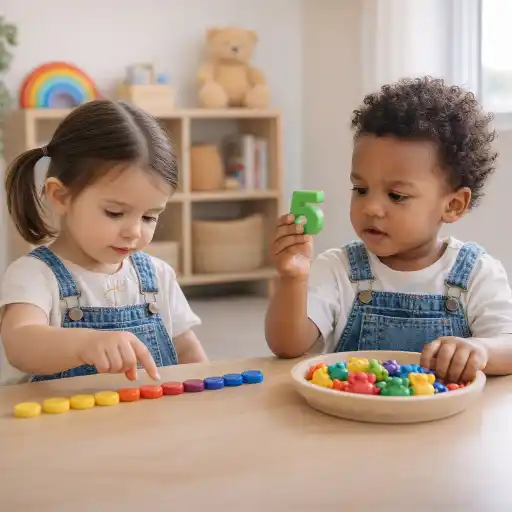
Ten-frames also make relationships visible. A child can notice that six is five and one, or that eight fills five spaces in one row and three in the next. With repeated exposure, children may begin recognizing familiar arrangements without counting every counter, a skill known as subitizing. The frame can connect physical objects to spoken number words, written numerals, and drawings.
Start with counters in children’s hands before moving to a printed representation. Model slowly: “I have four counters. I put one in each space as I count: one, two, three, four. There are four altogether.” Then invite children to build the same amount on a frame. For numbers above ten, use two frames: a full frame plus additional counters can make the structure of teen numbers more visible.
The Ten-Frames: Show the Number (1–10) worksheet Buy Now $1.49 and Ten-Frames: Show the Number (11–20) worksheet Buy Now $1.49 can extend hands-on work by asking children to draw dots in frames. Use a worksheet as a short way to represent or revisit a quantity—not as a substitute for building it with objects first.
How can providers turn ten-frame practice into meaningful play?
Children learn more when counting and representing amounts serve a purpose. Ten-frames can be part of brief games, routines, and classroom problems rather than isolated drills. Keep the frame familiar and vary the materials, questions, or challenge so children can focus on the mathematics.
- 🍎 Snack helper: Place one snack item in each space and decide whether the frame is full or how many more are needed.
- Build and compare: Two children make quantities on separate frames, then discuss which has more, fewer, or the same amount.
- Make a match: Draw a numeral card, build that quantity with counters, and check whether the frame shows the same amount.
- One more: Build a number, add one counter, and talk about what changed.
- Hidden counters: Cover one or two spaces and ask children to predict how many counters are hidden, then reveal and check.
Use open prompts that invite reasoning: “What do you notice?” “How do you know?” “Can you show the same amount another way?” If a child counts every counter, that is a valid strategy; there is no need to demand a faster response. Some children may be ready to notice a full row of five or a group of five and some extra counters, while others benefit from smaller quantities and adult modeling.
Make participation accessible. Use larger counters or magnetic pieces for children who need motor support, uncluttered high-contrast frames when helpful, and spoken, pointing, or home-language responses. Supervise loose materials and choose pieces appropriate to the age group. The goal is a welcoming mathematical conversation, not a test.
What common pitfalls can limit children’s number sense?
The first pitfall is assuming that a fluent number sequence demonstrates mastery of quantity. Singing, rhymes, and counting games remain valuable, but pair them with opportunities to count, build, compare, and explain groups. The second is using worksheets before children have handled or seen the quantities. A drawing can support learning, but the physical model helps make the amount concrete.
Another common mistake is expecting every child to count objects only when they are neatly lined up. Organized rows can reduce tracking demands at first, but children also need opportunities to count scattered objects and see sets rearranged. This helps them notice that quantity is not determined by spacing or order. Similarly, avoid correcting immediately; first ask the child to show how they figured it out. A pause may reveal whether the child is working on the sequence, one-to-one matching, or the meaning of the final count word.
- Do not make speed or perfect handwriting the measure of understanding.
- Do not extend the range to 20 before children have opportunities to make sense of smaller quantities.
- Do not treat one incorrect answer as a fixed judgment about a child’s ability.
- Use a range of representations—objects, fingers, dot patterns, frames, numerals, and everyday situations.
For directors and teams, brief reflection can support consistent practice: choose a counting routine, observe the questions adults ask, and consider whether children get to explain or show their thinking. State requirements vary - check your state licensing agency when determining whether training or documentation meets local expectations. For continued learning, ChildCareEd’s No Such Thing as Boring Math Buy Now $24.00, Letter & Number Planning in Child Care Buy Now $24.00, and CDA Subject Area 2 Buy Now $80.00 offer additional perspectives on math, play, and planning.
Conclusion: How can ten-frames help children move beyond rote counting?
Children may count to 20 while still developing an understanding of what those number words represent. This is a common part of early mathematical learning: reciting the sequence, coordinating one word with each object, understanding the total, and connecting quantities to numerals are related accomplishments, not one single skill.
Ten-frames offer a practical bridge. Their stable spaces help children organize objects, see totals, compare groups, and notice how numbers can be composed from smaller parts. Begin with physical counters, model meaningful counting language, and then invite children to represent the amount with a frame, drawing, or numeral. Use playful, purposeful contexts and observe each child’s strategy to select a manageable next step.
The central goal is not simply to help children say numbers farther along the sequence. It is to help them make sense of quantity—with curiosity, confidence, and many chances to show what they know.
- 45 Hour Child Growth and Development
- 45 Hour Preschool Methods and Materials
- What Makes Me Special: An Overview of Autism and ADHD
- 45 Hour Infant and Toddler Methods and Materials
- Baby Steps to Milestones
- CDA Bridge Bundle: Family Child Care without Portfolio Review
- CDA Bridge Bundle: Infant/Toddler without Portfolio Review
- CDA Bridge Bundle: Preschool without Portfolio Review
- Texas Director Credential Renewal
- Texas Director Credential
- CDA Certification en Español: Recursos y Consejos para Educadores Bilingües
- 💛🧩 ¿Cómo puedo hacer que mi enseñanza sea inclusiva para los niños con autismo?
- 👶 ¿Cuáles son las proporciones y grupos requeridos en Dakota del Norte? 🏫
- ¿Cómo puedo usar escenarios de juego de roles de primeros auxilios en mi aula?
- 10 Ejemplos de Cómo la Cultura Influye en el Desarrollo Infantil
- Proporciones de Cuidado Infantil y Tamaños de Grupo por Edad en Nueva Jersey (Guía Rápida para Centros y Hogares)
- Proporciones de Cuidado Infantil y Tamaños de Grupo por Edad en Virginia (Guía Rápida para Centros y Hogares)
- Lista para Guardería en Casa en Illinois: Cómo Iniciar una Guardería en el Hogar
- Por Qué la Supervisión Activa Es Clave para la Seguridad en el Cuidado Infantil
- Capacitación Previa al Servicio para Proveedores de Cuidado Infantil en Carolina del Norte
- Celebrando la amistad en el cuidado infantil durante el Día de los Mejores Amigos
- Diversión fresca de verano: actividades del Día Nacional del Helado para niños
- Canciones, juegos y preguntas de círculo para niños
- Cómo simplificar la capacitación para sus empleados de daycare
- Teaching Math to Young Children: Why Counting to 20 Doesn’t Mean They Understand 20
- How Can Child Care Providers Extend Ten-Frame Learning from 11 to 20?
- How Can You Make Addition Practice More Engaging Without Losing the Learning Goal?
- Why Can a Child Compare Two Piles but Struggle with Greater-Than Symbols?
- Why Is Counting to 20 Not the Same as Understanding Quantity?
- Why Can Children Count to 20 but Still Struggle to Understand Quantity?
