Before a fall gathering, a simple question—“Do we have enough seats?”—can become a meaningful math investigation for young children. Explore ways to teach one-to-one matching through playful table setting, and consider Math Foundations in Early Childhood  Buy Now $16.00 for practical strategies that help you weave hands-on math into classroom routines and play. The ideas below offer a starting point; the course provides a broader opportunity to strengthen your early math teaching practice.
Why is setting up for a gathering a meaningful math lesson?
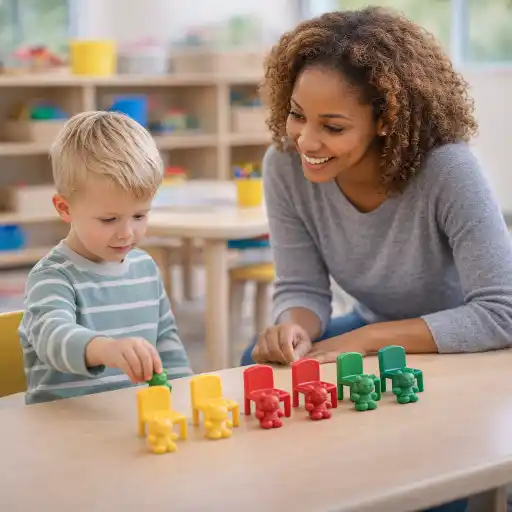
A pretend fall gathering gives children an authentic problem to solve: every guest needs a place to sit, and every place setting needs the right objects. As children match one chair to one guest, or one plate to one placemat, they begin to connect counting words to actual quantities. This is one-to-one correspondence: matching one item in one group with exactly one item in another, or assigning one number word to each object counted.
The activity also builds habits of reasoning. Children can notice when a guest has no chair, when a place setting is missing a cup, or when there is an extra plate. The concrete materials make these relationships visible and open the door to questions such as, “How do you know everyone has a seat?” and “What needs to change?”
One-to-one matching is more than a seasonal activity. It supports later counting, comparing quantities, and understanding that the final number word tells how many are in a set. Children may initially skip an item or count one twice; these are useful clues about what they are learning, not evidence that they have failed. A calm, playful setup gives children room to try, notice, and revise.
- Connects math to a familiar classroom event and purposeful play.
- Builds vocabulary such as enough, one more, left over, and same.
- Offers natural opportunities for turn-taking, collaboration, and problem-solving.
How can you prepare the Set the Fall Table Matching Challenge?
Choose a small number of seats to begin—two or three may be enough for children who are just learning to match. Gather chairs or chair pictures, guest figures or child-safe counters, and pretend tableware such as placemats, plates, cups, and napkins. You can use classroom materials, paper cutouts, or the Thanksgiving Table-Setting Activity Guide Buy Now $2.65 as a seasonal printable option.
Keep the setup clear and manageable. Place the guest figures in a row, then invite children to provide one chair for each guest. Once they have matched those groups, add another layer: one placemat for each seat, then one plate for each placemat. Model the language as you act: “One guest, one chair. Let’s check whether everyone has a place.”
Before beginning, inspect every item for age-appropriate size and condition. Avoid small loose pieces for children who may mouth objects, and supervise actively. Use large picture cards or larger play dishes when needed. The goal is thoughtful matching, not a polished table display.
- Start with a manageable quantity and add guests gradually.
- Use visually distinct, accessible materials that children can move easily.
- Offer a demonstration, then give children time to explore independently.
How do you teach children to match one item to one guest?
Begin with one-to-one pairing before expecting children to count a larger set independently. Invite a child to place one chair beside each guest, moving from guest to guest in a deliberate sequence. Then ask the child to put one plate at each place. A steady rhythm—“one guest, one chair”—helps make the relationship visible. Encourage children to touch or move each item as they say a number word when counting.
When all the guests have a chair, pause and ask, “Does anyone still need a seat?” Let children inspect the arrangement rather than supplying the answer. If there is a mismatch, invite them to check by pairing each guest with a chair again. Moving items into a line, or placing each matched pair side by side, can help children keep track and avoid recounting the same object.
As their understanding grows, invite children to tell how many guests are present after counting. This connects matching with cardinality: the last number said describes the total. Children who are still developing counting may point, gesture, or move each object; those actions are meaningful evidence of their thinking.
- Use brief prompts: “Who has a chair?” “What do you notice?” “How can we check?”
- Allow children to count at their own pace; accuracy and understanding matter more than speed.
- Accept spoken, gestured, or demonstrated responses as ways to communicate reasoning.
How can you adapt the challenge for different learners?
Children arrive with different experiences of counting, motor control, language, and group play. Adjust the task so that each child can participate meaningfully. For a child who is beginning to match, use one or two guests and a small number of large, easy-to-handle objects. A child who is confidently matching may set a larger table or compare two arrangements to identify which has an extra seat.
Make participation accessible by offering choices in how children respond. They may place items, point to picture cards, direct a peer, or explain in a home language. Use high-contrast images, uncluttered layouts, and stable materials when these support access. If grasping small objects is difficult, provide larger pieces, a tray, or a pointing response. Collaboration can also help: one child names a guest while another finds the matching chair.
Keep the math goal in view while making the process flexible. A child may need fewer objects, repeated modeling, or extra time; another may be ready to compare, add, or remove items. The challenge is not to make every child complete the same number of steps, but to offer a worthwhile next step for each learner.
- Beginning matchers: pair a guest with a chair or plate using just a few objects.
- Developing counters: arrange objects in a clear line and count as each is moved.
- Ready for extension: ask how many seats are needed if one more guest joins.
- 🌟 Invite peers to help, while ensuring every child has a meaningful role.
What questions and extensions deepen the math learning?
Once children have matched guests and seats, extend the activity with questions that encourage explanation and flexible thinking. Ask, “Are there enough chairs for everyone?” “How can we find out?” or “What happens if one more guest arrives?” Avoid turning every prompt into a quiz. Pause, listen, and follow the child’s idea; their explanations can show whether they are matching, counting, comparing, or using another strategy.
Children can also match the rest of the place settings: one placemat for each chair, one plate for each placemat, and one cup for each guest. Introduce comparison by placing a few extra chairs nearby and asking whether there are more chairs or guests. For children ready to extend, remove one chair and discuss what is missing, or add a guest and predict what else the table needs.
Keep the experience playful and connected to children’s lives. A classroom gathering can reflect a range of family traditions and meal practices; invite children to share what they know without suggesting that every family celebrates in the same way. Everyday mealtimes and transitions can offer more low-pressure practice, as described in DREME’s Math Moments.
- Try “same number,” “one extra,” “one fewer,” and “not enough” comparisons.
- Ask children to rearrange the settings: does the number of guests change?
- Connect with routines: count out one napkin or utensil for each place at snack.
How can educators observe learning and avoid common pitfalls?
Observation can remain light and useful. Notice whether a child pairs each guest with one chair, counts each object once, recognizes an unmatched item, or explains how they know there are enough seats. Record what you see in specific, neutral language—for example, “Matched four guests to four chairs independently,” or “Needed a reminder to check each guest.” These notes can help you choose a next step, such as repeating the activity with a smaller set or introducing one additional guest.
A common pitfall is focusing on a correct-looking table rather than children’s thinking. Another is moving too quickly to larger numbers or correcting every error before a child can investigate. Instead, use a brief prompt, give wait time, and invite the child to check the pairs. A child who counts the same chair twice may benefit from moving each counted item to a separate area.
Keep materials safe and suitable for the children using them, especially small loose parts. Include children with varied communication and motor needs through adapted materials and multiple ways to participate. If documenting the activity as part of program planning, follow your setting’s guidance; state requirements vary - check your state licensing agency.
- Observe strategies and progress, not just whether the final count is correct.
- Use mistakes as information for planning additional practice.
- Keep the activity brief, inviting, and responsive to children’s interests.
Conclusion: What should providers remember about the seat-counting challenge?
The question “Does our classroom have enough seats?” offers young children a concrete reason to match, count, and solve a problem together. When each guest receives one chair and each place receives one setting, abstract number ideas become visible and meaningful. Starting with a small group, modeling one-to-one matching, and allowing children time to check their work can make the activity accessible and enjoyable.
Remember to adapt the materials and level of challenge, observe children’s strategies, and connect the math to routines beyond the fall gathering. A missed match or repeated count is an opportunity to offer gentle support, not a reason to rush. With intentional prompts and playful practice, everyday classroom moments can help children build a stronger understanding of quantity and correspondence.
For further support in planning hands-on early math experiences, explore ChildCareEd’s Math Foundations in Early Childhood Buy Now $16.00. A well-prepared gathering can be both welcoming and a rich learning opportunity—one seat, one guest, and one discovery at a time.
- 45 Hour Child Growth and Development
- 45 Hour Preschool Methods and Materials
- What Makes Me Special: An Overview of Autism and ADHD
- Teach with Respect!
- 45 Hour Infant and Toddler Methods and Materials
- 45 Hour School Age Methods and Materials
- Brighter Futures: Social Emotional Development
- 45 hour Growth and Development Birth-age 12 ONLINE
- 45-Hour Infant and Toddler Curriculum
- CDA Certification en Español: Recursos y Consejos para Educadores Bilingües
- Cómo Abrir Una Quardería En Casa Sin Dinero?
- ¿Cuáles son las mejores actividades del Día de la Tierra para niños en casa o en el aula?
- ¿Cómo puedo usar escenarios de juego de roles de primeros auxilios en mi aula?
- 10 Ejemplos de Cómo la Cultura Influye en el Desarrollo Infantil
- Fall Circle Time Ideas for Preschool and Daycare
- La mejor manera de hacer seguimiento a la capacitación de su equipo de daycare How to Organize Staff Training for Your Child Care Center Cómo organizar la capacitación del personal para su centro de cuidado infantil
- Cómo simplificar la capacitación para sus empleados de daycare
- Too Wiggly to Sit? Fall Movement Activities Toddlers Will Love
- How Can Child Care Providers Use Learning Styles Responsibly in Early Childhood Classrooms?
- How Can You Write Objective Child Observation Notes?
- How Can Simple Fall Activities Support Kindergarten Readiness Through Play?
- How Can Preschool Providers Observe Early Number Recognition During Math Play?
- How Can Preschoolers Learn More, Fewer, and Equal Without Rushing Into Numbers?
- How Can Setting a Pretend Table Teach Children Whether There Is Enough for Everyone?
- When Leaves Become “Mine”: How Can We Teach Sharing During Fall Nature Play?
- How Can One Cardboard Box Become Four Fall Dramatic-Play Settings?
- How Can You Plan a Fall Family Night That Works for Different Schedules and Budgets?
- How Can a Name Card at Every Place Make a Preschool Fall Gathering More Meaningful?
- Does Our Classroom Have Enough Seats? Teaching One-to-One Matching Before a Fall Gathering
