A pretend meal can turn a familiar dramatic-play moment into a meaningful investigation of quantity, fairness, and belonging. Explore Early Mathematics Through Play Buy Now $24.00 and Math Foundations in Early Childhood  Buy Now $16.00 for practical strategies that help you notice and extend children’s mathematical thinking during play. Then try the simple table-setting approach below to help children discover, together, how they can tell whether there is enough for everyone.
Why does a pretend table make “enough for everyone” easier to explore?
“Is there enough?” is a real problem children can see and act on. When they set places for dolls, stuffed animals, or classmates, abstract ideas about quantity become visible: each guest needs a place, and the group can check whether the available plates, cups, and napkins match the number of guests. A pretend table also connects early mathematics with social understanding, language, planning, and imaginative play.
Children may begin by placing objects wherever they fit, then notice that one guest has no plate or that a place has two cups. Those discoveries are valuable. Instead of treating a mismatch as a mistake to correct immediately, invite children to investigate: “What do you notice?” “How could we check?” A child might count the guests, count the plates, or match one plate to each guest. Each strategy offers a window into developing #numberSense and reasoning.
Setting the table is especially useful because it gives counting a purpose. Children are not reciting number words for their own sake; they are trying to make the pretend meal work for the people in the story. The activity also makes inclusion tangible: the question is not only whether there are enough objects, but whether everyone has been considered. A printable table-setting activity can support this kind of matching and counting; see ChildCareEd’s table-setting activity guide Buy Now $2.65.
What mathematical ideas can children practice while setting places?
The most direct idea is one-to-one correspondence: matching one item to one person or place. A child who gives each of four toy guests one plate is connecting a quantity of guests with a quantity of plates. The child can then check by looking for an unmatched guest or leftover plate. This concrete action supports understanding beyond simply reciting “one, two, three, four.”
The play can also introduce comparison and cardinality. Children may count guests and plates separately, then decide whether the totals are the same. If they say, “There are four plates,” and understand that the last number tells how many plates there are altogether, they are using cardinality. Words such as #counting, more, fewer, same, enough, and leftover help make the relationships explicit.
- Invite children to count the guests first, then predict how many places they will need.
- Offer a small number of plates, cups, or napkins and ask how children can check the match.
- Encourage children to move objects as they count, so each item is counted once.
- Notice spatial language too: “beside,” “between,” “in front of,” and “at the end.”
These ideas grow through repeated, playful experiences, not pressure to give a fast or perfect answer. Follow children’s interests and adjust the number of guests or materials to keep the challenge manageable.
How can educators set up the activity and guide children’s thinking?
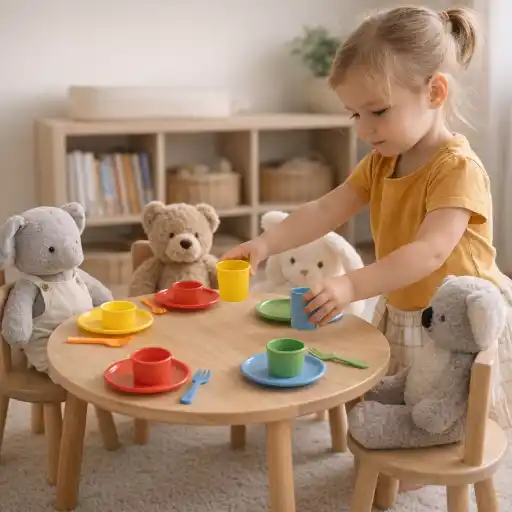
Keep the setup simple and inviting. Provide a small pretend table or mat, toy people or animals, and play plates, cups, and napkins. Begin with two or three guests and a limited number of items. You might say, “The bears are ready for lunch. How can we find out if each bear has a plate?” Then pause. Children need time to examine the materials and decide what to do.
Model a strategy only when it helps children move forward. For example, place one plate in front of each guest while narrating, “One plate for this bear, one for that bear.” Then invite children to continue. If a child counts the same plate twice, try a neutral prompt: “Which plate will you count next?” or “How could we keep track?” That supports learning without taking over the problem.
- Let children choose who is coming to the pretend meal and how many places to set.
- Ask open questions: “What do you notice?” “How do you know?” “What could we try?”
- Offer multiple ways to participate, including placing objects, pointing, gesturing, drawing, or explaining in a home language.
- 📋 Record a brief observation of the strategy a child uses, such as matching one napkin to each plate.
Children’s own play ideas may shift the scenario toward a picnic, restaurant, or family celebration. Those turns can deepen engagement. Adults can add gentle mathematical language while honoring children’s direction. For further professional learning on mathematical play and routines, see No Such Thing as Boring Math Buy Now $24.00.
What can children learn when there are too few—or extra—items?
A shortage or surplus creates a productive reason to compare. If three toy guests have only two plates, children can notice the mismatch and decide what to do next: find another plate, invite fewer guests, or change the pretend plan. If there is an extra plate, they can identify it as leftover, look for another guest, or set it aside. These are early problem-solving experiences grounded in objects children can see and move.
Use questions that help children explain rather than simply follow an adult’s answer: “Who still needs a plate?” “How can we check whether everyone has one?” “What changed when we added another guest?” Children may recount, line up objects, or pair each guest with an item. Accept different reasonable approaches and let the group test them.
It is also useful to distinguish equal quantities from fairness. In this activity, one plate per guest may be the practical goal. But fairness is not always identical distribution in every real-life situation; needs and context matter. Keep the conversation respectful and avoid labeling a child selfish or unfair when they are still learning how to coordinate their ideas with a group.
- Start with a small, visible difference—one item missing or one extra.
- Give children time to suggest and test a solution with the materials.
- Use words such as #fairness, equal, enough, and leftover without implying that one strategy defines fairness in every situation.
In this way, table setting supports both mathematical reasoning and peer communication. Children can learn to notice what others need, share their ideas, and revise a plan together.
How can providers adapt the experience and observe learning?
Adapt the activity to children’s ages, interests, motor abilities, communication styles, and prior experience. Toddlers may explore placing a large napkin beside a plate while an adult names “one for each.” Preschoolers may count a larger group, compare totals, or decide what to do with leftovers. Use sturdy, age-appropriate pretend materials, supervise closely, and avoid small loose parts for children who may mouth objects.
Make the play accessible by using a stable mat, larger items that are easy to grasp, picture cues, or a clear place marker for each guest. Children can communicate their thinking through speech, gestures, signs, home languages, or arranging the objects. Offer a partner model or extra time when useful, and avoid assuming that verbal explanations are the only evidence of understanding.
Observe the strategy, not speed. A useful note might read: “Jordan placed one cup at each of three seats, then noticed an extra cup.” Another might be: “Ari counted the plates aloud but skipped one while pointing.” Specific descriptions help you plan the next experience without turning a developing skill into a fixed label.
- For an early step, use two guests and two or three large items.
- For a next challenge, add guests, mix item types, or introduce one leftover.
- Invite children to draw the table or tell a story about who is joining the meal.
- Repeat the idea during snack or cleanup when appropriate, while respecting program routines and food-safety practices.
Common pitfalls include rushing to supply the answer, using too many materials at once, or insisting that every child use the same counting strategy. Keep the interaction playful and responsive. State requirements vary - check your state licensing agency when aligning classroom practices or professional development with local expectations.
Conclusion: How does a pretend table help children decide whether there is enough?
Setting a pretend table gives children a concrete way to investigate whether there are enough places and objects for everyone. As they match a plate or cup to each guest, they practice one-to-one correspondence; as they count and compare, they explore quantity and “how many”; and as they respond to a shortage or extra item, they plan, communicate, and consider others.
Start small, let children lead the scenario, and use open questions to make their thinking visible. Offer accessible, safe materials, observe the strategies children use, and treat mismatches as invitations to explore rather than errors to hurry past. With your guidance, a familiar pretend meal can become a welcoming opportunity to build #math, language, problem-solving, and a sense that everyone belongs.
Five relevant ChildCareEd courses:
- Early Mathematics Through Play
- From Play to Planning: Building Culturally Competent, Child-Centered Curriculum
- The ABCs of Behavior: Turning Challenges into Learning Opportunities
- The Best Promotion is Play
- Creating Engaging and Meaningful Learning Experiences
- Texas Director Credential
- Bienvenido! Welcoming All Families
- Montessori Cultural Activities: Exploring the World Through Play and Learning
- Every Moment Matters: Schedules and Transitions
- CDA Certification en Español: Recursos y Consejos para Educadores Bilingües
- 💛🧩 ¿Cómo puedo hacer que mi enseñanza sea inclusiva para los niños con autismo?
- Requisitos Para Ser Maestra Principal En Un Daycare: Lo Que Necesitas Para Empezar
- Que es Título 22 en California?
- Regulaciones de Licenciamiento de Cuidado Infantil en California para Centros y Hogares de Cuidado Infantil Familiar
- Proporciones de Cuidado Infantil y Tamaños de Grupo por Edad en Maryland (Guía Rápida para Centros y Hogares)
- Proporciones de Cuidado Infantil y Tamaños de Grupo por Edad en Nueva Jersey (Guía Rápida para Centros y Hogares)
- Proporciones de Cuidado Infantil y Tamaños de Grupo por Edad en Virginia (Guía Rápida para Centros y Hogares)
- Cómo Trabajar en el Cuidado Infantil en Carolina del Norte: Requisitos y Pasos
- Cómo Trabajar en el Cuidado Infantil en California: Requisitos y Pasos
- Cómo Ser Maestra de Preescolar en Wisconsin
- Celebrando la amistad en el cuidado infantil durante el Día de los Mejores Amigos
- Canciones, juegos y preguntas de círculo para niños
- Child Keeps Hitting Other Kids? Look for These 7 Patterns Before Reacting
- Active Supervision Examples: 10 Real Classroom Scenarios—Safe or Unsafe?
- How Should Child Care Providers Respond When Preschoolers Lie?
- What Is Child-Led Play, and Why Does It Matter?
- How Can Teachers Help Children Learn Responsibility Without Shame?
- What Are Developmentally Appropriate Ways to Introduce Goal Setting to Young Children?
- How Can Setting a Pretend Table Teach Children Whether There Is Enough for Everyone?
