Teen numbers become more meaningful when children can see that each one is made of one full ten and additional ones. Use the Ten-Frames: Show the Number (11-20) Practice Worksheet Buy Now $1.49 for focused visual practice, and explore Math Foundations in Early Childhood  Buy Now $16.00 to strengthen your strategies for play-based math instruction and professional knowledge.
Why does extending ten-frame learning beyond 10 matter?
Children often recognize the numerals 11 through 20 before they understand the quantities those numerals represent. The transition from 10 to 11 is therefore more than a counting exercise: it introduces the structure of the base-ten system. A double ten-frame makes that structure visible. The first frame represents one complete group of ten, while the second frame shows the additional ones.
This representation supports #number sense, cardinality, comparison, and early place-value reasoning. Research and curriculum guidance emphasize that young children benefit from concrete materials and multiple representations before being expected to reason abstractly. A ten-frame also allows children to count individually, recognize familiar arrangements, and explain how a quantity relates to 10.
For providers and directors, the goal is not to rush children through 11–20. The goal is to create repeated opportunities to notice, describe, build, and compare these quantities in meaningful contexts.
- 11 is one ten and one one.
- 15 is one ten and five ones.
- 20 is two complete groups of ten.
How should educators introduce the double ten-frame?
Begin with a concrete demonstration rather than a worksheet. Place ten counters in the top frame and invite children to describe what they see. Ask, “What do we know about this frame?” and “How many more counters would make 11?” Add one counter to the second frame, then connect the model to the numeral 11.
Repeat the process with a small range of numbers, such as 11–13, before introducing the entire sequence. Use consistent language: “one ten and two ones makes 12.” Avoid implying that the 1 in every teen number means merely “one”; explain that it represents one group of ten.
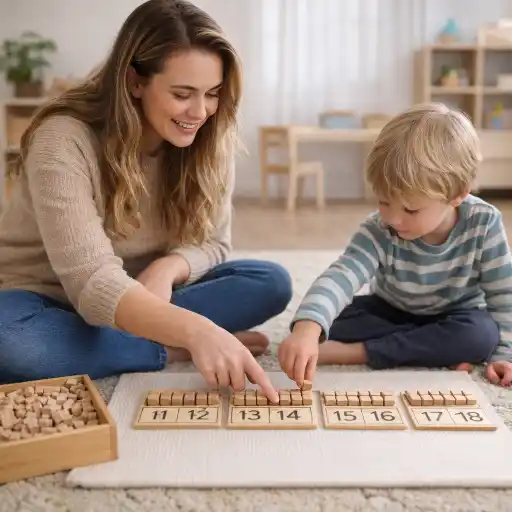
Hands-on materials may include counters, linking cubes, buttons, craft sticks, or large magnetic dots. For children who need additional support, use color coding: one color for the full ten and another for the ones. This distinction helps children notice the invariant ten while observing that the second part changes.
Connect the model to everyday routines. Count 10 children who are present, then ask how many there would be if one more arrived. During snack, build a group of ten crackers and add one, two, or three more. These brief moments make #counting purposeful and help children transfer the idea beyond a printed page.
How can the practice worksheet support meaningful learning?
The Ten-Frames: Show the Number (11-20) Practice Worksheet Buy Now $1.49 provides a concise way for children to represent teen numbers with dots on double ten-frames. Its two-page format and included answer key make it practical for a small group, math center, or brief individual follow-up.
Use the worksheet after children have explored physical counters. Invite them to verbalize each representation before marking it: “I see one full ten and four more. That is 14.” Encourage children to touch or point as they count, then ask them to check whether the first frame is complete.
The resource can serve several purposes:
- Introduce a new number with teacher modeling.
- Provide guided practice during a small-group lesson.
- Offer independent practice for children who are ready.
- Create a work sample for documentation and family communication.
- Reveal whether a child understands quantity, not just numeral recognition.
Keep the activity developmentally responsive. Some children may complete only a few numbers successfully, while others may explain patterns across the entire set. A worksheet should extend hands-on learning, not replace conversation, movement, or manipulatives.
How can providers differentiate instruction from 11 to 20?
Children will not reach teen-number understanding at the same time, and variation is expected. Begin with observation: Can the child count objects with one-to-one correspondence? Does the child understand that the last number tells how many? Can the child identify a full ten-frame? These observations help you select an appropriate entry point.
For children who need support, work with one number at a time and use real objects. Fill the first frame together, then add one object to the second. Offer sentence starters such as, “I have one ten and ___ ones.” Allow children to use fingers, counters, or a number line while they explain.
For children who are ready for extension, ask them to:
- Build the same number in two ways using counters and linking cubes.
- Compare 14 and 17 using “more,” “fewer,” or “how many more.”
- Count forward and backward from a given teen number.
- Write equations such as 16 = 10 + 6.
- Find one more, one less, two more, or two less.
🧩 For children who benefit from reduced visual or motor demands, enlarge the frames, use tactile counters, provide a partner, or invite oral responses instead of requiring extensive writing.
State requirements vary - check your state licensing agency when documenting curriculum alignment or professional development expectations.
What common mistakes should educators avoid?
A frequent mistake is treating teen numbers as isolated vocabulary words. Children may recite “11, 12, 13” while lacking a stable understanding of what those quantities contain. Pair every numeral with a representation and a discussion of tens and ones.
Another pitfall is asking children to count all 17 counters from the beginning every time. Counting is valuable, but the purpose of the double frame is to help children recognize the completed ten and count on from it. Ask, “How do you know this is 17?” rather than automatically directing, “Count everything.”
Educators should also avoid overcorrecting the arrangement of ones. The additional counters may be placed in different positions as long as the quantity is clear. Focus on mathematical reasoning, not a single “perfect” visual layout.
- Mistake: Moving to worksheets before concrete exploration. Better approach: Start with objects, then pictures, then numerals.
- Mistake: Teaching the digit 1 as “one.” Better approach: Explain that it identifies one group of ten in teen numbers.
- Mistake: Expecting every child to complete 11–20 at once. Better approach: Use small ranges and revisit concepts frequently.
How can staff assess and extend learning?
Assessment can be brief, natural, and useful. During a small-group activity, show a double ten-frame and ask, “What number is this? How do you know?” Record the child’s response, strategy, and level of independence. A child who counts every dot may be developing cardinality, while a child who immediately identifies one ten and six ones is demonstrating more integrated place-value reasoning.
Use the worksheet as one piece of evidence rather than a definitive test. Compare performance across materials and contexts: counters, drawings, ten-frame cards, snack objects, and oral explanations. This approach helps distinguish difficulty with number concepts from difficulty with pencil control or attention.
Professional learning can help teams plan consistent, developmentally appropriate math experiences. Early Mathematics Through Play Buy Now $24.00 addresses number sense, counting, early operations, patterns, geometry, measurement, and mathematical reasoning through hands-on experiences. No Such Thing as Boring Math Buy Now $24.00 can also support staff in designing playful mathematical exploration.
For directors, a simple coaching cycle works well: identify one instructional goal, observe a math interaction, provide focused feedback, and revisit the strategy within one or two weeks. Shared prompts such as “What do you notice?” and “How could you prove it?” build a common classroom language.
Conclusion: How can you make 11–20 understandable?
Extending ten-frame learning from 11 to 20 means helping children see structure, not merely memorize a sequence. Use a full ten-frame as an anchor, add the ones visibly, connect representations to numerals, and invite children to explain their thinking.
The featured practice worksheet Buy Now $1.49 offers an affordable, ready-to-use follow-up for visual representation, while hands-on materials and daily routines provide the conceptual foundation. Staff can deepen their practice through Math Foundations in Early Childhood Buy Now $16.00 and related ChildCareEd math courses.
- Begin with concrete materials.
- Use precise language about one ten and additional ones.
- Differentiate by number range, materials, and response format.
- Assess explanations and strategies, not just completed pages.
- Repeat short, playful experiences across the day.
Frequently asked questions
Should children count every dot?
Counting is appropriate, especially initially. Over time, encourage children to use the full ten as a known quantity and count on.
When should I introduce 20?
Introduce 20 after children have explored several teen numbers and can recognize a completed ten. Two full frames provide a natural representation of 20.
Are worksheets developmentally appropriate?
They can be useful when brief and connected to hands-on experiences. They should supplement, not replace, manipulatives, play, and discussion.
How can families practice at home?
Families can make groups of ten with snacks, blocks, or socks and add one to nine more. Ask children to describe the quantity as one ten and some ones.
What if a child recognizes numerals but cannot represent them?
Return to concrete objects, use a completed ten as an anchor, reduce the number range, and model the language repeatedly.
Additional course options
- 45 Hour Child Growth and Development
- CDA Home Visitor Subject Area 3 Part 3 Birth to 5
- 45 Hour Preschool Methods and Materials
- 45 Hour Infant and Toddler Methods and Materials
- Pediatric RSV First Aid & CPR/AED
- 45 Hour School Age Methods and Materials
- Emergent Learning & Development
- Texas Director Credential
- 🍑 ¿Qué capacitación requiere DECAL cada año para el personal de cuidado infantil en Georgia?
- 👶 ¿Cuáles son las proporciones y grupos requeridos en Dakota del Norte? 🏫
- 10 Ejemplos de Cómo la Cultura Influye en el Desarrollo Infantil
- Cómo Solicitar una Licencia de Guardería en Texas
- Regulaciones de Licenciamiento de Cuidado Infantil en California para Centros y Hogares de Cuidado Infantil Familiar
- Proporciones de Cuidado Infantil y Tamaños de Grupo por Edad en Maryland (Guía Rápida para Centros y Hogares)
- Proporciones de Cuidado Infantil y Tamaños de Grupo por Edad en Nueva Jersey (Guía Rápida para Centros y Hogares)
- Proporciones de Cuidado Infantil y Tamaños de Grupo por Edad en Virginia (Guía Rápida para Centros y Hogares)
- Lista para Abrir una Guardería en Casa en Carolina del Norte: Cómo Empezar
- Lista para Guardería en Casa en Texas: Cómo Iniciar una Guardería en el Hogar
- Cómo Trabajar en el Cuidado Infantil en Georgia: Requisitos y Pasos
- Cómo Trabajar en el Cuidado Infantil en Wisconsin: Requisitos y Pasos
- Capacitación Previa al Servicio para Proveedores de Cuidado Infantil en Georgia
- Requisitos para Guarderías en Casa en Georgia
- Capacitación CDA gratuita en Illinois
- Celebrando la amistad en el cuidado infantil durante el Día de los Mejores Amigos
- Diversión fresca de verano: actividades del Día Nacional del Helado para niños
- Canciones, juegos y preguntas de círculo para niños
- Cómo simplificar la capacitación para sus empleados de daycare
- How Can Child Care Providers Extend Ten-Frame Learning from 11 to 20?
