A playful fall story can turn “take away” from an abstract phrase into something children can see, move, and explain. Try the activity below to build early subtraction understanding with simple materials, and explore Math Foundations in Early Childhood  Buy Now $16.00 to strengthen your practical knowledge of hands-on math instruction. For a ready-to-use companion, the Take Away & Count! My First Subtraction Preschool Math Activity Pack Buy Now $2.49 offers stories, games, worksheets, and teacher guidance for introducing subtraction to ages 3–5.
Why does a squirrel story make subtraction easier to understand?
Preschoolers make sense of early operations through actions and relationships, not by memorizing symbols alone. In a “The Squirrel Took Two” story, children begin with a visible group of acorns, watch two disappear into the squirrel’s nest, and count what remains. This sequence gives the word “subtract” a concrete meaning: a group changes when objects are removed.
Stories also make room for language, prediction, and shared attention. Children can anticipate what might happen, act out the events, and explain how they found the answer. An educator’s role is to guide thinking with prompts and notice the strategies children use. Research on supporting preschool mathematical understanding emphasizes recognizing children’s ideas, using precise math language, and assessing understanding during meaningful activity (Bhargava, “Learning to Guide Preschool Children’s Mathematical Understanding”).
Keep the goal modest: help children connect the starting amount, the objects taken away, and the amount left. A child who shows the answer with counters or a gesture is participating in mathematical reasoning, even before writing a number sentence. A playful, low-pressure setting helps each child approach #subtraction with curiosity rather than fear of being wrong.
- Make the starting group visible and count it together.
- Show the action of taking away, rather than describing it only in words.
- Invite children to represent or explain what remains in their own way.
How can you set up “The Squirrel Took Two” activity?
Gather a squirrel puppet or picture, a small nest or bowl, and five large, safe acorn counters—or substitute classroom counters, felt pieces, or paper acorns. Begin with small quantities, such as three to five, so children can focus on the change in the group. Inspect materials and follow your program’s supervision and sanitation practices; avoid small loose items when they are not appropriate for children in your care. State requirements vary - check your state licensing agency.
Tell the story with a warm, expressive voice: “Squirrel found five acorns under the tree. She carried two to her nest. How many are still on the ground?” Place five counters where everyone can see them. Count them together, then move two to the nest. Pause before counting the remaining acorns so children have time to predict.
Offer turns to move the squirrel, carry the acorns, or count what remains. The resource Take Away & Count! Buy Now $2.49 includes a teacher guide, count-and-take-away worksheets, story matching, an introduction to the minus sign, hands-on games, and an observation checklist—useful options when you want to extend the story beyond one group activity.
- Start with a small, clearly spaced group of counters.
- Use a tray or mat to distinguish “under the tree” from “in the nest.”
- 🍂 Invite children to choose the next number of acorns or invent a new squirrel problem.
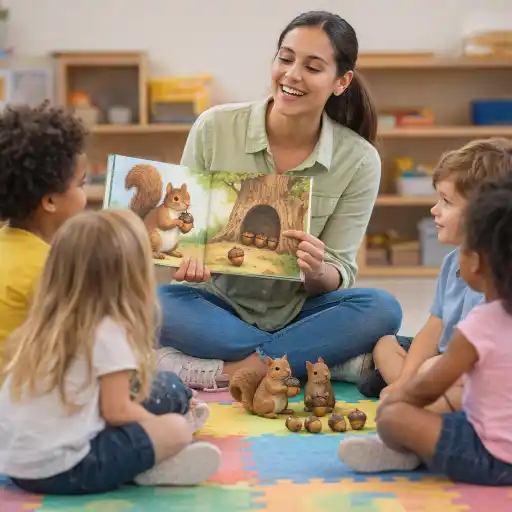
What questions help children reason through taking away?
Thoughtful questions encourage children to attend to the quantities and actions in the story. Ask one question at a time, then wait. Instead of immediately supplying an answer, let children move the counters, count aloud, point, or explain. Prompts such as “How many did Squirrel find at first?” and “What changed when two went to the nest?” help children connect the story’s events to the quantities.
Use consistent language: “start with,” “take away,” “move,” “left,” and “remain.” When children are ready, connect those phrases to a simple equation, explaining each part as you point to the model: “Five acorns, take away two, leaves three.” Keep the symbols secondary to the meaning at first. Children may show understanding by counting the remaining objects, recognizing a small group, or using words such as “three left.”
Support participation through multiple response modes. A child may answer verbally, point to the remaining counters, show fingers, or use a home language. If a child’s count differs from yours, ask, “Can you show me how you counted?” This reveals the child’s approach and keeps the exchange respectful. One-to-one matching—moving one object for each number word—can help children check a count without turning the story into a test.
- “How many acorns were there before Squirrel moved any?”
- “How many went into the nest? How could we check?”
- “How many are left under the tree?”
- “Can you show the story another way?”
How can you adapt the story for different learners?
Children do not all approach subtraction in the same way or at the same pace. Keep the central idea—changing a quantity by taking some away—but adjust the numbers, materials, and support. For a child beginning to count, use three objects, arrange them with space between each one, and move one at a time. A child who is comfortable with the basic story might solve several versions with quantities up to five or choose the number the squirrel carries away.
Offer visual and communication supports when useful: a picture sequence, gestures, dot cards, or a simple two-space mat labeled “tree” and “nest.” Pair spoken number words with objects and give children time to respond. Children ready for an extension can create a problem for a partner, compare two groups, or solve a missing-part story: “There were five acorns. Now three are under the tree. How many went to the nest?”
Observe what the child actually does rather than relying only on a final answer. Does the child count the starting group accurately? Track the objects being moved? Identify how many remain? A brief note can guide the next invitation: “Counted four acorns and moved one; next, offer a five-acorn story and ask the child to explain the remaining amount.” This strengths-based approach builds from demonstrated knowledge and develops a confident #learner.
- Beginning: use two or three objects, clear spacing, and adult modeling.
- Developing: let children move the objects and count what remains independently.
- Ready for more: invite children to invent a story or find a missing amount.
How can you extend the activity without rushing to worksheets?
Repeat the same story structure with fresh details: the squirrel finds four acorns and carries one away; later, it finds five and carries two. Familiarity with the narrative lets children focus on changing quantities, while varied materials keep the experience engaging. Children can act out the story with a puppet, draw the acorns before and after, or build a simple “tree and nest” scene in dramatic play.
After children have explored the action with objects, connect it to drawings and, when appropriate, numerals. A child might draw five circles, cross out two, and count three remaining circles. Then you can show 5 − 2 = 3, explaining how each number corresponds to the story. The progression should be flexible: returning to counters is a useful support, not a step backward.
Use a printable as brief follow-up rather than the whole lesson. The activity pack Buy Now $2.49 includes visual worksheets and hands-on games that can help you vary practice. For professional learning on number sense, early operations, and play-based instruction, Early Mathematics Through Play Buy Now $24.00 and No Such Thing as Boring Math Buy Now $24.00 are additional English-language options. These five courses and resources connect classroom activities with broader math teaching strategies.
- Retell the story with different quantities and familiar classroom objects.
- Invite children to draw the action after manipulating counters.
- Introduce the minus sign only when it helps record an idea children have explored.
What common pitfalls should providers avoid?
It is easy to make an engaging activity feel like a quiz by asking rapid-fire questions or focusing only on correct answers. Slow the pace, give children time to think, and value the strategy they use. If a child guesses, return to the objects and invite them to demonstrate the story. The aim is to make the mathematical relationship visible, not to reward speed.
Another common pitfall is moving to worksheets or equations before children understand what is happening to the group. Start with a tangible action, then use drawings and symbols to represent it. Avoid changing too many variables at once: keep the story structure and materials familiar while adjusting the quantity or challenge. And do not assume that a child who can recite numbers automatically understands how many objects remain; observe the actual count and reasoning.
Finally, make the activity accessible and safe. Choose materials suitable for the children in your group, supervise their use, and provide alternative larger counters or picture cards when needed. Children may participate by speaking, pointing, moving objects, or drawing. The inclusive question is not “Did every child answer in the same way?” but “What evidence shows each child is making sense of the change in quantity?”
- Do not equate fast answers with deeper understanding.
- Do not make worksheets the primary way children experience subtraction.
- Do not insist on one explanation or representation when children can show their thinking in other ways.
Conclusion: How can a squirrel story introduce subtraction?
A squirrel-and-acorn story introduces subtraction by making a change in quantity visible, memorable, and meaningful. Begin with a small group of counters, act out the taking-away action, count what remains, and invite children to explain or show their reasoning. Adapt quantities and supports to children’s current strategies, then connect objects to drawings and symbols gradually.
The central goal is not a completed worksheet or a memorized minus sign; it is helping children understand what happens when some objects leave a group. With a playful story, responsive questions, and careful observation, providers can make early subtraction a welcoming part of classroom life. Keep the acorns ready—children may be eager to create the next problem themselves.
- 45 Hour Child Growth and Development
- Moving About the Classroom: Effective Transitions for Everyday
- 45 Hour Preschool Methods and Materials
- From Tantrums to Triumphs: Equipping Preschoolers with Self-Regulation Skills
- Children at the Wheel: Emergent Curriculum
- 45 Hour Infant and Toddler Methods and Materials
- Setting the Stage: Story Time
- Art from the Heart for Preschoolers: Open Ended Art Projects that Build Self-Esteem
- Texas Director Credential
- From Tantrums to Triumphs: Equipping Preschoolers with Self-Regulation Skills
- CDA Certification en Español: Recursos y Consejos para Educadores Bilingües
- 10 Ejemplos de Cómo la Cultura Influye en el Desarrollo Infantil
- Proporciones de Cuidado Infantil y Tamaños de Grupo por Edad en Maryland (Guía Rápida para Centros y Hogares)
- Proporciones de Cuidado Infantil y Tamaños de Grupo por Edad en Nueva Jersey (Guía Rápida para Centros y Hogares)
- Proporciones de Cuidado Infantil y Tamaños de Grupo por Edad en Virginia (Guía Rápida para Centros y Hogares)
- Cómo Trabajar en el Cuidado Infantil en Carolina del Norte: Requisitos y Pasos
- Cómo Ser Maestra de Preescolar en Virginia
- Celebrando la amistad en el cuidado infantil durante el Día de los Mejores Amigos
- Canciones, juegos y preguntas de círculo para niños
- Cómo simplificar la capacitación para sus empleados de daycare
- Count It, Sort It, Find It! Fall Math Games for Preschoolers
- How Can Short, Focused Practice Build Subtraction Fluency Within 10?
- How Can Concrete Models Help Children Understand Subtraction Before Worksheets?
- How Can Patterned Practice Help Young Children Master Subtraction Facts?
- How Can Simple Movement Breaks Help Restless Preschoolers Reset?
- How Can Leaf Piles Become Preschoolers’ Next Great Story Adventure?
- How Can a Squirrel Story Help Preschoolers Discover Subtraction?
- How Can Five Apples Help Kindergarteners Explore Number Bonds?
- How Can Fall Path Games Help Preschoolers Prepare to Write?
- How Can Cozy Animal Bedtime Play Teach Preschoolers Sequencing in Fall?
