When a four-year-old spots three leaves at a glance, they are doing more than naming a number: they are building number sense. Try the printable Colorful Fall Leaves: Quick-Look Quantity Cards for Ages 4–5 Buy Now $1.49 for a brief, playful classroom invitation, and explore Early Mathematics Through Play Buy Now $24.00 to strengthen your strategies for supporting early math through routines and hands-on learning. In the sections below, you’ll find practical ways to help children notice small quantities while keeping the experience warm, responsive, and free of pressure.
What is subitizing, and why does it matter?
Subitizing is recognizing how many objects are in a small group without counting them one by one. A child who sees three dots on a card and says “three” immediately is using perceptual subitizing. With experience, children may also recognize a larger group by seeing its parts—for instance, noticing two leaves beside another two and understanding that the whole set is four. This is often called conceptual subitizing.
These ways of seeing quantity support number sense: children begin connecting number words to amounts, noticing that a group can be composed of smaller groups, and comparing quantities. Subitizing and counting are related but distinct. A child may recite number words or count objects accurately while still needing practice recognizing a small set at a glance. Both strategies are valuable; the goal is not to replace counting but to build flexible ways of thinking about quantity.
Subitizing is not a speed test or a milestone that every child reaches on the same schedule. How quickly a child responds can depend on the arrangement, familiarity, attention, and comfort with the activity. Researchers and early-math resources distinguish immediate recognition of a small set from grouping parts within a larger quantity; both develop through meaningful, repeated experiences. For preschoolers, the most helpful adult response is curiosity: “What did you notice?”
How can providers use quick-look cards with four- and five-year-olds?
Quick-look cards turn a short visual moment into an invitation to notice, remember, represent, and talk about an amount. The fall-leaf resource offers a seasonal context for exploring small sets with children ages four to five. Start with a card showing a quantity the child can approach comfortably—often one, two, or three—and expand gradually as interest and understanding grow.
Show the card for a few seconds, then cover it. Invite the child to say the amount, show it on their fingers, point to a matching numeral, or build the same set with counters. If the child chooses to count, allow it; counting is a valid strategy and gives you useful information about their thinking. Then ask an open question, such as “What did you see first?” or “How could you make that amount?”
- Keep the first round brief and use only a few cards to avoid visual overload.
- Offer several ways to respond: speaking, pointing, using fingers, or making a matching group.
- Return to the same quantity in a different arrangement so children focus on the amount, not a memorized picture.
- 🍂 Invite children to compare card pictures with real leaves collected outdoors, noticing that the objects may look different while the quantity stays the same.
Use large, safe materials and supervise children closely if counters or natural objects are part of the activity. The aim is a relaxed math conversation, not a performance. The ChildCareEd overview of preschool subitizing also describes quick-look cards and other playful ways to connect visual patterns with quantity.
How can short activities build number sense without becoming drills?
Brief activities work well when children can look closely, handle materials, and revisit an idea in different contexts. A two-minute card game can be enough: show a small group, hide it, invite a response, and give children time to explain or demonstrate what they noticed. Repeat the activity on another day with a new arrangement or material rather than asking children to produce faster answers.
Try adapting familiar routines and play:
- Look, cover, build: Show a leaf card, cover it, and invite a child to make the amount with blocks, counters, or play leaves.
- Show it another way: Arrange four counters in a row, then as two pairs. Ask, “What stayed the same? What changed?”
- Roll and represent: Roll a die and place the matching number of objects on a game board, allowing children to count or recognize its familiar pattern.
- Notice quantities in routines: Comment naturally, “There are two cups here,” or “We need three books for the table.”
As children grow comfortable with small amounts, invite them to notice parts within a set: “I see two leaves here and one there. How many altogether?” Do not rush toward larger numbers. The Young Mathematicians dot-card games illustrate why varied dot arrangements can help children form different mental images of the same quantity. A rich activity allows children to explore, talk, and choose a strategy—not simply repeat a response on cue.
How can educators make the activity inclusive and responsive?
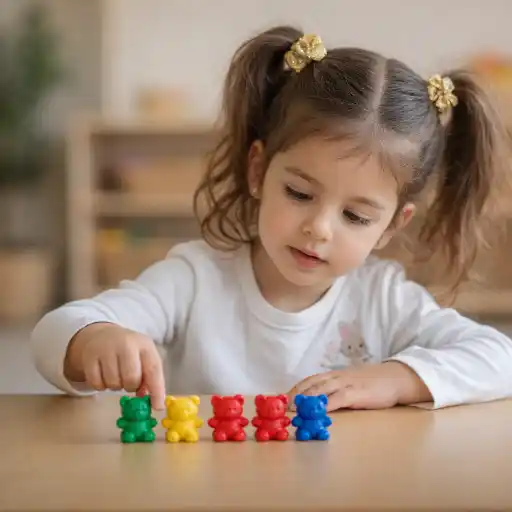
Children show what they know in different ways. A child may answer aloud, point to a choice, match a card, arrange objects, or use fingers. Offer these response options so language demands do not obscure mathematical understanding. For multilingual learners, gestures, visual examples, and familiar number words in a home language can help make the exchange accessible. Give children enough wait time to look and think before repeating or rephrasing a question.
Pay attention to the visual and sensory demands of your materials. Clear spacing may help a child see a set, while a crowded pattern may prompt counting. Reduce the number of choices, simplify the display, or use tactile materials when that better supports participation. Keep natural materials clean and appropriate for the age group, and supervise their use according to program practices.
Use observation to plan the next invitation, not to label a child. A note such as “Recognized three leaves on the card; counted four counters after they were rearranged” gives you concrete evidence. It also suggests a useful next step: revisit four using several arrangements and invite the child to build it. As the Eastern Center for Early Childhood Education resource on mathematics with young children emphasizes, children benefit from materials and experiences that invite them to describe quantity and from adults’ thoughtful math talk.
What common pitfalls should providers avoid?
Even an enjoyable activity can lose its value if it becomes a test. Avoid treating quick responses as the only evidence of understanding. A child who counts each object may be using a sound strategy; a child who answers immediately may recognize a familiar pattern without yet generalizing it to new arrangements. Listening to children’s explanations and noticing what they do with materials gives a fuller picture.
- Making speed the goal: Allow time to think. Focus on noticing, confidence, and reasoning rather than rapid answers.
- Using only one pattern: Show the same amount in different layouts to help children recognize quantity beyond a memorized image.
- Moving to large quantities too soon: Build a comfortable foundation with small sets, then extend as children show readiness.
- Correcting before listening: Ask “How did you figure that out?” first; the strategy can be instructive even if the answer needs support.
- Relying only on worksheets: Pair cards or printables with objects, conversation, games, and everyday routines.
For directors and teaching teams, shared language can make math interactions more consistent: encourage staff to ask open questions, provide wait time, and observe strategies without turning play into a formal assessment. State requirements vary - check your state licensing agency for applicable training or documentation expectations. Continued professional learning can also help providers plan developmentally appropriate math experiences; Math Foundations in Early Childhood  Buy Now $16.00 offers practical approaches for integrating hands-on math into teaching.
Conclusion: How can we help preschoolers recognize small quantities without counting?
Preschoolers build the ability to recognize small quantities through repeated, low-pressure opportunities to look, notice, represent, and talk. Quick-look cards offer a simple starting point: show a small set, cover it, invite children to respond in a way that works for them, and ask what they noticed. Extend the experience with varied arrangements, fingers, dice, counters, real leaves, and familiar classroom routines.
Remember that counting remains a useful strategy, and children’s approaches differ. Observe what each child does, provide time and accessible ways to participate, and use those observations to choose a manageable next step. The central question has a practical answer: foster subitizing by making quantity visible and meaningful through playful interaction. With your encouragement, children can grow into curious and confident #learners who see themselves as capable #mathematicians. Brief #math experiences can strengthen #numberSense, while responsive #teaching keeps every child’s exploration at the center.
Explore relevant professional learning:
- Early Mathematics Through Play Buy Now $24.00 — strategies for meaningful math through play and routines.
- Math Foundations in Early Childhood Buy Now $16.00 — hands-on approaches to early math learning.
- How Preschoolers Develop Buy Now $32.00 — developmental knowledge to inform age-appropriate instruction.
- Preschool Assessments & Observations Buy Now $24.00 — objective observation and responsive planning.
- No Such Thing as Boring Math Buy Now $24.00 — play, exploration, and early mathematical learning.
- 45 Hour Child Growth and Development
- Power of Art: Bldg Self-Esteem & Positive Behavior for ALL Abilities
- CDA Bridge Bundle: Family Child Care without Portfolio Review
- Art from the Heart for Preschoolers: Open Ended Art Projects that Build Self-Esteem
- CDA Bridge Bundle: Infant/Toddler without Portfolio Review
- CDA Bridge Bundle: Preschool without Portfolio Review
- Texas Director Credential
- Celebrando la amistad en el cuidado infantil durante el Día de los Mejores Amigos
- Count It, Sort It, Find It! Fall Math Games for Preschoolers
- Teaching Math to Young Children: Why Counting to 20 Doesn’t Mean They Understand 20
- How Can Preschool Math Become Meaningful, Playful, and Part of Every Day?
- How Can Even vs. Odd Sorting Introduce Early Number Sense?
- How Can You Create Easy Preschool Math Centers with Print, Prep, and Start Learning?
- How Can Child Care Providers Extend Ten-Frame Learning from 11 to 20?
- How Can Child Care Providers Make Counting and Simple Operations Playful?
- How Can Child Care Providers Build One-to-One Correspondence with Small Objects?
- How Can Child Care Providers Integrate Counting into Seasonal Art Activities?
- How Can Providers Build Addition Understanding Before Written Problems?
- How Can Addition Review Feel Purposeful and Engaging for Young Children?
- How Can Sorting Help Kindergarteners Understand Odd and Even Numbers?
- A Child Counts Correctly but Cannot Show the Quantity: What Comes Next?
- A Child Counts Correctly but Cannot Show the Quantity: What Comes Next?
- Following Children's Counting Questions into an Investigation: How Can Educators Turn Curiosity into Meaningful Math?
- How Can Preschoolers Learn to Recognize Small Quantities Without Counting?
- How Can Preschool Providers Observe Early Number Recognition During Math Play?
- How Can Preschoolers Learn More, Fewer, and Equal Without Rushing Into Numbers?
- How Can Preschoolers Recognize Small Quantities Without Counting Every Object?
