Young children build mathematical understanding when they can move, compare, explain, and play—not simply complete isolated worksheets. Pair the classroom-ready Simple Math Fun activity Buy Now $0.49 with Math Foundations in Early Childhood  Buy Now $16.00 to strengthen your practice with hands-on strategies for counting, comparison, and beginning operations while supporting professional learning goals.
Why do playful counting and operations matter?
Counting is more than reciting a sequence. Children develop mathematical meaning when they connect number words to quantities, recognize that the final number tells how many objects are present, compare groups, and reason about what changes when objects are added or removed. These understandings form the foundation for later addition, subtraction, measurement, and problem solving.
Play creates a low-pressure context for this development. A child who counts crackers at snack, distributes blocks fairly, or notices that one tower is taller is already engaging with quantity and relationships. Research on play-based interventions and math games suggests that concrete materials, repeated practice, and adult conversation can support early numerical knowledge and mathematical interest.
For providers, the goal is not to turn every moment into a formal lesson. Instead, notice the mathematics already present and add a brief prompt:
- “How many do we have?”
- “Which group has more? How can we check?”
- “What happens if we add one more?”
- “Can we make the two groups equal?”
This approach supports #numberSense while preserving children’s agency, curiosity, and enjoyment.
Which foundational skills should children practice first?
A thoughtful progression moves from concrete experiences toward drawings, numerals, and simple equations. Children do not all advance at the same pace, so observation should guide the next challenge.
- One-to-one correspondence: touching or moving one object for each number word.
- Cardinality: understanding that the last number counted represents the total.
- Quantity comparison: using more, fewer, same, greater, and less.
- Subitizing: recognizing small quantities without counting every item.
- Composing and decomposing: discovering that a quantity can be made from smaller parts.
- Early operations: acting out joining, separating, sharing, and comparing situations.
The preschool math guidance from ChildCareEd emphasizes that early mathematics includes patterns, measurement, geometry, data, and spatial reasoning—not only number work. This broader view helps directors plan balanced experiences.
For example, a child who counts to ten but loses track of objects may need smaller collections and pointing practice. A child who counts accurately may be ready to compare two groups or solve a “one more” problem. Use the child’s current strategy, rather than age alone, to determine the next step.
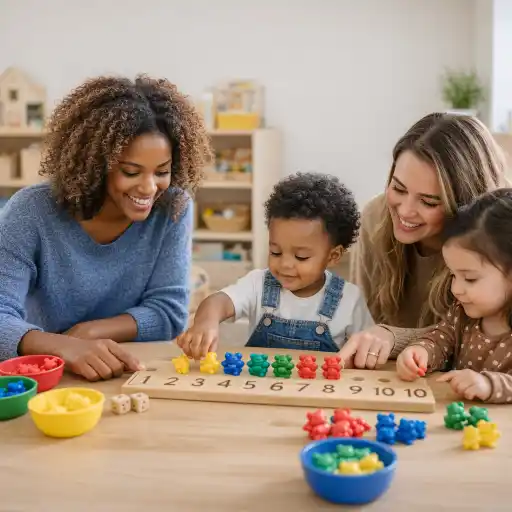
How can providers use the Simple Math Fun activity effectively?
The Simple Math Fun activity Buy Now $0.49 combines three approachable challenges on one print-and-go page: counting objects, comparing groups, and completing a simple addition problem. Its compact format makes it useful for a math center, a short small-group experience, morning work, or an individual follow-up after hands-on play.
Begin with concrete materials before inviting children to record answers. Provide counters, toy animals, blocks, or classroom objects that match the pictures. Model the process aloud: “I will touch each object once as I count.” After children complete a task, ask them to explain how they know rather than focusing only on whether the answer is correct.
- Use quantities from one to three for emerging counters.
- Offer quantities up to five or ten for children who demonstrate reliable correspondence.
- Invite advanced learners to create a second representation with counters, drawings, or an equation.
- Ask children to compare two collections before writing a symbol such as greater than or less than.
- Connect addition to a story: “You had two bears and found one more. How many are there now?”
🎲 A die, counters, and the activity page can become a short partner game: one child rolls, both children build the quantity, and the pair discusses which group is larger. Keep turns collaborative rather than competitive so children attend to strategies and language.
How can counting and operations fit into daily routines?
Routines provide frequent, meaningful practice without requiring extensive preparation. A one-minute exchange repeated across several days may be more useful than a long lesson that children rarely revisit. Directors can encourage staff to use a simple cycle: observe, name the mathematics, ask a question, and record a useful next step.
- Arrival: Count name cards or graph how many children are present.
- Snack: Give each child one cup or cracker, then discuss equal shares and whether more are needed.
- Transitions: Count steps, claps, jumps, or children waiting in line.
- Cleanup: Sort materials and ask children to compare which basket has more objects.
- Block play: Compare towers and discuss taller, shorter, wider, beside, and underneath.
- Outdoor play: Collect, tally, and compare leaves, stones, or other safe natural materials.
Use language that encourages reasoning: “What do you notice?” “How could we find out?” and “Is there another way?” If a child gives an incorrect answer, avoid immediate correction. Invite the child to check by touching each object, rearranging the groups, or using a second representation.
For infants and toddlers, emphasize large safe objects, filling and dumping, matching, and words such as more, empty, big, and small. Never provide loose small parts to children who may mouth objects, and follow program safety policies.
How can teachers differentiate and assess learning through play?
Differentiation means keeping a shared mathematical idea while adjusting the quantity, materials, language, representation, or level of adult support. One child may need two objects and a teacher model; another may be ready to solve a missing-part problem with ten counters.
- Beginning learners: Use quantities of one to three, large manipulatives, gestures, and visual dot cards.
- Developing learners: Increase quantities gradually, use five- or ten-frames, and ask children to state the total.
- Extending learners: Invite children to find multiple ways to make a number, solve “how many more?” problems, or create a story problem.
- Children needing access supports: Offer larger materials, scoops, magnetic pieces, picture cues, and oral response options.
- Dual language learners: Pair gestures, images, numerals, and key vocabulary in English and the child’s home language whenever possible.
Assessment can remain brief and useful. Record specific evidence, such as: “Maya counted six counters, touched each once, and named the total without recounting.” Then identify one next step. Photos of a completed set, tower, or drawing can supplement anecdotal notes.
Common mistakes include relying on worksheets, introducing too many terms at once, treating speed as understanding, and grouping children permanently by ability. Use the Simple Math Fun activity as one representation within a varied experience—not as a replacement for manipulatives, conversation, movement, and observation. State requirements vary - check your state licensing agency when determining documentation or training expectations.
How can directors build a sustainable math-friendly program?
Program-wide consistency helps children encounter the same ideas across classrooms and routines. Directors can select one monthly goal, such as counting with one-to-one correspondence to five, and identify three daily contexts where staff will practice it. A small, accessible math shelf can include counters, blocks, dice, ten-frames, number cards, measuring tools, and reusable activity pages.
Staff reflection does not need to be lengthy. During a 15-minute meeting, invite teachers to share one observation, one successful question, and one adjustment for the coming week. Encourage educators to notice children’s strategies and interests, then adapt activities accordingly.
Families can extend learning through ordinary experiences: count stairs, distribute utensils, sort laundry, compare grocery quantities, or measure ingredients. Send one short suggestion at a time, such as, “Ask your child which plate has more fruit and how they know.” Respect home languages and cultural routines; mathematical thinking can develop through many familiar activities.
For broader professional learning, Early Mathematics Through Play Buy Now $24.00 explores number sense, counting, early operations, patterns, geometry, measurement, and reasoning through play and routines. No Such Thing as Boring Math Buy Now $24.00 offers another option for connecting intentional play with children’s cognitive development. Letter & Number Planning in Child Care Buy Now $24.00 can support providers who want to plan numeracy experiences while considering individual needs.
Conclusion: What makes counting and simple operations playful?
Playful math is concrete, conversational, brief, and responsive. Children learn counting and simple operations when they can touch objects, act out stories, compare groups, explain strategies, and revisit ideas across routines. A printable activity such as Simple Math Fun is most powerful when paired with manipulatives, meaningful questions, and observation.
- Build from one-to-one correspondence and cardinality toward comparison and operations.
- Use snack, transitions, cleanup, blocks, sensory play, and outdoor exploration as mathematical contexts.
- Differentiate by adjusting quantities, materials, language, and representations.
- Assess strategies through short observations rather than relying on worksheets or speed.
- Strengthen staff consistency and invite families into practical, low-preparation math experiences.
The central question is not whether young children can complete a page quickly. It is whether they are developing confidence and flexible ways to think about quantity, relationships, and change. With intentional support, everyday play can become a joyful foundation for lifelong mathematical learning.
- Early Mathematics Through Play
- CDA Bridge Bundle: Family Child Care without Portfolio Review
- The Best Promotion is Play
- Potty Training Made Simple
- No Such Thing as Boring Math
- Connections That Count: Building Relationships in Child Care
- Texas Director Credential
- Letter & Number Planning in Child Care
- Access for All: Inclusion and the ADA
- Enhancing STEM Education for Infants and Toddlers
- Mathematical Skill Development
- Capacitación en Salud y Seguridad Preventiva en Línea para Proveedores de Cuidado Infantil
- Proporciones de Cuidado Infantil y Tamaños de Grupo por Edad en Maryland (Guía Rápida para Centros y Hogares)
- Proporciones de Cuidado Infantil y Tamaños de Grupo por Edad en Nueva Jersey (Guía Rápida para Centros y Hogares)
- Proporciones de Cuidado Infantil y Tamaños de Grupo por Edad en Virginia (Guía Rápida para Centros y Hogares)
- Lista para Guardería en Casa en Texas: Cómo Iniciar una Guardería en el Hogar
- Cómo Trabajar en el Cuidado Infantil en Wisconsin: Requisitos y Pasos
- Canciones, juegos y preguntas de círculo para niños
- Cómo simplificar la capacitación para sus empleados de daycare
- How Can Preschool Math Become Meaningful, Playful, and Part of Every Day?
- How Can Even vs. Odd Sorting Introduce Early Number Sense?
- How Can Early Math Activities Build Young Children’s Mathematical Thinking?
- How Can You Teach Numbers to Ten with Ten-Frames and Visual Models?
- How Can Child Care Providers Extend Ten-Frame Learning from 11 to 20?
- How Can You Make Addition Practice More Engaging Without Losing the Learning Goal?
- How Can Child Care Providers Make Counting and Simple Operations Playful?
- How Can Familiar Objects Make Addition Concrete for Young Children?
- How Can Child Care Providers Build One-to-One Correspondence with Small Objects?
- How Can Providers Build Addition Understanding Before Written Problems?
- How Can Child Care Providers Teach Zero Through Empty Collections?
