Young children do not need to memorize number symbols before they can make sense of quantity. With a handful of fall leaves, educators can help preschoolers see, touch, match, and explain what “more,” “fewer,” and “the same” mean; the Early Mathematics Through Play course Buy Now $24.00 offers broader strategies for weaving early math into routines, exploration, and classroom play. For a ready-to-use activity, explore Colorful Fall Leaves: More, Fewer, or the Same Buy Now $1.49, a printable resource with comparison scenes, vocabulary cards, and a reusable mat.
Why begin with visible groups instead of numerals?
Quantity comparison is a meaningful early math idea in its own right. Children first encounter it through tangible questions: Are there enough leaves for everyone? Which pile has more? Do these two groups match? These everyday comparisons give children a reason to notice quantity before they are expected to connect it to written symbols.
When children can arrange and move objects, they can test their ideas. They might judge one group by sight, then count or pair the leaves to check. That process supports emerging #numberSense, counting, and mathematical reasoning. Head Start’s preschool mathematics framework identifies comparing numbers and understanding relationships between numbers and quantities as important developmental goals, while recognizing that children learn through interactions with materials.
Starting with concrete objects also gives educators a chance to hear children’s thinking. A child who points to the longer-looking row may be using visual appearance; a child who pairs each leaf may be checking one-to-one correspondence. Both responses are useful evidence for planning the next prompt—not a reason to hurry toward a worksheet.
- Make quantity visible before asking children to interpret numerals.
- Use real or pictured leaves to connect seasonal curiosity with purposeful math.
- Value children’s strategies and explanations, not just the final answer.
How can you prepare a leaf-comparison invitation?
Keep the setup simple and clearly organized. Place two small collections of leaves, paper leaf cutouts, or other safe counters on a mat with separate spaces. A reusable comparison mat can help children see each group’s boundaries and move pieces without losing track. Start with a manageable number—perhaps one to three leaves per group—and adjust as children show interest and readiness.
Natural materials invite observation as well as math: children may notice color, shape, texture, or size. Before use, inspect leaves for mold, insects, sharp stems, or other hazards, and follow your program’s sanitation practices. Use larger paper or fabric leaves when natural objects are not suitable, and avoid small loose parts for children who mouth materials. Maintain active supervision. State requirements vary - check your state licensing agency.
Introduce only a few comparison words at a time. Picture cards or gestures can help children connect what they see with the words “more,” “fewer,” and “the same.” The ChildCareEd printable Colorful Fall Leaves activity Buy Now $1.49 includes eight autumn comparison scenes, vocabulary cards, a reusable mat, and educator guidance for children ages three to five.
- Offer two groups with a clear space between them.
- Choose leaves that are similar enough in size that appearance does not distract from quantity.
- 🍂 Invite children to select or sort the leaves before comparing their groups.
How do you model more, fewer, and the same?
Place the two groups in parallel rows, then invite children to compare them. You might begin with a prediction—“Which group do you think has more?”—and then check together. Count each leaf once, moving or touching one object for every number word. Next, pair one leaf from the first row with one from the second. If a leaf is left without a partner, that group has more; the other has fewer. If every leaf has a partner, the groups have the same number.
Matching provides a visual way to compare without relying only on counting. It also helps children notice that two groups may be equal even when objects are arranged differently. An educator can narrate the action: “Each leaf has a partner. These groups have the same number.” The one-to-one approach is consistent with early math guidance emphasizing the relationship between individual objects and number words.
Model precise, natural language without turning the activity into a drill. Try open prompts such as:
- “What do you notice about these groups?”
- “How could we check which one has fewer?”
- “Can you move a leaf so the groups have the same number?”
- “What might happen if we add one more here?”
Accept pointing, gestures, demonstrations, and home-language explanations as meaningful participation. Children may understand a relationship before they can say the vocabulary fluently. Your calm narration helps connect their action with the mathematical idea.
How can you respond to different levels of readiness?
Preschoolers do not all approach comparison in the same way or on the same timeline. One child may be learning to count each leaf once; another may count accurately but need support deciding which total is greater. A third may be ready to make two groups equal by adding or removing an object. Keep the shared activity while changing the quantity, materials, or question.
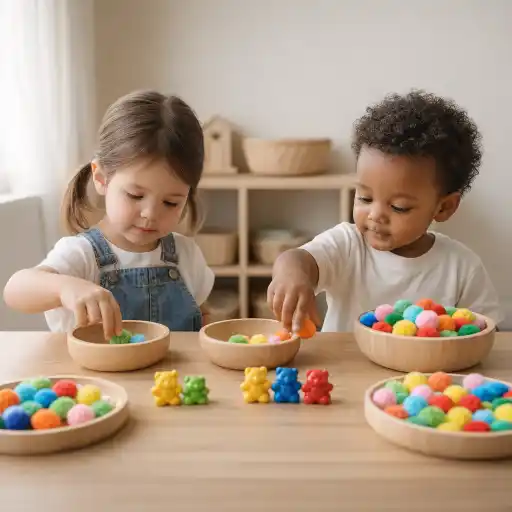
- Beginning comparers: Use one to three large leaves in each group. Model matching and pair words with gestures.
- Developing counters: Gradually increase the number of leaves. Invite children to count each group and then compare.
- Ready for a challenge: Ask children to make a group have one more or one fewer, or to explain how many leaves would make the groups equal.
- Children who benefit from access supports: Use high-contrast images, larger pieces, defined tray spaces, and options to point or answer verbally.
- Dual-language learners: Pair vocabulary with visuals and gestures, welcome home-language reasoning, and model English terms without requiring children to stop using familiar language.
Give feedback that names the strategy: “You matched each leaf to check,” or “You noticed one group needed another leaf.” This affirms persistence and reasoning rather than labeling a child as naturally “good” or “bad” at math. If a child’s estimate differs from the final count, invite the child to show how they decided and explore another way to check.
How can you extend the learning and notice progress?
Once children are comfortable comparing two leaf groups, reuse the same idea in familiar classroom experiences. Sort leaves by color and compare the color groups. Make a simple class graph of collected leaves and discuss which column has more, fewer, or the same number. During cleanup, compare two baskets of blocks; at snack, compare small collections of safe items. Repeating the concept in varied contexts helps children recognize comparison as a useful way of thinking, not just a seasonal game.
Observe what children do while they play. Do they count each object once? Do they match objects across groups? Can they explain or demonstrate which group has more? Do they notice that rearranging leaves does not change how many there are? A brief note can guide your next step: “Jordan counted four leaves in each row and matched them to show the groups were equal; next, offer a group with one extra leaf.”
Avoid making the activity a race, correcting a child before hearing their reasoning, or treating a worksheet as the only evidence of understanding. Keep the interaction playful and responsive. For professional learning beyond this focused activity, the Math Foundations in Early Childhood course  Buy Now $16.00 explores hands-on strategies for integrating math into teaching, while No Such Thing as Boring Math Buy Now $24.00 focuses on intentional play and mathematical learning.
Conclusion: How can fall leaves build a foundation for number concepts?
Preschoolers can learn “more,” “fewer,” and “the same” through visible groups long before formal number symbols are the focus. Offer two manageable collections, model counting and one-to-one matching, and use open questions that invite children to explain what they notice. The leaves make quantity concrete; your language and responsive prompts help children connect that experience to mathematical ideas.
Keep the pace flexible, welcome different ways of communicating, and observe children’s strategies to decide what comes next. A simple leaf activity can support comparison, counting, vocabulary, and confidence without rushing children toward abstraction. In this way, educators answer the central question through practice: begin with what children can see and handle, then build toward more abstract number concepts as understanding grows.
- 45 Hour Child Growth and Development
- Lesson Planning for Preschoolers
- 45 Hour Preschool Methods and Materials
- CDA Bridge Bundle: Preschool
- CDA Bridge Bundle: Family Child Care without Portfolio Review
- CDA Bridge Bundle: Infant/Toddler without Portfolio Review
- CDA Bridge Bundle: Preschool without Portfolio Review
- Texas Director Credential
- CDA Certification en Español: Recursos y Consejos para Educadores Bilingües
- 💛🧩 ¿Cómo puedo hacer que mi enseñanza sea inclusiva para los niños con autismo?
- Proporciones de Cuidado Infantil y Tamaños de Grupo por Edad en Maryland (Guía Rápida para Centros y Hogares)
- Proporciones de Cuidado Infantil y Tamaños de Grupo por Edad en Virginia (Guía Rápida para Centros y Hogares)
- ¿Cuál es la Diferencia Entre la Crianza Respetuosa y la Crianza Permisiva?
- Ejemplos de Crianza Respetuosa vs. Crianza Permisiva
- Celebrando la amistad en el cuidado infantil durante el Día de los Mejores Amigos
- Canciones, juegos y preguntas de círculo para niños
- Mixed-Age Daycare Schedule: How to Plan a Day for Different Age Groups
- How Can Preschool Math Become Meaningful, Playful, and Part of Every Day?
- How Can Child Care Providers Build One-to-One Correspondence with Small Objects?
- How Can You Use a Hundreds Chart Beyond Rote Counting?
- Why Can a Child Compare Two Piles but Struggle with Greater-Than Symbols?
- How Can Preschoolers Build Towers of the Same Height with Different Numbers of Blocks?
- Why Does Measuring Start at Zero, and How Can We Teach Ruler Alignment Through Play?
- How Can You Adapt Greater-Than and Less-Than Activities Without Giving Children the Answer?
- How Can Hands-On Fall Math Teach Children More, Fewer, and Equal?
- How Can Hands-On Fall Math Teach More, Fewer, and Equal?
- How Can Preschoolers Learn More, Fewer, and Equal Without Rushing Into Numbers?
- How Can Fair Sharing Build Early Math Skills Beyond “Take Turns”?
