Children do not need to arrive at kindergarten as fluent calculators, but a solid feel for quantity can make classroom learning more accessible and joyful. Explore the Early Mathematics Through Play Buy Now $24.00 course to build practical strategies for teaching counting, number sense, and early operations through play and everyday routines. The ideas below can help you recognize what matters—and how to nurture it without turning preschool into formal school.
Why do early number concepts matter beyond memorizing a sequence?
Reciting “one, two, three” is a useful beginning, but knowing number words is not the same as understanding quantities. A child may count aloud to ten yet be unsure how many blocks are in a group, or whether two collections contain the same amount. Number understanding develops as children connect spoken number names, objects, quantities, and eventually written numerals.
These connections support later learning because children use number ideas to compare, share, measure, and solve problems. The Head Start preschool mathematics framework identifies counting, recognizing small sets, relating numbers to quantities, comparing numbers, and connecting quantities with numerals as important developmental goals. The kindergarten standards then build on these foundations, extending children’s work with counting, cardinality, operations, and number representation.
Everyday experiences offer a meaningful starting point. Children may want to know if there are enough cups for everyone, which block tower is taller, or how many more pieces are needed. Attending to these questions helps them see mathematics as a way to make sense of their world—not simply a worksheet or a test. A nurturing, playful approach also lets educators build on children’s curiosity and existing knowledge.
Which counting and quantity ideas are useful foundations?
Before kindergarten, many children are developing a cluster of related skills rather than mastering one isolated checklist. The goal is to offer frequent opportunities, notice individual strategies, and support the next reasonable step. Core foundations include:
- Counting sequence: Saying number names in a stable order, with growing flexibility to count forward or backward in familiar situations.
- One-to-one correspondence: Matching one number word to one object, counting each object once and only once.
- Cardinality: Understanding that the final number word names how many objects are in the whole group.
- Small-set recognition: Noticing a very small amount without counting each item, and gradually seeing familiar groupings.
- Quantity comparison: Using ideas such as more, fewer, and the same, sometimes by matching objects or counting to check.
- Number representations: Beginning to connect a quantity with a spoken number and a written numeral, often within small ranges.
These skills develop at different rates and overlap. A child might recognize three dots at a glance but still need help counting a scattered set accurately. Another may count objects correctly yet count again when asked “How many?” Such variation gives educators useful clues about what to model next; it is not a reason to label or rush a child.
How can educators build understanding through play and routines?
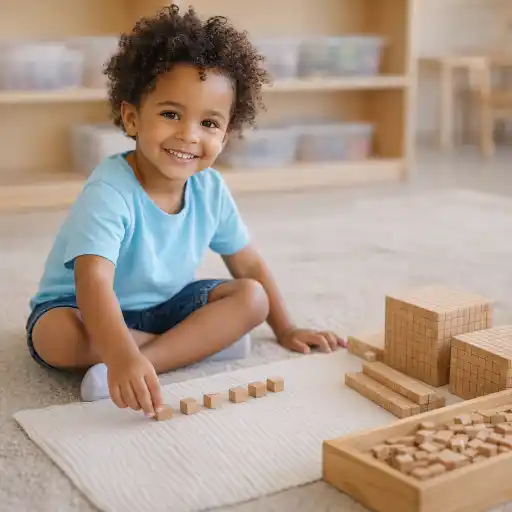
Children learn number ideas by handling materials, hearing useful language, and having a reason to find out “how many.” Keep activities brief and open-ended, and let children touch, move, group, and represent objects. Real materials make abstract number words visible and give teachers a chance to observe children’s strategies.
- At snack, invite a child to give one napkin to each classmate, then check whether everyone has one.
- During block play, compare two towers and ask, “Which has more blocks? How could we find out?”
- Use dice or dot cards to make a matching collection of counters; children can count or recognize familiar patterns.
- While cleaning up, sort toys into groups and compare which group has more or fewer.
- Read number-rich stories or sing counting songs, pausing to let children point, move, or show amounts with fingers.
- 🧺 Invite children to gather a small number of safe objects, arrange them in different ways, and discuss what changed—and what stayed the same.
Use prompts that invite thinking rather than demand a single quick answer: “How did you figure that out?” “What might happen if we add one?” “Can you show that amount another way?” For dual-language learners, visuals, gestures, hands-on materials, and home-language explanations can make the mathematical idea accessible while children continue developing English.
How can you notice progress without turning math into a test?
Observe children during play and routines, then use one focused prompt if it would help clarify their thinking. A brief note about what a child did is usually more useful for planning than a broad judgment such as “good at math.” For example: “Counted five bears, touching each once; when asked how many, counted the set again.” This observation suggests a next opportunity to emphasize that the last number names the whole group.
Look for patterns in what children can do and what still takes effort. Can the child coordinate number words and objects? Do they use the last number to describe the collection? Can they compare two small groups or recognize a familiar arrangement? Research on preschool numeracy assessment highlights skills such as one-to-one counting, cardinality, subitizing, number comparison, numeral identification, and simple story problems as distinct but related areas to observe.
Plan a manageable next step rather than drilling every skill at once. If a child skips objects, reduce the set and model moving each counted item aside. If counting is secure, ask the child to compare groups or make a set with one more. Use familiar materials and revisit the idea over several days. State requirements vary - check your state licensing agency when determining applicable assessment or documentation expectations.
What common pitfalls should providers avoid?
Early math can lose its meaning when the emphasis shifts from reasoning to performance. Avoid expecting every preschooler to recognize the same numerals or count to the same endpoint on a fixed schedule. Developmental frameworks describe broad goals, not a guarantee that every child will demonstrate each skill at a particular age or in the same way.
- Rote counting as the only measure: A memorized sequence does not by itself show that a child can count objects or understand a total. Pair number songs with objects and meaningful questions.
- Moving too quickly to worksheets: Give children time to build and compare real sets before relying heavily on paper-and-pencil tasks.
- Correcting before listening: Ask how the child decided. Their explanation or action can show what they understand and where support is needed.
- Making speed the goal: Allow wait time and accept counting, pointing, gestures, or building as valid ways to respond.
- Using one pace for everyone: Adjust the size of the set, material, or prompt while keeping the shared activity inclusive.
Math readiness is not about pushing children ahead. It is about offering rich, developmentally appropriate experiences, responding to what children show you, and helping them feel capable of exploring number ideas.
Conclusion: What should preschoolers understand about numbers before kindergarten?
Before kindergarten, children benefit from developing meaningful connections among number words, objects, quantities, and written numerals. Useful foundations include counting objects one at a time, beginning to understand that the final count tells how many, recognizing small groups, comparing amounts, and exploring simple ways to join or separate collections. Children will vary in how and when these abilities emerge.
Providers can support this growth through playful, repeated experiences: distribute materials, count during routines, compare block structures, explore dice patterns, and invite children to explain their thinking. Observe specific strategies, then choose a next step that fits each child. The central goal is not perfect performance before school entry; it is helping children approach numbers with curiosity, confidence, and a growing sense of what quantities mean.
For additional practical strategies across number sense, counting, operations, patterns, geometry, and measurement, explore Math Foundations in Early Childhood  Buy Now $16.00. The No Such Thing as Boring Math Buy Now $24.00 course focuses on intentional play and mathematical exploration, while Letter & Number Planning in Child Care Buy Now $24.00 supports developmentally appropriate activity planning. To connect a broader range of preschool math concepts to everyday practice, consider Early Mathematics Through Play Buy Now $24.00.
- 45 Hour Child Growth and Development
- Early Mathematics Through Play
- 45 Hour Preschool Methods and Materials
- What Makes Me Special: An Overview of Autism and ADHD
- CDA Bridge Bundle: Preschool
- CDA Bridge Bundle: Family Child Care without Portfolio Review
- CDA Bridge Bundle: Infant/Toddler without Portfolio Review
- CDA Bridge Bundle: Preschool without Portfolio Review
- Lesson Planning for Preschoolers
- CDA Certification en Español: Recursos y Consejos para Educadores Bilingües
- Ready, Set, Kindergarten!
- 🚨 Reporte Obligatorio en Nevada
- ¿Cómo pueden los equipos de cuidado infantil practicar habilidades rápidas de primeros auxilios en situaciones reales?
- Retraso del Habla en la Guardería: Cómo Pueden Ayudar los Proveedores
- How can we prepare preschoolers for kindergarten success?
- How can I teach colors, shapes & numbers through play in Michigan classrooms?
- Celebrando la amistad en el cuidado infantil durante el Día de los Mejores Amigos
- National Ice Cream Day: Sweet Activities for Preschoolers
- How can North Dakota child care providers build number sense in everyday routines?
- How can we best prepare preschool children for kindergarten?
- Is Your Child Ready for Kindergarten? A Kindergarten Readiness Checklist
- Is My Preschooler Ready for Kindergarten? Milestones Beyond ABCs and 123s
- How Can You Teach Numbers to Ten with Ten-Frames and Visual Models?
- How Can Simple Fall Activities Support Kindergarten Readiness Through Play?
- How Can Family Partnership and Gratitude Support Kindergarten Readiness?
- What Should Preschoolers Understand About Numbers Before Kindergarten?
- Why Is Self-Regulation Becoming One of the Most Important School-Readiness Skills?
- Why Do Young Children Confuse Yesterday, Today, and Tomorrow?
- How Can You Teach Temperature Before Children Understand Weather Numbers?
