When a child confidently recites numbers to 20, it is tempting to assume that number knowledge is firmly in place—but rote counting and understanding quantity are different accomplishments. The Early Mathematics Through Play Buy Now $24.00 course can help providers turn counting routines into meaningful experiences with number sense, comparison, and reasoning while building practical professional knowledge for the classroom.
Why is reciting numbers different from understanding quantity?
Rote counting is the ability to say number words in an accepted sequence. It is useful, but it is only one part of early mathematical development. A child may recite “1, 2, 3…” fluently while still struggling to coordinate each number word with one object or to explain how many objects are in a group.
Understanding quantity requires several interconnected ideas. Children gradually learn stable order, one-to-one correspondence, cardinality, order irrelevance, and abstraction. In practical terms, they must understand that each object receives one counting word, that the words follow a consistent sequence, and that the final number word identifies the total quantity. Young Mathematicians explains counting and cardinality as distinct but related competencies.
This distinction matters because children can appear advanced during songs or transitions yet need substantial support when asked to count a scattered collection, give someone five objects, or determine whether two groups contain the same amount. A #preschooler’s performance may also vary with fatigue, language experience, attention, motor skills, and familiarity with the materials.
Rather than treating an incorrect response as failure, view it as useful information. Ask yourself:
- Does the child touch or move each object once?
- Does the child stop at the target number?
- Can the child state the total without recounting?
- Does the child recognize that rearranging objects does not change the amount?
What mathematical ideas must children coordinate to understand 20?
Understanding 20 is not a single milestone. It develops through repeated experiences that connect language, objects, visual patterns, symbols, and meaningful problems. The child needs a flexible relationship among several representations of quantity.
One-to-one correspondence means assigning exactly one number word to exactly one object. A child counting six bears while touching one bear twice may know the counting sequence but not yet be coordinating action and language accurately.
Cardinality means understanding that the last number said tells “how many altogether.” After a child counts six cubes, ask, “How many cubes are there?” If the child immediately says “six,” cardinality may be emerging. If the child begins again, the child may still be learning that the final word represents the whole set. The Eastern Connecticut State University resource on cardinality offers useful examples of this progression.
Order irrelevance develops when children discover that objects can be counted from different starting points or in different paths and still produce the same total. Abstraction allows children to count unlike items together—such as two blocks, a button, and a shell—because they are being treated as one collection.
Finally, children need to connect quantity to written numerals. The symbol “20” is not meaningful simply because it has been memorized; it must be linked to a collection, number name, and relationships such as one more than 19 or two groups of 10.
How can teachers assess genuine understanding during play?
Assessment does not require a worksheet or a formal test. Brief observations during play often reveal more about children’s mathematical thinking than a repeated request to “count to 20.” Choose tasks that vary the arrangement, purpose, and representation of counting.
Try asking a child to:
- Count a row of objects, then tell how many there are in all.
- Give a puppet exactly seven crackers from a larger group.
- Count a scattered collection of cars, leaves, or buttons.
- Show 8 using fingers, dots, blocks, or two smaller groups.
- Compare two collections and explain which has more, fewer, or the same.
- Match a numeral card to a corresponding quantity.
Observe strategies rather than focusing only on correctness. Does the child organize objects into a line? Move counted objects aside? Use visual groupings? Recount after the objects are rearranged? These behaviors show what support may be helpful next.
A simple documentation note might read: “During snack, Maya counted eight crackers with one-to-one correspondence but recounted when asked how many there were.” The next instructional step could be to model the phrase, “One, two, three, four, five, six, seven, eight—there are eight altogether,” and repeat the experience with different materials.
Use assessment to guide instruction, not to label children. Development varies, and multilingual children may understand a quantity before they can express the number word in English.
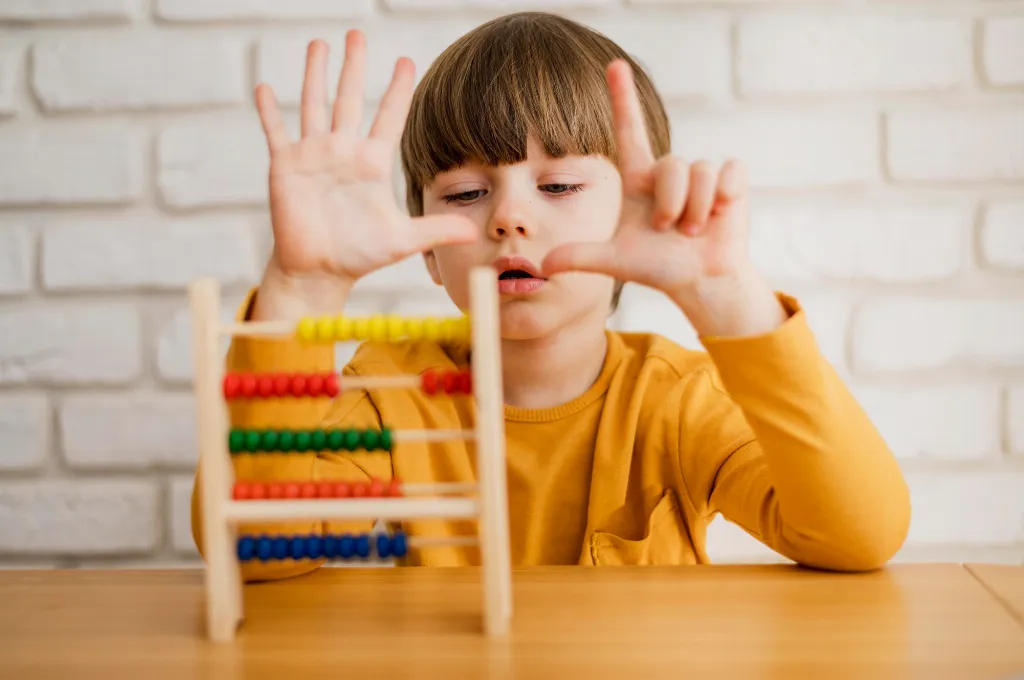 Which classroom experiences build understanding beyond rote counting?
Children need abundant opportunities to count for authentic reasons. Counting becomes more meaningful when it solves a problem, supports a social purpose, or helps children make a prediction. NAEYC’s discussion of meaningful mathematics emphasizes playful exploration, real situations, and open-ended teacher questions.
- 🍎 Snack distribution: Ask children to place one cracker on each plate and determine whether more are needed.
- Block construction: Compare towers, count blocks, and ask how many more are needed to make two towers equal.
- Creature Spots: Roll a die, count out that many paper spots, and ask, “How do you know you have enough?”
- Outdoor collections: Count leaves or stones arranged in lines, clusters, and scattered groups.
- Movement games: Count jumps, claps, or steps, then begin counting from a number other than one.
- Dot cards and fingers: Invite children to recognize small quantities without counting and explain how they saw them.
Subitizing—recognizing a small quantity immediately—helps children notice groups within larger numbers. A child who sees 8 as 5 and 3 is developing a more flexible understanding than a child who can only count eight objects one at a time. Dot cards, dominoes, dice, ten-frames, and finger patterns make these relationships visible.
Keep the mathematics embedded in enjoyable activity. The goal is not to accelerate children through a number list but to help them reason about quantity in varied contexts.
How should providers avoid common counting misconceptions?
Several well-intentioned practices can unintentionally emphasize performance over understanding. The first is treating the ability to count aloud as proof of number mastery. Instead, pair verbal counting with objects, movement, visual representations, and questions about totals.
A second misconception is assuming that children should always count objects in a neat line. Although linear arrangements are accessible, children also need experience with irregular and rearranged collections. NCETM recommends counting objects in varied arrangements and counting out a target number, because these tasks draw attention to quantity rather than memorized procedure.
A third pitfall is correcting too quickly. When a child says there are seven after counting six, pause and ask, “Show me how you know.” The child may reveal whether the difficulty involves number sequence, object tracking, language, or cardinality.
Additional safeguards include:
- Use developmentally appropriate quantities before extending the range.
- Limit new vocabulary and repeat terms such as more, fewer, same, altogether, before, and after.
- Offer larger manipulatives and visual supports for children with motor or sensory needs.
- Use home languages and familiar cultural materials with dual language learners.
- Do not require children to write numerals before they understand the quantities those symbols represent.
For directors, staff reflection can be brief: choose one counting routine, observe teacher prompts, and discuss whether children were asked to explain their reasoning. Professional learning such as Math Foundations in Early Childhood  Buy Now $16.00, No Such Thing as Boring Math Buy Now $24.00, Letter & Number Planning in Child Care Buy Now $24.00, and Enhancing STEM Education for Infants and Toddlers Buy Now $16.00 can support intentional planning across age groups. State requirements vary - check your state licensing agency.
What should families and teachers remember about counting to 20?
Counting to 20 is a valuable accomplishment, but it is a starting point for deeper learning rather than a final measure of mathematical understanding. Children need time to connect number words with objects, totals, comparisons, patterns, and symbols. They also need repeated opportunities to use mathematics in situations that matter to them.
Invite families to count socks while sorting laundry, distribute utensils at meals, compare piles of toys, count steps, or play with dice and dominoes. Encourage adults to ask, “How many altogether?” and “How do you know?” rather than simply prompting children to recite the number sequence.
In the classroom, use a simple cycle:
- Observe what the child does with objects and number words.
- Interpret which counting principle appears secure and which is developing.
- Scaffold with modeling, organization, gestures, and purposeful questions.
- Revisit the idea using different materials and arrangements.
Remember that a child can know the number sequence to 20 and still be developing cardinality, one-to-one correspondence, or flexible number sense. Conversely, a child may demonstrate meaningful quantity understanding before fluent verbal counting emerges. Careful observation helps educators recognize both forms of knowledge and respond respectfully.
Conclusion: What does it really mean to understand 20?
Understanding 20 means more than saying the words in order. It involves coordinating number language with objects, recognizing that the last number identifies the total, counting collections in different arrangements, comparing quantities, composing and decomposing groups, and connecting numerals to meaning.
For child care providers and directors, the practical answer is to replace isolated counting drills with short, purposeful, play-based experiences. Count to solve real problems, ask children to explain their strategies, document one meaningful observation, and use the information to plan the next step. When adults treat children as capable mathematicians and make room for exploration, counting becomes a pathway to #numberSense, reasoning, confidence, and lifelong mathematical learning.
References and further reading
- Teaching Math to Young Children, ChildCareEd.
- Counting and Cardinality, Head Start.
- Counting on Counting, DREME/Stanford University.
- Play Games, Learn Math!, NAEYC.
- Learning to Guide Preschool Children’s Mathematical Understanding, Early Childhood Research & Practice.
- CDA Certification en Español: Recursos y Consejos para Educadores Bilingües
- 🔍 ¿Qué ves cuando observas a un niño aprender?
- Cómo ChildCareEd y Rasmussen University pueden apoyar tus metas educativas
- ¿Cómo puedo usar escenarios de juego de roles de primeros auxilios en mi aula?
- 10 Ejemplos de Cómo la Cultura Influye en el Desarrollo Infantil
- Cómo Solicitar una Licencia de Guardería en Texas
- Reglas de Cuidado Infantil en Dakota del Norte
- Cómo Celebrar el Día Nacional del Kindergarten
- Consejos de Supervisión Activa para Salones de Preescolar y el Juego al Aire Libre
- Cómo Ser Maestra de Preescolar en Texas
- Capacitación Previa al Servicio para Proveedores de Cuidado Infantil en Carolina del Norte
- Diversión fresca de verano: actividades del Día Nacional del Helado para niños
- Canciones, juegos y preguntas de círculo para niños
- Horas de capacitación para daycare en Carolina del Norte: ¿cuántas necesita?
- Teaching Math to Young Children: Why Counting to 20 Doesn’t Mean They Understand 20
- How Can Child Care Providers Extend Ten-Frame Learning from 11 to 20?
- How Can Visual Feedback Support Multiplication Fluency?
- ¿Cómo puede la retroalimentación visual apoyar la fluidez en la multiplicación?
