Before preschoolers can make sense of numerals on a page, they need opportunities to touch, compare, group, and talk about quantities. The Math Foundations in Early Childhood  Buy Now $16.00 course offers hands-on strategies for integrating number ideas through play and routines, helping you strengthen classroom practice and build children’s confidence. For a broader exploration of playful math across the preschool day, consider Early Mathematics Through Play Buy Now $24.00 as a next step.
What does number sense look like before worksheets?
Number sense is not simply the ability to recite “one, two, three” or identify a printed numeral. It includes understanding that number words describe quantities, that quantities can be compared, and that groups can be composed, separated, or represented in different ways. A child who gives one cup to each friend, notices that one block tower is taller, or recognizes three apples without counting every one is developing important mathematical ideas.
These understandings grow through interaction with real objects and meaningful situations. The Head Start preschool mathematics framework includes number names and sequence, recognizing small sets, connecting quantities to numbers, comparing groups, and beginning operations among its preschool goals. Those goals do not require children to begin with pencil-and-paper exercises. They call for carefully sequenced, accessible experiences that let children act on and describe mathematical ideas.
It also helps to remember that number sense develops along different paths. One child may confidently count a long sequence but not yet understand that the last number names the total. Another may see that one plate has more crackers without being able to explain how they know. Both observations can guide your next interaction. The goal is not to hurry children toward a uniform performance, but to make quantities visible, useful, and interesting.
Why build concepts through play first?
Worksheets can show whether a child can mark, trace, or match a symbol, but they may not reveal whether the child understands the amount that symbol represents. When preschoolers manipulate objects, they can test ideas, revise their thinking, and connect words with visible quantities. NAEYC’s Making Math Meaningful for Young Children explains that real tasks—such as finding enough beads or placing one cracker on each plate—make quantities more meaningful than isolated drills.
Play also lets teachers notice strategies in the moment. You can see whether a child touches each object once while counting, pairs objects to compare groups, or relies on the apparent length of a row. These details help you decide whether to model one-to-one correspondence, rearrange a collection, or invite the child to explain a prediction.
- Concrete materials make abstract quantities available to see and handle.
- Conversation connects children’s actions with mathematical vocabulary and reasoning.
- Open-ended play welcomes different strategies and reduces pressure to answer quickly.
- Repeated, brief experiences make math part of the day rather than a separate worksheet period.
Research-informed guidance from the What Works Clearinghouse practice guide on teaching math to young children recommends teaching along developmental progressions, monitoring progress, and integrating mathematics throughout the day. In practice, that means intentional teaching can happen inside play—not instead of it.
How can everyday routines become number experiences?
Routines offer repeated, authentic reasons to think about “how many.” Start with a small goal, such as matching one object to each child or comparing two groups. Use short interactions, then give children time to respond, move materials, and explain. A question should invite thinking rather than feel like a test.
- Snack: Give each child one napkin or fruit piece. Ask, “Does everyone have one? How can we check?”
- Arrival: Count name cards together or compare the number of children present today with yesterday.
- Cleanup: Sort toys into sets and ask which basket has more, fewer, or the same number.
- Transitions: Count steps, claps, or jumps; connect number words to one action at a time.
- Block play: Compare two structures, count blocks, or ask what might happen if one more block is added.
- 🔢 Outdoor discovery: Collect a few leaves or stones, make groups, and compare them; inspect materials for safety and supervise closely.
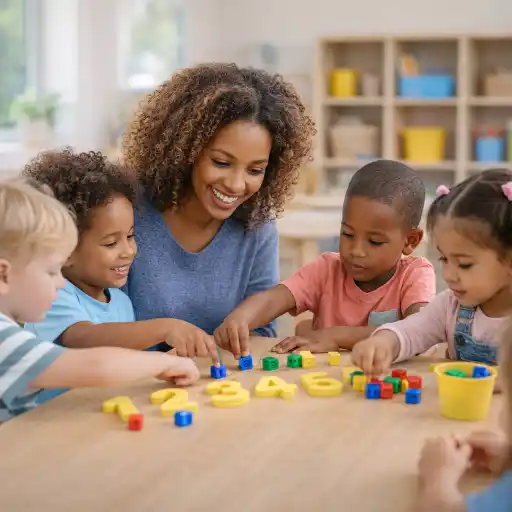
Use simple math language in context: more, fewer, same, one more, altogether, first, and next. DREME’s resource Counting on Counting describes how counting objects involves coordinating one number word with each object and understanding that the final count tells the total. Model that process by pointing or moving each item as you count. If a child loses track, count together without turning the moment into a correction or a race.
Which hands-on activities help children connect quantities?
Choose simple materials that children can rearrange: blocks, large counters, cups, toy animals, picture cards, or classroom objects. Begin with small groups and repeat the same idea in different arrangements. This helps children discover that a quantity stays the same even when the objects move or look different.
- Make a matching set: Show a small group of objects and invite a child to make a group with the same number.
- One-to-one delivery: Give a child a job delivering one block to each toy animal, then check whether every animal received one.
- Compare and pair: Place two groups in rows and match objects across them. Ask what is left over or whether the groups are equal.
- Quick looks: Briefly show a small arrangement of dots or objects, cover it, and invite children to describe or recreate what they noticed. Counting is welcome; speed is not the goal.
- Story problems with props: “Two bears are sitting here. One more joins them. How many bears are there now?” Let children move the bears to find out.
Adapt the challenge rather than expecting every child to respond in the same way. For an emerging counter, offer two or three large objects and model touching each once. For a child who counts reliably, invite comparison or “one more” situations. Children can answer by speaking, pointing, using fingers, or arranging objects. Families’ home languages and familiar everyday materials can also support children’s mathematical reasoning.
Keep activities safe and developmentally appropriate: avoid small loose parts for children who may mouth objects, inspect natural materials, and follow program supervision practices. The NAEYC discussion of nurturing early math play highlights how filling, sorting, stacking, comparing, and math-rich adult language create meaningful opportunities well before formal written work.
How can teachers observe progress without turning play into a test?
Observe first, then use a brief prompt to learn more about a child’s thinking. Rather than recording a broad judgment such as “knows numbers,” note what the child did and said in a specific context. For example: “During snack, Ari gave one cracker to each of four plates, then counted the extras.” That note gives you evidence of matching and suggests a possible next step—comparing the two groups.
A simple cycle can keep planning manageable:
- Notice: Watch children during a routine or play episode.
- Name: Identify the idea involved—counting, comparing, matching, or composing a set.
- Extend: Offer one question or material that supports the next step.
- Record: Save a one-line observation or a photo with the child’s explanation, consistent with program practices.
Look for strategies, not just correct answers. Does the child touch each item once? Do they understand that the final number tells how many? Can they compare groups by pairing objects or counting? The study on the Preschool Numeracy Scales describes early skills such as one-to-one counting, cardinality, subitizing, number comparison, and numeral identification. These are useful lenses for observation, not reasons to rush every child through the same sequence.
Common pitfalls include introducing symbols before children have explored quantities, asking rapid-fire questions, or treating worksheets as the only evidence of learning. Keep symbols available as one representation alongside objects, gestures, drawings, and talk. State requirements vary - check your state licensing agency for applicable documentation or training expectations.
How can you move from concrete play toward worksheets thoughtfully?
Worksheets need not be prohibited; they are simply one representation and are most useful when they follow experiences children understand. A child who has counted and matched real objects may be ready to connect a small set with a picture or numeral. Start with brief, optional tasks that invite meaningful choices, such as drawing the number of blocks used in a structure or matching a numeral card to a set the child made.
Move gradually among representations:
- Objects: Children touch, move, count, group, and compare items.
- Actions and words: Children describe what they did using “one more,” “same,” or “how many altogether?”
- Pictures: Children draw, arrange dots, or match images to their collections.
- Numerals and marks: Children connect a written symbol or mark to a quantity they already recognize.
Offer choice and watch for understanding rather than neatness or speed. If a child can circle the numeral 4 but cannot build a group of four objects, return to concrete play. If the child explains and represents four in several ways, a short paper task may reinforce that connection. NCTM’s position statement on mathematics in early childhood learning emphasizes reasoning, problem solving, inclusive practice, and honoring children’s cultural and linguistic experiences. A responsive progression keeps worksheets in their place: as a possible tool, not the foundation.
For additional professional learning, No Such Thing as Boring Math Buy Now $24.00 focuses on intentionally planned play and mathematical exploration, while Letter & Number Planning in Child Care Buy Now $24.00 addresses planning math and literacy activities with individual needs in mind.
Conclusion: How can preschool teachers build number sense before worksheets?
Preschool teachers build number sense by helping children handle quantities, compare groups, count with purpose, and explain what they notice before asking them to work primarily with written symbols. Make math visible in routines and play, offer safe materials that children can rearrange, and use open questions that welcome different strategies. Observe specific actions and use those observations to choose a next step for each child.
When worksheets are introduced, connect them to experiences children already understand and use them as one tool among many. The essential answer is straightforward: build meaning first through playful, repeated, responsive interactions. Those small moments help children see themselves as capable #learners, grow #confidence, connect #counting to real quantities, explore #playful mathematics, and develop lasting #numberSense.
- 45 Hour Child Growth and Development
- 45 Hour Preschool Methods and Materials
- What Makes Me Special: An Overview of Autism and ADHD
- 45 Hour Infant and Toddler Methods and Materials
- Art from the Heart for Preschoolers: Open Ended Art Projects that Build Self-Esteem
- CDA Bridge Bundle: Preschool without Portfolio Review
- 45 hour Growth and Development Birth-age 12 ONLINE
- 45-Hour Infant and Toddler Curriculum
- 45-Hour Preschool Curriculum
- 👶 ¿Cuáles son las proporciones y grupos requeridos en Dakota del Norte? 🏫
- ¿Cómo empiezo mi certificación CDA en Florida en línea?
- Cómo Celebrar el Día Nacional del Kindergarten
- Celebrando la amistad en el cuidado infantil durante el Día de los Mejores Amigos
- Canciones, juegos y preguntas de círculo para niños
- How can I use simple math activities for preschoolers every day?
- How can preschool classrooms effectively support early math skills?
- How can everyday play build number sense in young children?
- Pumpkin Math Without the Worksheets: Hands-On Pre-K Learning
- How Can Preschool Math Become Meaningful, Playful, and Part of Every Day?
- How Can Child Care Providers Extend Ten-Frame Learning from 11 to 20?
- How Can Child Care Providers Introduce Even and Odd Numbers Through Visual Patterns?
- How Do Dot-to-Dot Activities Support Number Order and Pencil Control?
- How Can Child Care Providers Integrate Counting into Seasonal Art Activities?
- How Can Concrete Models Help Children Understand Subtraction Before Worksheets?
- Why Can a Child Compare Two Piles but Struggle with Greater-Than Symbols?
- How Can Preschool Teachers Build Early Classification Skills Through Everyday Materials?
- How Can a Squirrel Story Help Preschoolers Discover Subtraction?
- How Can Preschool Teachers Build Number Sense Before Introducing Worksheets?
- Why Do Young Children Confuse Yesterday, Today, and Tomorrow?
