A child who recites the numbers and counts objects accurately has built an important foundation—but may still be learning what a number represents. Strengthen your next steps with Math Foundations in Early Childhood  Buy Now $16.00, a course that offers practical, hands-on strategies for supporting number sense through play and daily routines. Keep reading to see how to identify the learning gap and turn counting into meaningful understanding.
What does it mean when a child counts correctly but cannot show how many?
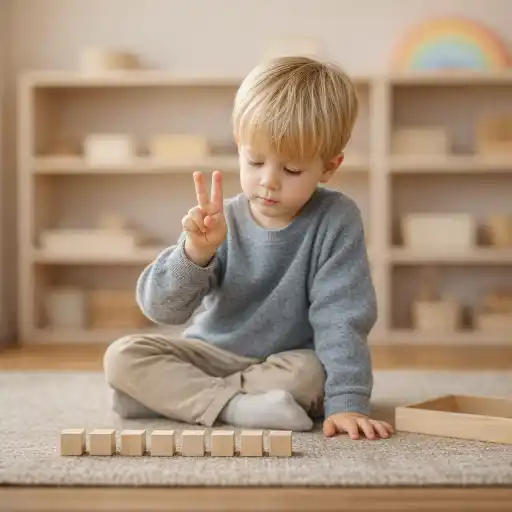
A child may say “one, two, three, four” while touching four objects in sequence, yet hesitate when asked to show four objects, match the group to the numeral 4, or answer “How many altogether?” This does not mean the child’s counting is meaningless or that they are behind. It may mean that several related concepts are developing at different rates.
Rote counting is reciting number names in order. One-to-one correspondence is matching one number word to one object. Cardinality is understanding that the final number word names the total quantity. These skills are connected, but mastering one does not automatically mean a child has mastered all of them. Early mathematics guidance describes children’s work with number words, counted objects, totals, and numerals as related but distinct learning tasks.
Observe what the child can do across several situations: Can they give you three blocks from a larger pile? Can they arrange four counters on a mat? Can they match four dots with four objects? A brief, calm observation helps you identify the specific bridge to build, rather than treating the response as a simple right-or-wrong result.
Why does the distinction between counting and quantity matter?
Understanding quantity supports children’s ability to compare groups, connect numerals with sets, and later reason about adding and taking away. A child who can recite a number sequence may not yet know that “five” represents a group containing five things, or that moving those things around does not change how many there are. This understanding—often called cardinality—is a key part of early number sense.
That distinction is useful for providers because it turns a puzzling moment into information for teaching. If a child counts accurately but cannot show the quantity, you can focus on representing and discussing small amounts instead of asking them to repeat the count sequence more often. Head Start’s preschool mathematics goals include recognizing small sets and understanding relationships between numbers and quantities, alongside knowing number names and the count sequence.
Children develop unevenly, and the response may also vary with attention, experience, language, or the materials used. Offer repeated, low-pressure opportunities and notice growth over time. The goal is not to rush a child toward a worksheet or a particular pace; it is to help number words, objects, and visual models become connected in the child’s thinking.
How can you find the child’s next learning step?
Use a few short prompts during play, one at a time. Keep the quantity small—perhaps one to five objects at first—and observe the child’s strategy. The question “How many?” after counting is especially informative: does the child name the last number again, recount, or seem unsure? Recounting is not automatically a concern; it can be a strategy the child currently relies on.
- “Can you give the bear three blocks?” This checks whether the child can count out a target amount.
- “You counted one, two, three. How many are there altogether?” This draws attention to the final count as the total.
- “Can you show four with counters, fingers, or dots?” This invites representation in different forms.
- “I moved the counters. Did the amount change?” This explores whether quantity stays the same when objects are rearranged.
Record a specific observation rather than a broad label. For example: “Counted five objects with one-to-one correspondence; when asked for the total, counted them again.” That note suggests a useful next step: model naming the total after counting, then repeat with another set and a different arrangement. Research and practice resources emphasize that children need opportunities to count, count out a target set, match numerals and quantities, and see amounts in varied arrangements .
Which activities help a child connect a number to a quantity?
Start with real objects and a clear purpose. Invite the child to count out snack pieces, set out a matching number of toy animals, or give a puppet a requested number of blocks. As the child acts, narrate the connection: “You gave the puppet four blocks. There are four altogether.” Provide time to look, touch, move, and explain rather than turning each activity into a rapid quiz.
A ten-frame can make quantities easier to see because it organizes spaces into two rows of five. Use counters first: say a number, place one counter in each space while counting, then ask the child to describe the amount. Invite the child to build the same quantity using fingers, loose parts, or a drawing. This makes the frame one helpful visual model among several—not a substitute for hands-on exploration.
- 🧩 Build a small set with counters, then draw one dot for each counter.
- Show a numeral card and invite the child to match it with objects or a ten-frame.
- Flash a small group of dots briefly and ask what the child noticed; encourage them to explain how they saw it.
- Rearrange a counted set and ask whether it is still the same amount.
- Compare two small groups: “Which has more, or do they have the same?”
For a ready-to-use practice option, the Ten-Frames: Show the Number (1–10) Practice Worksheet Buy Now $1.49 invites children to draw dots to represent numbers, with an answer key included. Use it after children have explored quantities with physical objects, and invite them to compare the drawing with their model.
How can providers adapt support without making practice feel like a test?
Keep the mathematical idea steady while adjusting the amount, materials, language, and support. A child who is just beginning to connect a number to a group may benefit from two or three large counters and an adult model. Another child may be ready to represent numbers through five, match numerals, or explain how many spaces remain empty in a ten-frame.
- For emerging understanding: Use small sets, large objects, and a consistent routine: touch, say, and move each object once.
- For growing confidence: Ask the child to count out a requested group, state the total, and match it to a numeral or dot arrangement.
- For further challenge: Ask the child to show a quantity another way, add one, take one away, or explain why two arrangements contain the same number.
- For access: Offer larger counters, magnetic pieces, pointing, gestures, drawing, or a response in the child’s home language.
Avoid assuming that all children will show their thinking by speaking or writing. Watch their actions, allow wait time, and use familiar objects when possible. If a child makes an error, try “Show me how you figured it out” before correcting; the child’s approach can reveal whether the next step is tracking objects, understanding the total, or connecting the group with a numeral.
Common pitfalls include moving to ten before a smaller amount feels secure, relying on worksheets alone, emphasizing speed, or expecting identical dot placement. Keep practice playful and responsive. State requirements vary - check your state licensing agency when aligning curriculum, documentation, or professional learning with local expectations.
How can you carry the learning into daily routines?
Children benefit when quantity has a purpose beyond a math activity. During snack, ask a child to place one piece on each plate and check whether the group has enough. At cleanup, count a small set of cars into a labeled container. In block play, invite children to build a tower with four blocks and show the same amount using a different material. These moments make it natural to talk about “how many,” “altogether,” “same,” and “one more.”
Repeat a familiar idea with varied objects and arrangements. A child may understand a quantity when counters are in a row but need more experience when they are scattered or grouped. Offer the same number through blocks, fingers, dots, and classroom materials, then invite the child to explain or demonstrate what stays the same. This helps build flexible number understanding without demanding long lessons or extensive paperwork.
For continued professional learning, explore Math Foundations in Early Childhood Buy Now $16.00 for strategies to integrate hands-on math into teaching. You can also learn about broader play-based approaches in Early Mathematics Through Play Buy Now $24.00, No Such Thing as Boring Math Buy Now $24.00, Letter & Number Planning in Child Care Buy Now $24.00, and Enhancing STEM Education for Infants and Toddlers Buy Now $16.00.
Conclusion: What comes next when a child can count but cannot show the quantity?
When a child counts accurately but cannot show the amount, the next step is to connect the number word to a real group, a visual representation, and—gradually—a numeral. Observe what the child already does, use small sets and hands-on materials, model the final count as the total, and revisit the idea in playful routines. A ten-frame worksheet can support this progression after children have had a chance to build and discuss quantities with objects.
Above all, treat the child’s response as useful evidence of learning in progress. With patient prompts, repeated experiences, and flexible ways to respond, you can help the child move from saying the count to understanding what the number means.
- 45 Hour Child Growth and Development
- 45 Hour Preschool Methods and Materials
- 45 Hour Infant and Toddler Methods and Materials
- CDA Bridge Bundle: Preschool
- 45 Hour School Age Methods and Materials
- CDA Bridge Bundle: Family Child Care
- CDA Bridge Bundle: Infant/Toddler
- Creating Environments that Nurture Growth and Community
- Texas Director Credential
- 🤯 ¿Por qué este niño está teniendo un comportamiento difícil de repente?
- 😫🧸 ¿Qué hacer cuando un bebé no quiere dormir la siesta en el aula?
- 🚨 Reporte Obligatorio en Nevada
- Que es Título 22 en California?
- ¿Cómo solicito la licencia para una guardería en California?
- Regulaciones de Licenciamiento de Cuidado Infantil en California para Centros y Hogares de Cuidado Infantil Familiar
- Proporciones de Cuidado Infantil y Tamaños de Grupo por Edad en Maryland (Guía Rápida para Centros y Hogares)
- Cómo Trabajar en el Cuidado Infantil en California: Requisitos y Pasos
- Capacitación Previa al Servicio para Proveedores de Cuidado Infantil en Dakota del Norte
- Kindergarten Songs for Circle Time: 15 Sing-and-Move Ideas That Sneak in Learning
- How Can Child Care Providers Make Counting and Simple Operations Playful?
- How Can Child Care Providers Build One-to-One Correspondence with Small Objects?
- Why Can a Child Compare Two Piles but Struggle with Greater-Than Symbols?
- A Child Counts Correctly but Cannot Show the Quantity: What Comes Next?
- A Child Counts Correctly but Cannot Show the Quantity: What Comes Next?
- How Can Preschoolers Build Towers of the Same Height with Different Numbers of Blocks?
- What Do Missing-Number Problems Reveal About a Child’s Math Strategy?
- Why Can a Child Skip Count by Twos but Not by Sixes?
- How Can Preschoolers Learn to Recognize Small Quantities Without Counting?
