Seasonal art becomes even more meaningful when children count, compare, and explain their creations while they work. Pairing a festive resource such as 4th of July Count and Color with the Early Mathematics Through Play Buy Now $24.00 course can help providers strengthen counting instruction, plan developmentally appropriate experiences, and build practical math knowledge that transfers across the preschool day.
Why does combining counting and seasonal art matter?
Art invitations naturally attract children’s attention, while counting gives the experience a clear mathematical purpose. A child who colors five stars, adds three stripes, or compares two groups of fireworks is practicing more than rote number words. The child is connecting numerals, quantities, one-to-one correspondence, visual discrimination, fine-motor control, and language.
This integration also respects how young children learn. Early mathematics develops through active exploration, meaningful materials, repetition, and conversation. Research-based guidance emphasizes that children benefit when adults provide opportunities to sort, match, compare, count, and describe quantity, especially during play. Seasonal themes add relevance because children recognize familiar colors, symbols, celebrations, and family experiences.
For directors, the approach is efficient: one activity can support several domains without turning the classroom into a worksheet station. The seasonal learning guidance similarly recommends using seasonal interests to connect math, language, science, sensory exploration, and social-emotional development.
- Counting objects supports one-to-one correspondence and cardinality.
- Coloring and placing materials strengthen fine-motor coordination.
- Seasonal vocabulary encourages conversation and oral-language growth.
- Comparing groups introduces more, fewer, equal, and same.
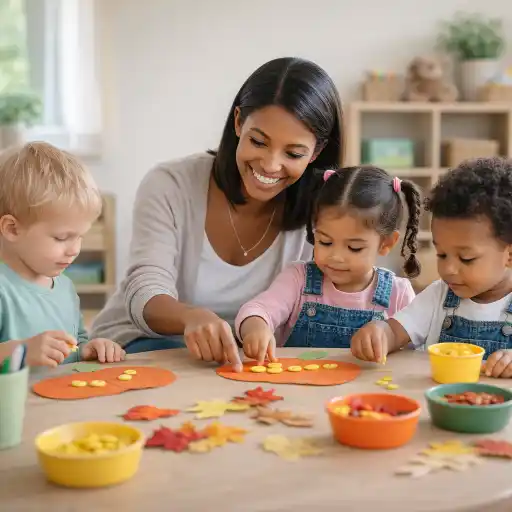
How can 4th of July Count and Color become a purposeful math invitation?
A count-and-color resource works best when educators treat it as a conversation starter rather than a completed product. Before children begin, preview the pictures and identify one or two learning goals. For example, children may count groups from one to ten, match each group to a numeral, or use red, white, and blue to create a repeating pattern.
Model the process slowly. Touch each flag, star, or firework once while counting aloud. Then ask children to tell you how many they counted altogether. This final question matters because it supports cardinality—the understanding that the last number said represents the total quantity.
Offer the resource in a small group so adults can notice strategies and provide individualized support. Children who are beginning counters may work with quantities from one to three. Children who are ready for more challenge can count larger groups, compare two pictures, or create a new design using a specified number of shapes.
- 🖍️ Invite children to color a picture after counting its objects.
- Ask, “How do you know there are six stars?”
- Have children place a numeral card beside each counted group.
- Invite children to draw one more object or remove one object and recount.
Keep the activity playful and flexible. The goal is not identical pages; it is meaningful mathematical thinking supported by art.
Which counting concepts can children explore through seasonal art?
Seasonal art can address a progression of mathematical ideas. Begin with rote counting and one-to-one correspondence, then extend toward comparison, patterning, measurement, and informal operations. A single patriotic image might show four flags, two stars, and three fireworks, giving children multiple ways to analyze quantity.
Use precise but accessible language. Say “You touched each star one time,” “This group has more,” or “Both groups have the same number.” Encourage children to represent their thinking with fingers, counters, dots, drawings, or numerals. Concrete representations help children connect an abstract number to an observable quantity.
Patterns are especially appropriate for seasonal art. Children can arrange red, white, and blue paper squares in an AB or ABC pattern, decorate a flag with alternating colors, or create a fireworks design with repeated shapes. Ask children to predict what comes next and explain the rule.
- Number sense: count, recognize, represent, and compare quantities.
- Geometry: identify circles, stars, rectangles, and triangles in decorations.
- Patterns: repeat colors, shapes, lines, or stickers.
- Measurement: compare ribbon lengths or count how many shapes fit across a page.
- Operations: add or remove objects in simple story problems.
As children work, document the mathematical language they use. A note such as “Maya counted five stars by touching each one and then drew five dots” provides stronger assessment information than a finished page alone.
How can providers differentiate the activity for diverse learners?
Effective differentiation changes the materials, quantity, representation, or adult prompt—not the child’s opportunity to participate. Some children may need larger crayons, adaptive scissors, stickers instead of drawing, or a partner who helps stabilize the paper. Others may communicate their answer by pointing, using gestures, or selecting a numeral card.
For children developing English, pair number words with gestures, visual quantity cards, and home-language support. Invite families to share number words or seasonal traditions so the activity reflects the children in the program rather than presenting one narrow version of a celebration.
Consider several levels of challenge:
- Beginning counters: count and match quantities from one to three using large objects.
- Developing counters: count groups to ten, match numerals, and compare more or fewer.
- Extending learners: create patterns, solve “how many more?” problems, or compose two groups.
- Children needing motor support: use dot markers, stamps, magnetic pieces, or verbal responses.
- Children sensitive to sensory input: offer a quieter table, predictable steps, and non-glitter materials.
Use encouragement that recognizes strategy: “You checked by counting again,” or “You found another way to show four.” This strengthens confidence while keeping the focus on reasoning. The Art from the Heart for Preschoolers Buy Now $35.00 course can further support providers who want to preserve choice, creativity, and self-esteem in art experiences.
How can directors plan, assess, and extend seasonal counting activities?
Directors can help staff move from isolated crafts to intentional curriculum by establishing a simple planning cycle. First, select one observable objective. Next, prepare accessible materials and a small-group prompt. Finally, decide what evidence teachers will collect. A photograph, child quote, or one-sentence anecdotal note is often enough to guide the next experience.
For example, a weekly goal might be: “Children will count up to five seasonal objects using one-to-one correspondence.” Teachers can provide the count-and-color page on Monday, a loose-parts flag activity on Wednesday, and a movement game on Friday. Repeated practice across different contexts helps children generalize the concept.
Extend the learning beyond the art table:
- Count children’s finished stars and graph the totals.
- Sort artwork by the number of objects included.
- Invite families to count flags, windows, steps, or sidewalk shapes at home.
- Use children’s designs as prompts for storytelling and descriptive language.
- Compare the number of red, white, and blue materials used by the group.
Common mistakes include emphasizing neatness over thinking, correcting before children can recheck, and introducing too many goals at once. Choose one or two targets, allow adequate time, and value process over product. For deeper planning support, Lesson Planning for Preschoolers  Buy Now $24.00 offers guidance on developmentally appropriate activity design. State requirements vary - check your state licensing agency when determining whether a course or documentation method meets local expectations.
What should providers remember when integrating counting into seasonal art?
Counting and seasonal art work well together when the mathematical goal remains visible but the experience stays joyful. Begin with familiar images, use concrete objects, model one-to-one counting, and invite children to explain how they know. Then adjust the challenge so each child can participate meaningfully.
The most effective classroom practice is consistent rather than elaborate. A short count-and-color invitation, followed by a brief conversation and observation note, can provide valuable learning evidence. Over time, repeated opportunities with stars, flags, flowers, leaves, snowflakes, or other seasonal materials build durable number sense.
For additional professional learning, explore No Such Thing as Boring Math Buy Now $24.00, which connects intentionally planned play with mathematical exploration. Together, targeted training and practical resources can help staff create art experiences that are creative, inclusive, and mathematically rich.
Conclusion: How can seasonal art make counting more meaningful?
Seasonal art makes counting meaningful by giving children visible, hands-on quantities to explore while they create. When providers pair 4th of July Count and Color with purposeful questions, concrete materials, differentiation, and brief documentation, children practice number sense, comparison, patterning, language, and fine-motor skills in one engaging experience.
The answer is not to make art more academic or to replace play with worksheets. It is to notice the mathematics already present, name it thoughtfully, and extend it through joyful exploration. Choose one learning goal, invite children to count and create, and use their strategies to plan what comes next.
References and related resources
- How can preschool programs intentionally support early math skills every day?
- How Does Counting Shapes Build Early Number Sense Through Play?
- Simple Counting Activity for Preschoolers
- Mathematics with Young Children
- July 4th theme activities and printables
- Preschool Fourth of July Lesson Planning Ideas
- 4th of July Worksheets for Preschool
- Frog Art Activity that Builds Counting Skills
- Hands-On Counting Activities
- The BIG List of Counting Activities
- Play-Based Counting Activities
- Number Activities for Preschoolers and Toddlers
- Preschool Colors Theme
- Outdoor Art Activities
- 4th of July Color By Number
#counting, #math, #art, #preschoolers, and #play become especially powerful when they are woven together with intention.
- 45 Hour Child Growth and Development
- Early Mathematics Through Play
- Many Colors, One Canvas: MD ECE Conference
- Power of Art: Bldg Self-Esteem & Positive Behavior for ALL Abilities
- Art from the Heart for Preschoolers: Open Ended Art Projects that Build Self-Esteem
- Connections That Count: Building Relationships in Child Care
- Texas Director Credential
- Montessori Cultural Activities: Exploring the World Through Play and Learning
- Professional Integrity in Child Care
- Pumpkins, Pinecones, and Leaves: Autumn-themed STEM Projects
- Pumpkin Spice and Sensory Delight: Easy Autumn Sensory Bins for Early Learners
- CDA Certification en Español: Recursos y Consejos para Educadores Bilingües
- Regulaciones de Licenciamiento de Cuidado Infantil en California para Centros y Hogares de Cuidado Infantil Familiar
- Proporciones de Cuidado Infantil y Tamaños de Grupo por Edad en Maryland (Guía Rápida para Centros y Hogares)
- Proporciones de Cuidado Infantil y Tamaños de Grupo por Edad en Nueva Jersey (Guía Rápida para Centros y Hogares)
- Proporciones de Cuidado Infantil y Tamaños de Grupo por Edad en Virginia (Guía Rápida para Centros y Hogares)
- Lista para Guardería en Casa en Texas: Cómo Iniciar una Guardería en el Hogar
- Cómo Trabajar en el Cuidado Infantil en Wisconsin: Requisitos y Pasos
- Capacitación CDA gratuita en Illinois
- How Do Art Activities Support Cognitive Growth in North Dakota Preschoolers?
- Cómo simplificar la capacitación para sus empleados de daycare
- How can seasonal activities (spring, summer, fall, winter) combine fun with clear educational goals?
- How can pumpkin science create meaningful, hands-on fall learning for preschool classrooms?
- How Can Early Childhood Programs Implement Practical Sustainability Practices?
- Can Counting Activities Really Feel Like Play?
- Bring the Pumpkin Patch Inside: Dramatic Play Ideas for Preschool
- Go on a Fall Hunt! Outdoor Learning Challenges for Preschoolers
- How Can Child Care Providers Integrate Counting into Seasonal Art Activities?
