When children count small objects, saying numbers is only part of the work: they must coordinate words, movement, attention, and quantity. A playful activity such as Watermelon Seed Counting gives providers a concrete way to strengthen this foundational skill; for deeper guidance on turning exploration into intentional math learning, explore No Such Thing as Boring Math  Buy Now $24.00, which can help you plan engaging, developmentally appropriate math experiences and earn useful professional training hours.
One-to-one correspondence develops when a child assigns one number word to one object, touches or moves each object once, and understands that the final number names the total. This coordination is more complex than rote counting, yet it grows naturally through repeated, supportive practice. Small objects—when selected and supervised safely—offer an especially flexible context because children can arrange, separate, match, and recount them.
Why does one-to-one correspondence matter in early childhood?
One-to-one correspondence is a foundation for number sense. A child may recite “one, two, three, four” fluently while still skipping an object, counting one item twice, or continuing after the collection has been exhausted. The concept becomes meaningful when the child coordinates each spoken number with a distinct object and then recognizes the final count as the quantity of the set.
This skill supports later comparison, addition, subtraction, measurement, and problem solving. It also strengthens attention, working memory, motor planning, and mathematical language. In a familiar classroom activity, children are not merely practicing numbers; they are learning that quantities can be represented, organized, communicated, and changed.
Research-informed early math guidance consistently emphasizes concrete materials, brief repetition, and responsive adult interaction. The ChildCareEd resource Teaching Math to Young Children similarly highlights counting, cardinality, comparison, and math talk through play.
- Rote counting means reciting number words in sequence.
- One-to-one correspondence means matching one number word to one object.
- Cardinality means understanding that the last number counted tells how many objects are in the set.
- Comparison extends the skill by asking which group has more, fewer, or the same.
Children may need weeks or months of varied opportunities. That is not a lack of ability; it is evidence that counting requires coordinated speech, movement, perception, and reasoning.
How can Watermelon Seed Counting make the skill concrete?
Watermelon Seed Counting creates a motivating seasonal context while keeping the mathematical target clear. Prepare a watermelon-shaped mat or paper plate, numeral cards or dot cards, and large, safe counters representing seeds. Real watermelon seeds should be used only with children who can safely handle them and under close supervision; larger counters, felt pieces, craft pom-poms, or laminated paper seeds are safer alternatives for younger children.
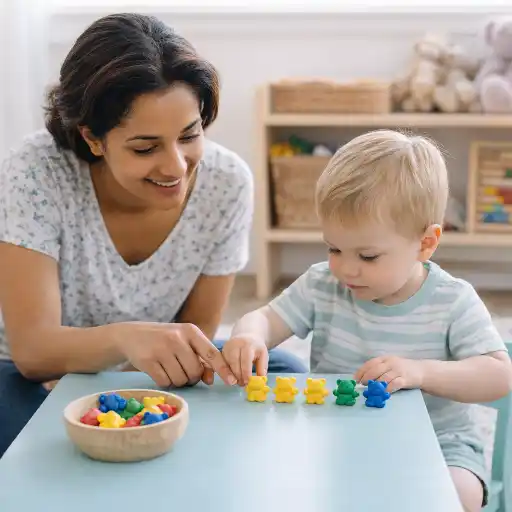
Begin with a small quantity—perhaps one to three objects for emerging counters. Place the objects in a scattered arrangement and invite the child to move each “seed” onto the watermelon while saying one number word per movement. Model slowly: “One seed,” as you move one object; “two seeds,” as you move the next. After the last object, pause and ask, “How many seeds are on the watermelon?”
- Show a small collection and invite the child to look before counting.
- Demonstrate touching or moving each object once.
- Encourage the child to count aloud while transferring the objects.
- Ask for the total after counting, without immediately requiring a recount.
- Rearrange the same objects and ask whether the quantity changed.
The activity becomes richer when children make choices: “Should we put the seeds in rows or a circle?” “Can you make another watermelon with the same number?” The goal is not speed or a perfect product. The goal is accurate coordination and growing confidence.
How should providers scaffold counting for different learners?
Effective scaffolding adjusts the quantity, arrangement, motor demand, language, and level of adult support. Begin where the child is successful, then add one manageable challenge. If a child loses track at five, return to two or three objects and increase repetition. If a child counts accurately to ten, invite comparisons or simple changes such as adding one seed.
- Emerging counters: use one to three large objects, a clear workspace, and hand-over-hand modeling only when appropriate.
- Developing counters: use quantities to five, dot cards, and a consistent “touch, say, move” routine.
- Confident counters: use quantities to ten, numeral cards, ten-frames, and questions about more, fewer, and same.
- Children developing fine-motor control: offer scoops, larger counters, magnetic pieces, stickers, or verbal responses.
- Dual-language learners: pair gestures, photographs, numerals, and number words in English and the child’s home language when possible.
Use inclusive math talk rather than correction-heavy prompts. Try “Show me how you counted,” “Which seed will you move next?” and “How do you know there are six?” These questions reveal strategy and invite reasoning. The course Math Foundations in Early Childhood Buy Now $16.00 offers additional strategies for integrating hands-on math, play, exploration, and problem solving into daily teaching.
Safety remains part of good instruction. Small objects can present choking risks, particularly for children under three or children who mouth materials. Follow program policies, maintain active supervision, and remove loose parts immediately when the activity ends.
How can teachers extend Watermelon Seed Counting beyond basic counting?
Once children can coordinate one-to-one counting with small sets, extend the activity toward cardinality, comparison, composition, and representation. Give two watermelon mats and different quantities of seeds. Ask, “Which watermelon has more?” or “How can we make them the same?” Children can physically add, remove, or redistribute objects before describing what changed.
Try these extensions:
- 🎲 Roll a large foam die and place that many seeds on the mat.
- Match a numeral card to a corresponding collection.
- Make two equal groups and discuss fair sharing.
- Add one seed and ask, “How many now?”
- Remove two seeds and invite children to recount what remains.
- Arrange seeds in rows, circles, or groups of five and compare the layouts.
- Create a simple class graph showing favorite watermelon colors or shapes.
Invite children to represent their thinking with drawings, tally marks, photographs, or invented numerals. Concrete objects should come before symbolic recording for many learners, but representation can gradually connect action to written mathematics.
For a sellable classroom resource, Watermelon Seed Counting can be presented as a reusable center: include differentiated mats, numeral cards, dot cards, simple teacher prompts, and an observation checklist. This makes the resource useful across several weeks rather than a one-time seasonal craft. The related ChildCareEd article Simple Counting Activity for Preschoolers also demonstrates how manipulatives can connect number recognition, cardinality, and fine-motor practice.
How can providers assess progress without turning play into a test?
Assessment should be brief, authentic, and useful for planning. During Watermelon Seed Counting, observe whether the child says numbers in order, touches or moves each object once, stops after the collection is counted, states the total, and compares two groups. Record one specific behavior and one next step rather than a general judgment.
- “Jordan counted four seeds, touching each once, and stated the total independently.”
- “Mina counted six words but moved the same seed twice; next time, provide a transfer tray.”
- “Luis matched five objects to the numeral 5 and explained that both groups had the same amount.”
Change the arrangement to check whether the child understands quantity rather than memorizing a visual pattern. Ask the child to count a scattered group, a row, and a cluster. If the child recounts, that is not automatically a concern; recounting can be a productive strategy. Look for increasing accuracy, independence, and explanation over time.
Common mistakes include using quantities that are too large, rushing children, emphasizing worksheets over objects, and praising speed instead of strategy. Avoid asking several questions at once. Choose one clear prompt, wait patiently, and accept pointing, gestures, home-language responses, or physical demonstrations as valid evidence of thinking.
State requirements vary - check your state licensing agency when aligning documentation, training hours, materials, or assessment practices with local expectations. Directors can support consistency by placing a short observation form beside the math shelf and discussing examples during staff reflection.
How can families reinforce one-to-one correspondence at home?
Families do not need specialized materials. Encourage caregivers to count socks while sorting laundry, place one utensil at each seat, count steps to the door, or distribute crackers one at a time. The most helpful adult behavior is to slow down, touch or move each object, and ask children to explain how they know the total.
Send home one short prompt instead of a packet: “Find five safe objects. Move each one into a bowl while counting. Ask, ‘How many are there altogether?’” Families can use bottle caps, large blocks, toy animals, or pieces of fruit, while avoiding small objects with children who may mouth materials.
Invite families to share counting words from home languages. A child’s ability to count or explain quantity may appear differently across languages and contexts, so family knowledge can help teachers interpret learning more accurately. Celebrating these connections also communicates that mathematics belongs to every child and family.
For providers who want broader support in planning math-rich routines and activities, Early Mathematics Through Play Buy Now $24.00 explores number sense, counting, early operations, patterns, geometry, measurement, and mathematical reasoning through hands-on experiences.
Conclusion: How can small objects build big mathematical ideas?
One-to-one correspondence grows through repeated, meaningful opportunities to coordinate one object with one number word. Watermelon Seed Counting offers a simple, engaging context for children to touch, move, organize, compare, and describe small quantities. Begin with a manageable set, model deliberately, use supportive questions, and increase complexity only when observation shows readiness.
The strongest implementation combines safe materials, differentiated access, playful repetition, math language, and brief documentation. Remember the central question: how can providers build one-to-one correspondence with small objects? By giving children frequent chances to act on quantities, explain their strategies, and experience themselves as capable mathematicians. Explore ChildCareEd’s Letter & Number Planning in Child Care Buy Now $24.00 for additional support connecting intentional math activities to individualized classroom planning.
Frequently asked questions
- Is rote counting the same as one-to-one correspondence? No. Rote counting is reciting number words; one-to-one correspondence requires matching each word to one object.
- What quantity should I introduce first? Start with one to three objects when children are beginning, then increase gradually based on observation.
- Can I use real watermelon seeds? Only when developmentally and programmatically appropriate, with close supervision and attention to choking and sanitation policies. Larger substitute counters are often safer.
- What if a child counts accurately but cannot state the total? Continue practicing cardinality by asking, “How many altogether?” and encouraging the child to identify the final number as the total.
- How often should we practice? Brief, repeated opportunities across centers, routines, and small groups are more useful than occasional lengthy lessons.
- 45 Hour Child Growth and Development
- 45-Hour School Age Curriculum
- 45 Hour Preschool Methods and Materials
- Power of Art: Bldg Self-Esteem & Positive Behavior for ALL Abilities
- Birth to Five CDA Credential with Portfolio Review
- 45 Hour Infant and Toddler Methods and Materials
- 45 Hour School Age Methods and Materials
- Connections That Count: Building Relationships in Child Care
- Texas Director Credential
- 10 Ejemplos de Cómo la Cultura Influye en el Desarrollo Infantil
- Proporciones de Cuidado Infantil y Tamaños de Grupo por Edad en Maryland (Guía Rápida para Centros y Hogares)
- Proporciones de Cuidado Infantil y Tamaños de Grupo por Edad en Virginia (Guía Rápida para Centros y Hogares)
- La mejor manera de hacer seguimiento a la capacitación de su equipo de daycare How to Organize Staff Training for Your Child Care Center Cómo organizar la capacitación del personal para su centro de cuidado infantil
- Cómo simplificar la capacitación para sus empleados de daycare
- How can I teach early math through everyday routines?
- Teaching Math to Young Children: Why Counting to 20 Doesn’t Mean They Understand 20
- How Can Preschool Math Become Meaningful, Playful, and Part of Every Day?
- How Can Even vs. Odd Sorting Introduce Early Number Sense?
- How Can Early Math Activities Build Young Children’s Mathematical Thinking?
- How Can Cleanup Time Become a Lesson in Sorting, Counting, and Teamwork?
- How Can You Teach Numbers to Ten with Ten-Frames and Visual Models?
- How Can Child Care Providers Extend Ten-Frame Learning from 11 to 20?
- How Can Child Care Providers Introduce Even and Odd Numbers Through Visual Patterns?
- How Can Child Care Providers Make Counting and Simple Operations Playful?
- How Can Child Care Providers Build One-to-One Correspondence with Small Objects?
- How Can Child Care Providers Integrate Counting into Seasonal Art Activities?
- How Can Addition Review Feel Purposeful and Engaging for Young Children?
- A Child Counts Correctly but Cannot Show the Quantity: What Comes Next?
- A Child Counts Correctly but Cannot Show the Quantity: What Comes Next?
