What happens when a simple “pair them up” game becomes a child’s first investigation of quantity, fairness, and patterns? Even-and-odd sorting gives providers a concrete way to introduce early #numberSense while children count, compare, communicate, and revise their ideas. For a broader professional learning experience, explore Early Mathematics Through Play Buy Now $24.00, which connects number sense, counting, operations, and mathematical reasoning to practical classroom experiences.
Why does even-and-odd sorting matter for young children?
Even-and-odd sorting is not simply an exercise in memorizing which numerals end in 0, 2, 4, 6, or 8. For young children, the meaningful starting point is quantity: Can a collection be arranged into pairs with nobody left over? When children physically organize objects, they begin to connect counting words, quantities, relationships, and representations.
This matters because #numberSense develops through flexible understanding rather than isolated recall. Research and professional guidance emphasize that children need opportunities to touch, move, compare, and explain mathematical ideas. Sorting creates a particularly accessible entry point because the rule is visible and testable.
- It strengthens one-to-one correspondence as children match objects into pairs.
- It develops cardinality when children recognize that the final count names the whole collection.
- It introduces comparison language such as more, fewer, equal, and leftover.
- It encourages reasoning because children must justify why a set belongs in one category.
- It supports confidence by making abstract ideas concrete and playful.
NAEYC explains that sorting helps children notice how objects are alike and different while building foundational literacy and mathematics skills. The process also prepares children for later work with sharing, multiplication, division, and grouping.
How can providers introduce the concept through pairing?
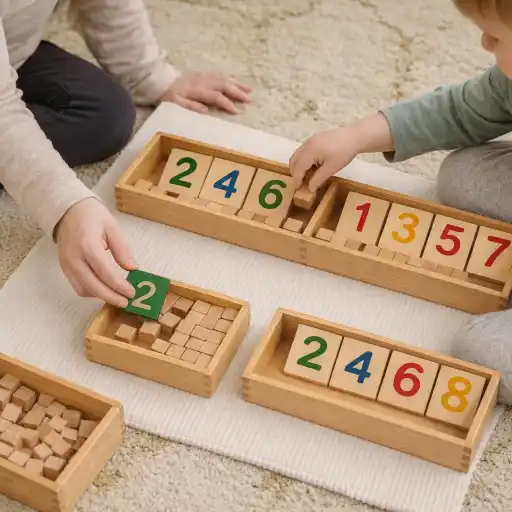
Begin with familiar objects: counters, toy animals, blocks, socks, large buttons, or classroom figures. Avoid starting with a rule that depends only on written numerals. Instead, invite children to create pairs. Place two objects together and say, “These friends have a partner.” Add one object and ask, “Who is waiting for a partner?”
Use collections from two through eight, adjusting the range to children’s experience. After children arrange a set, count the objects together and discuss what happened.
- “How many objects do we have?”
- “Can every object find a partner?”
- “Does anyone have to stand alone?”
- “What could we change to make the set even?”
- “What happens if we add one more?”
When all objects have partners, introduce the word even. When one object remains without a partner, introduce odd. Keep the language connected to the action: “Six is even because it makes three pairs. Seven is odd because one is left over.” This approach honors children’s developing #reasoning and avoids asking them to memorize a pattern before they understand its meaning.
For children who are ready, represent each collection with a numeral card. The numeral becomes a symbol for an experience the child has already tested.
Which activities make even-and-odd sorting engaging?
Short, repeatable games work well in centers, small groups, transitions, and family take-home activities. The Odd or Even Sorting Mat Buy Now $1.49 is one option: children classify numbers from one through eight and place them in the appropriate column. Use the mat after children have had opportunities to pair physical objects so that the worksheet-like representation remains connected to concrete learning.
Try these variations:
- 🎲 Roll, build, and pair: Children roll a die, collect that many counters, arrange pairs, and identify the result.
- Snack sharing: Distribute crackers or fruit pieces and ask whether two children can receive equal shares without leftovers. Follow all allergy and choking-prevention procedures.
- Partner parade: Children form pairs during a movement game. If one child is unpaired, discuss what makes the group odd and how adding a participant would change it.
- Odd-one-out collections: Display several small sets and invite children to identify which cannot be completely paired.
- Number-card sort: Provide cards with quantities shown as dots, pictures, and numerals. Let children sort by parity and explain their strategies.
Re-sort the same materials in different ways. Children may first sort by even and odd, then by color or object type. This reinforces the idea that classification depends on a chosen attribute.
How should the experience be differentiated?
Children will not arrive with identical counting, motor, language, or attention skills. Differentiation means changing the pathway while preserving meaningful participation. Begin with two or three objects for children who are developing one-to-one correspondence. Use large manipulatives, clear visual spaces, and adult modeling.
For children who need language support, pair gestures with concise phrases: “two together,” “one left,” “same groups,” and “no leftover.” Offer home-language labels and invite children to explain their thinking in the language most comfortable to them. Photos, dot cards, and paired objects can make the concept accessible to dual language learners and children with communication differences.
- Beginning: The adult models pairing while the child counts and notices partners.
- Developing: The child pairs collections from two through six and names even or odd with support.
- Extending: The child predicts the result before pairing and checks the prediction.
- Advanced: The child explains why adding or removing one changes parity and explores larger quantities.
Some children may need adaptive tools, nonslip mats, or pre-arranged pairing spaces. Others may benefit from movement or a dramatic-play context. Avoid treating an incorrect classification as failure. Ask, “Show me how you decided,” then invite the child to check by pairing again.
You can use one of our ready-made resources like: Sorting Mat - Odd or Even Buy Now $1.49
How can educators assess learning without turning play into a test?
Observe the strategy, not only the answer. A child may correctly label a numeral by memory without understanding pairing, while another child may reason accurately with objects but not yet know the written word even. Brief observations help providers distinguish these forms of knowledge.
- Does the child touch or move each object once while counting?
- Can the child make pairs without losing track?
- Does the child recognize the leftover object?
- Can the child explain the sorting rule?
- Can the child predict what will happen after adding one?
Record specific notes such as, “Jordan paired eight bears independently and explained that four pairs had no leftovers.” A useful next step might be to offer ten-frame representations or ask Jordan to compare two collections.
Use multiple representations: objects, dot patterns, fingers, movement, drawings, and numeral cards. This supports transfer and prevents children from associating even and odd only with one material. The open educational resource Early Number Concepts and Number Sense emphasizes that thinking about the problem and using manipulatives are more valuable than focusing only on the answer.
What common mistakes should providers avoid?
A frequent mistake is introducing the last-digit rule too early. Although the rule is useful later, it does not explain the concept for a child who has not experienced equal pairing. Begin with concrete quantities, then connect those experiences to numerals and patterns.
Another pitfall is using parity as a speed drill. Fast responses are less important than careful reasoning. Give children time to arrange, recount, and revise. Avoid implying that there is only one acceptable arrangement; two groups can be formed in different spatial layouts while remaining equal.
- Mistake: Starting with worksheets. Better: Pair real objects first, then use print materials as representation.
- Mistake: Correcting without asking for evidence. Better: Say, “How could we check?”
- Mistake: Teaching too many terms at once. Better: Repeat even, odd, pair, partner, and leftover in meaningful contexts.
- Mistake: Treating the activity as purely mathematical. Better: Notice fine-motor control, language, turn-taking, persistence, and collaboration.
Use safe, age-appropriate materials. Small objects may create choking hazards, particularly for children under three. Supervise closely and follow program policies. State requirements vary - check your state licensing agency when documenting learning or determining whether professional development hours apply.
Conclusion: How does even-versus-odd sorting build early number sense?
Even-and-odd sorting introduces early number sense by helping children experience numbers as quantities that can be organized, compared, shared, and represented. Pairing objects makes parity visible: an even collection has partners for everyone, while an odd collection leaves one object without a partner.
The strongest practice is playful and intentional. Start with concrete materials, use precise but accessible math language, invite children to explain their thinking, and gradually connect collections to dot cards and numerals. Observe strategies rather than relying on right-or-wrong responses, then adjust the next experience to each child’s development.
For additional professional learning, consider No Such Thing as Boring Math  Buy Now $24.00, which explores how intentionally planned play can support mathematical learning, or Math Foundations in Early Childhood Buy Now $16.00, which focuses on hands-on, play-based approaches to early math instruction. A third option is Letter & Number Planning in Child Care Buy Now $24.00, which connects developmentally appropriate numeracy and literacy planning.
When children pair socks, share snacks fairly, or explain why one counter is left alone, they are doing more than sorting. They are building a flexible mathematical identity—one curious, concrete discovery at a time.
References
- Early Mathematics Through Play
- CDA Preschool Credential with Portfolio Review
- Building Early Science Foundations
- CDA Family Child Care Credential with Portfolio Review
- 45 Hour Infant and Toddler Methods and Materials
- CDA Bridge Bundle: Preschool
- CDA Infant/Toddler Credential with Portfolio Review
- CDA Bridge Bundle: Family Child Care
- CDA Bridge Bundle: Infant/Toddler
- Texas Director Credential
- CDA Certification en Español: Recursos y Consejos para Educadores Bilingües
- 👶 ¿Cuáles son las proporciones y grupos requeridos en Dakota del Norte? 🏫
- Recursos en Español sobre el Sueño Seguro del Bebé
- Que es Título 22 en California?
- ¿Cómo empiezo mi certificación CDA en Florida en línea?
- 10 Ejemplos de Cómo la Cultura Influye en el Desarrollo Infantil
- ¿Cómo solicito la licencia para una guardería en California?
- Proporciones de Cuidado Infantil y Tamaños de Grupo por Edad en Maryland (Guía Rápida para Centros y Hogares)
- Proporciones de Cuidado Infantil y Tamaños de Grupo por Edad en Virginia (Guía Rápida para Centros y Hogares)
- Cómo Celebrar el Día Nacional del Kindergarten
- Cómo Trabajar en el Cuidado Infantil en Carolina del Norte: Requisitos y Pasos
- Celebrando la amistad en el cuidado infantil durante el Día de los Mejores Amigos
- Canciones, juegos y preguntas de círculo para niños
- Cómo simplificar la capacitación para sus empleados de daycare
- How Can Cut, Sort, and Glue Activities Strengthen Early Learners’ Development?
- Why Is Wild vs. Farm Animal Sorting a Favorite Preschool Activity?
- How Can Even vs. Odd Sorting Introduce Early Number Sense?
- How Can Child Care Providers Introduce Even and Odd Numbers Through Visual Patterns?
- How Can Sorting Help Kindergarteners Understand Odd and Even Numbers?
- Why Does a Child Think Odd Numbers Are Always Smaller—and How Can Providers Help?
