A child who can count aloud may still be unsure where a number belongs when one is missing. Playful sequence games help preschoolers notice number order, reason from what comes before and after, and build confidence beyond memorized counting. Explore the Early Mathematics Through Play course Buy Now $24.00 for practical strategies to make math meaningful throughout the day, and the No Such Thing as Boring Math course  Buy Now $24.00 for ideas that connect play, exploration, and early math concepts.
Why do missing-number games build more than counting skills?
Completing a sequence such as 1, 2, __, 4 asks children to do more than recite a familiar count. They must hold the sequence in mind, notice the gap, and decide which number fits the position. This supports understanding that numbers have a stable order and that each number has relationships to its neighbors.
Those relationships matter well beyond a game. Knowing that 3 comes after 2 and before 4 helps children compare quantities, follow number paths, and later make sense of addition and subtraction. The goal is not to rush children toward formal calculation; it is to help them connect number words, written numerals, and quantities through accessible experiences.
Missing-number activities also create a useful, low-pressure opportunity for educators to observe mathematical thinking. A child may fill a blank by counting from one, recognize the answer immediately, or use objects to check. Each approach offers information about what the child currently understands and which support may help next. As discussed in observing strategies in missing-number problems, the child’s reasoning can be more informative than a correct answer alone.
- Children attend to number order, position, and neighboring numbers.
- Educators can notice the difference between reciting and reasoning.
- Small successes can help children see themselves as capable math learners.
How does a missing number reveal number-order understanding?
When a child completes “2, 3, __, 5,” they use the numbers around the blank as clues. They must recognize that the sequence continues in a predictable order rather than simply repeat a counting chant from the beginning. This is a small but meaningful shift: the child is starting to think about where a number belongs.
Pay attention to how children approach the task. Does a child restart at 1 each time, count on from the number before the blank, or identify the missing value by looking at the whole sequence? Can the child name the number before and after it? These responses reveal the child’s emerging understanding of order and connection.
Use open, encouraging prompts rather than turning the game into a quiz:
- “What do you notice about the numbers around the empty space?”
- “Which number comes before the blank? What comes after?”
- “How could we check your idea with counters?”
For preschoolers, sequences within 1–5 offer an inviting starting point. The Missing Pumpkin Number Sequences 1–5 activity Buy Now $2.00 provides a seasonal way to practice these early relationships. A familiar theme can spark interest, while the educator’s questions keep attention on number order rather than only on the picture.
One wrong answer does not define a child’s ability. Look for patterns over time, and consider attention, comfort with the materials, language, and experience with numerals. The purpose is to notice and support growth—not to label children.
How can providers make the game playful and developmentally appropriate?
Begin with a simple sequence and materials children can touch and move. Write numbers on cards, place them in a row, and cover one card with a paper pumpkin or small cloth. Invite children to choose the missing number, then check the sequence together. Small, concrete steps make it easier to focus on the idea without adding unnecessary demands.
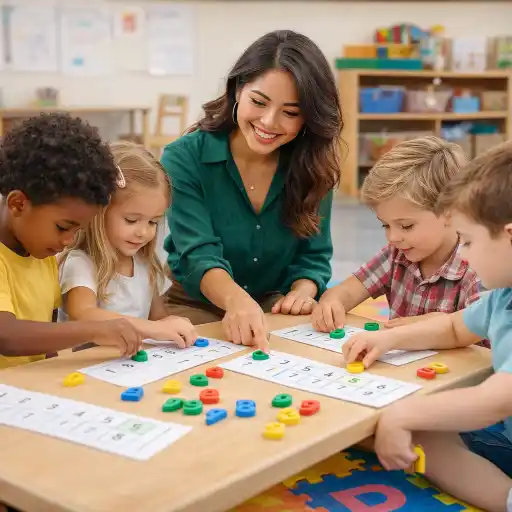
Offer different ways to represent the same task. Say the sequence aloud, arrange numeral cards, build a number path on the floor, or pair each numeral with dots or counters. These variations help children connect spoken number words, written symbols, and quantity. They also give children with different language and motor strengths more ways to participate.
Make the routine brief and flexible. A quick game during a transition or at a math center can be more effective than a long worksheet session. Children can take turns hiding a card, choosing a missing numeral, and explaining their thinking. Keep the materials safe and sized appropriately for the children in your care.
- 🍂 Place numeral cards 1–5 in order, cover one, and invite children to find it.
- Use five large counters or picture cards so children can match numerals with quantities.
- Let children move along a floor number path and pause at the covered space.
- Invite children to create a sequence puzzle for a friend to solve.
A printable can be a helpful starting point, but it need not be the whole experience. Let children manipulate, count, talk, and try again. For another practical perspective on designing these activities, see hands-on ways to use missing-number activities.
How should educators respond to children’s answers and mistakes?
Respond with curiosity. If a child says “5” for “1, 2, __, 4,” pause and ask what they notice about the numbers on either side. Offer a number path or counters if useful, and give the child time to reconsider. The aim is to help them examine the sequence, not to make speed or immediate accuracy the measure of success.
Look at the strategy as well as the result. A child who counts from 1 to find 4 may be developing the sequence but not yet counting on from a given number. A child who says “four” but cannot choose the numeral 4 may understand the verbal sequence while still learning written-symbol recognition. Pair observations with other everyday experiences, such as counting a small collection or matching numeral cards to dots.
Keep brief, descriptive notes that help guide instruction:
- Sequence: Which numbers could the child order or complete?
- Representation: Could they connect a numeral to a group of objects?
- Strategy: Did they count from one, count on, or use visual clues?
- Next step: What material or prompt might support further learning?
Avoid treating one task as a formal diagnosis. Consider whether the child was tired, distracted, unfamiliar with the activity, or working across languages. State requirements vary - check your state licensing agency when determining documentation or assessment expectations. For more background on thoughtful observation, explore DREME’s guided small-group preschool math activities.
How can providers extend learning without adding pressure?
Use what you notice to choose a manageable next step. If a child is still building the sequence, repeat short games with songs, movement, and number cards. If the child can order 1–5 comfortably, try a new arrangement, ask for the number before or after a given numeral, or introduce a slightly larger range when the child is ready. Keep the challenge close enough to current understanding that success remains possible.
Connect the sequence to real quantities. Place three toy apples beside the numeral 3, then ask what happens if one more is added. Children can count the objects, move a numeral card, or explain their thinking in words or gestures. This bridges number order and quantity without requiring formal arithmetic.
Children can also become the puzzle-makers. Let them decide which numeral to hide and invite a peer to solve it. Creating a puzzle gives children a meaningful reason to consider sequence and offers providers a chance to hear their math language. Encourage explanations such as “I know it’s 4 because it comes after 3.”
Professional learning can help providers plan these experiences with intention. Explore the Math Foundations in Early Childhood course Buy Now $16.00 for strategies to integrate hands-on math and the Letter & Number Planning in Child Care course Buy Now $24.00 for developmentally appropriate activity-planning ideas.
- Beginning: Use 1–3, offer the number cards, and model checking the order.
- Developing: Use 1–5 and invite the child to explain how they found the blank.
- Extending: Vary the starting number or ask for the number before and after.
Conclusion: How can missing-number games strengthen early math confidence?
Missing-number games strengthen early math confidence by helping preschoolers notice number order and reason about what belongs in a sequence—not simply repeat a memorized count. The blank gives children a manageable puzzle, while their strategies show educators how they connect numbers, symbols, and quantities.
Start with a familiar range such as 1–5, offer hands-on and visual supports, and keep the experience playful and pressure-free. Ask children how they know, watch for patterns across attempts, and use observations to plan a supportive next step. A small pumpkin sequence can become a meaningful opportunity for children to experience themselves as curious, capable mathematical thinkers.
- 45 Hour Child Growth and Development
- Early Mathematics Through Play
- 45 Hour Preschool Methods and Materials
- 45 Hour Infant and Toddler Methods and Materials
- Pediatric RSV First Aid & CPR/AED
- 45 Hour School Age Methods and Materials
- Texas Director Credential Renewal
- Texas Director Credential
- 45-Hour Infant and Toddler Curriculum
- Actividades de Motricidad Gruesa que Desarrollan el Equilibrio, la Coordinación y la Fuerza
- 10 Ejemplos de Cómo la Cultura Influye en el Desarrollo Infantil
- Cómo Trabajar en el Cuidado Infantil en Carolina del Norte: Requisitos y Pasos
- How can I teach colors, shapes & numbers through play in Michigan classrooms?
- Canciones, juegos y preguntas de círculo para niños
- Cómo simplificar la capacitación para sus empleados de daycare
- How can I use simple math activities for preschoolers every day?
- How can preschool classrooms effectively support early math skills?
- How can everyday play build number sense in young children?
- How can preschool programs intentionally support early math skills every day?
- How Can Preschool Teachers Effectively Support Early Math Skills in the Classroom?
- Count It, Sort It, Find It! Fall Math Games for Preschoolers
- What Are the Best Print-and-Play Activities for Substitute Teachers?
- How Do Dot-to-Dot Activities Support Number Order and Pencil Control?
- How Can Concrete Models Help Children Understand Subtraction Before Worksheets?
- How Can Child Care Providers Help Children Correct Their Own Number-Sequence Mistakes?
- How Can Simple Fall Activities Support Kindergarten Readiness Through Play?
- What Can Preschool Board Games Teach Beyond Taking Turns?
- How Can Preschoolers Build Confidence When They Skip Numbers?
- How Can Missing-Number Games Strengthen Early Math Confidence?
