When a child spots three leaves at a glance—or carefully counts each one—you are seeing useful clues about how number understanding is developing. Use playful, purposeful observation to turn those moments into responsive teaching; ChildCareEd’s Preschool Assessments & Observations  Buy Now $24.00 course can help you strengthen objective observation and assessment practices. For a hands-on math experience to try alongside your notes, explore the Colorful Fall Leaves: Quick-Look Quantity Cards for Ages 4–5 Buy Now $1.49.
Why is observing number recognition during play worthwhile?
Number recognition is more than naming a written numeral. Preschoolers are gradually connecting number words, symbols, and amounts, and they may show that knowledge in different ways. A child might identify a numeral, match it with a group of objects, recognize a small quantity without counting, or count each item to find the total. These are related but distinct skills, so watching children play gives educators richer information than a single right-or-wrong response.
Observation matters because it helps you choose an appropriate next step without turning play into a test. The Institute of Education Sciences’ practice guide recommends teaching number and operations along a developmental progression and using progress monitoring to build on what children know. Research on preschool numeracy assessment likewise identifies multiple skills—including subitizing, numeral identification, one-to-one counting, and matching sets to numerals—as meaningful parts of early math learning.
For busy providers, the goal is not to write an essay every time a child touches a card. A brief, specific note can reveal whether a child recognizes an arrangement, counts objects, uses a visual pattern, or benefits from a prompt. Thoughtful #observation helps you notice strengths as well as possible teaching needs, while playful #math keeps children engaged and confident.
What should educators look and listen for?
Choose one clear focus before the activity. For ages four to five, a useful starting point is whether a child recognizes small quantities—such as one to four—without counting each object, and how the child connects that amount to number words or numerals. The featured fall leaf quantity cards Buy Now $1.49 are designed for brief, autumn-themed practice recognizing quantities one through four. They offer a natural opportunity to notice children’s approaches while they play.
- Does the child name a quantity right away, count each item, or pause and look again?
- Can the child match a card to the same number of counters, leaves, or fingers?
- Does the child recognize the same quantity when the arrangement changes?
- What does the child say or do to show how they know?
- Does the child respond differently when there are more choices, visual distractions, or added language demands?
Include nonverbal communication in your notes. Pointing, grouping objects, holding up fingers, and matching can show understanding even when a child does not answer aloud. This is especially important for multilingual learners and children who communicate in varied ways. Give adequate wait time, and invite an explanation gently: “What did you notice?” or “How did you figure that out?” Avoid assuming that a quiet response means a child does not understand.
Keep the purpose in view: you are gathering information about number understanding, not judging a child’s speed or ability. Children’s skills and strategies vary, and they may show more knowledge with familiar materials or in a calm small group.
How can quick-look cards support meaningful math play?
Quick-look cards make a small quantity visible and give children a chance to notice an amount before counting. The featured printable includes 12 fall-themed cards, reusable cover cards, and educator guidance for children ages four to five. Its focus on quantities one through four can help providers offer a brief, repeatable experience without requiring a long formal lesson.
Set out cards and a small collection of safe, age-appropriate counters or play leaves. Show one card for a few seconds, cover it, then invite the child to say, show, or build the amount they saw. If the child counts, let them count; counting is a valid strategy and useful evidence. You can then ask whether they noticed a pattern or grouped objects in a particular way.
- Begin with a small number of cards and quantities the child can explore comfortably.
- Invite several ways to respond: naming, pointing, showing fingers, or making a matching set.
- Repeat a quantity with a different arrangement so children focus on the amount, not only a memorized picture.
- Offer a peer turn when it supports cooperation, while ensuring each child has a comfortable chance to participate.
- 🍂 Connect the cards with a nature walk or classroom leaf collection; compare the real objects with the pictured quantity.
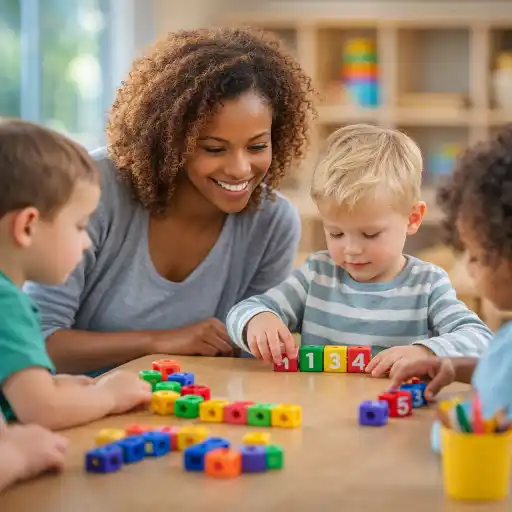
Use open prompts such as “How many leaves did you see?” “What did you notice first?” and “Can you make that amount another way?” These questions encourage mathematical talk without demanding a particular explanation. Keep the play short, warm, and flexible. If the cards become frustrating, reduce the choices, model one example, or return to familiar objects before trying again. Play-based math works best when children have room to explore, and educators remain attentive to children’s ideas.
How can providers document what they notice objectively?
A useful observation separates what happened from what you think it means. Record the date, activity, materials, and specific action or words. For example: “During leaf-card play, Maya looked at a card showing three leaves, said ‘three’ before the cover was placed, then matched it with three counters.” This captures evidence. “Maya is excellent at math” is an interpretation and does not tell another educator what the child actually did.
A simple note-taking routine can keep documentation manageable:
- Before: Select one focus, such as recognizing quantities one to four or matching an amount to a numeral.
- During: Watch and record concise facts, including the child’s exact words or actions when useful.
- After: Note the context and one possible next invitation based on the evidence.
- Over time: Revisit the skill with different materials or arrangements and compare observations rather than drawing conclusions from one moment.
Notice strategy as well as accuracy. A child who counts each of four leaves may be showing reliable one-to-one correspondence, even if the child does not recognize four at a glance. Another child may identify four in a familiar arrangement but count when the leaves are spread out. Both observations help you plan. The article on observing with purpose in early childhood assessment offers further guidance on objective notes and using observations to inform next steps.
Protect children’s privacy and follow your program’s documentation procedures. If you use photographs or digital records, confirm that your program’s consent and confidentiality practices are followed. State requirements vary - check your state licensing agency for applicable documentation and training expectations.
How can observations guide responsive teaching and family communication?
Use what you observe to make one small adjustment, not to label a child. If a child readily recognizes one, two, and three but counts four objects individually, offer repeated opportunities with four in varied patterns. If a child counts accurately but does not yet connect the amount to a written numeral, pair a numeral card with a matching set and name the connection naturally. The What Works Clearinghouse guidance emphasizes building instruction on children’s current knowledge and integrating math throughout the day.
Keep math experiences varied and accessible. Use fingers, blocks, snack items, dice, picture cards, and naturally occurring collections. Children can respond by speaking, pointing, matching, or building. For multilingual learners, support understanding with familiar objects, gestures, visual examples, and home-language number words when possible. The aim is a meaningful connection between amount and representation, not uniform performance in one format.
Share observations with families in strengths-based, concrete language. Rather than saying “She is behind in numbers,” try: “Today she recognized three leaves right away and counted each of four leaves to check. We’ll keep exploring four in different arrangements.” Invite families to share the number games and everyday experiences their child enjoys. If a pattern raises questions over time, follow your program’s assessment and family partnership procedures and use more than one source of information before considering next steps.
Providers who want to deepen these practices can explore ChildCareEd’s Early Mathematics Through Play Buy Now $24.00 course for approaches to number sense and hands-on math, or Math Foundations in Early Childhood Buy Now $16.00 for ways to integrate math into teaching. For assessment-focused learning, Tracking Progress, Shaping Futures: Observation & Assessment Skills Buy Now $55.00 addresses objective documentation and using assessment information to guide instruction. Check course details and local requirements before enrolling.
Conclusion: What is the best way to observe early number recognition?
Observe early number recognition by watching what children do with small quantities during relaxed, purposeful math play. Notice whether they recognize an amount, count each item, connect quantities to numerals, or use gestures and visual patterns to show their thinking. Record specific evidence rather than conclusions, revisit the skill with varied materials, and use what you learn to plan an inviting next step.
Quick-look cards can be one useful tool among many. The fall leaf resource gives children ages four to five a playful way to explore quantities one through four, while everyday materials and routines help extend that learning. Keep the experience low-pressure, inclusive, and responsive: children’s different strategies are valuable information, and your careful attention helps turn small math moments into meaningful teaching.
- Preschool Arithmetic Activity
- ❄️ ¿Qué actividades al aire libre funcionan bien para los niños de Illinois en cada estación? 🌷🍂
- ¿Cómo empiezo mi certificación CDA en Florida en línea?
- 10 Ejemplos de Cómo la Cultura Influye en el Desarrollo Infantil
- Proporciones de Cuidado Infantil y Tamaños de Grupo por Edad en Virginia (Guía Rápida para Centros y Hogares)
- Consejos de Supervisión Activa para Salones de Preescolar y el Juego al Aire Libre
- Cómo Ser Maestra de Preescolar en Illinois
- Celebrando la amistad en el cuidado infantil durante el Día de los Mejores Amigos
- Canciones, juegos y preguntas de círculo para niños
- How Can I Use Fun Math Activities for Preschoolers Every Day?
- How can I use simple math activities for preschoolers every day?
- How can everyday play build number sense in young children?
- Kindergarten Songs for Circle Time: 15 Sing-and-Move Ideas That Sneak in Learning
- How Can Preschool Math Become Meaningful, Playful, and Part of Every Day?
- How Can Early Math Activities Build Young Children’s Mathematical Thinking?
- How Can Connect-the-Dots Activities Reinforce Number Sequence and Motor Planning?
- How Can Independent Practice Connect Numerals and Number Words?
- Why Can a Child Match a Shape but Struggle to Rebuild It with Pieces?
- How Can Toddler Classroom Jobs Build Early Math Beyond Counting?
- How Can Preschool Providers Observe Early Number Recognition During Math Play?
