When children can touch, pair, and sort objects, odd and even numbers become more than labels on a worksheet—they become ideas they can test. Use the No Such Thing as Boring Math course  Buy Now $24.00 to build practical strategies for play-based math, exploration, and developmentally informed teaching; its broader learning can help you turn everyday classroom materials into meaningful math experiences. Read on for a simple progression that makes sorting purposeful, inclusive, and engaging.
Why is sorting a meaningful way to introduce odd and even?
Sorting invites kindergarteners to investigate a number rather than memorize a rule. When children make pairs from a group of objects, the distinction becomes visible: an even quantity can be paired completely, while an odd quantity leaves one object without a partner. This concrete action gives meaning to words such as pair, equal, and leftover.
The experience also supports broader early #numberSense. Children coordinate one number word with each object, compare quantities, and explain how they decided where a set belongs. Sorting naturally creates opportunities to count, notice patterns, communicate, and revise an idea. As the ChildCareEd discussion of even-versus-odd sorting and early number sense explains, these experiences connect counting and classification to reasoning.
Keep the initial goal modest: children should explore whether a collection can be arranged in complete pairs. Kindergarteners do not need to master a formal divisibility definition to benefit from this investigation. A calm, playful approach helps children see math as something they can explore—not a speed test with one acceptable strategy.
- Pairing supports one-to-one counting and careful attention to each object.
- Sorting lets children compare sets and describe what they notice.
- Explaining a choice builds mathematical language and confidence.
How can educators introduce the idea through hands-on pairing?
Start with familiar, easy-to-handle materials such as large blocks, toy animals, socks, or classroom counters. Show a small collection—perhaps four objects—and model placing two together at a time. Say, “Everyone found a partner; there is no one left over.” Then try five objects and invite children to notice the unpaired item.
Use quantities children can count reliably, beginning with two through six and expanding when they are ready. Ask questions that focus attention on the process:
- “How many objects are in this group?”
- “Can every object find a partner?”
- “Is anyone waiting without a partner?”
- “What might happen if we add one more?”
Allow children to arrange pairs in different ways. A row, circle, or two small groups can all show the same quantity; the layout may change, but the number of objects does not.
How can the Sorting Mat - Odd or Even extend learning?
The Sorting Mat - Odd or Even Buy Now $1.49 gives children a visual place to classify numbers from one through eight. Its two-column format can help make the sorting rule clear, and the activity includes placing numbers in the appropriate category. It works best as a follow-up to pairing real objects, so children can connect the mat’s symbols to an experience they understand.
Try this sequence in a small group or math center:
- Offer a number card and a matching set of objects.
- Invite the child to count and arrange the objects in pairs.
- Ask the child to identify whether anyone is left without a partner.
- Have the child place or record the number in the matching column.
- Ask for a brief explanation: “How do you know?”
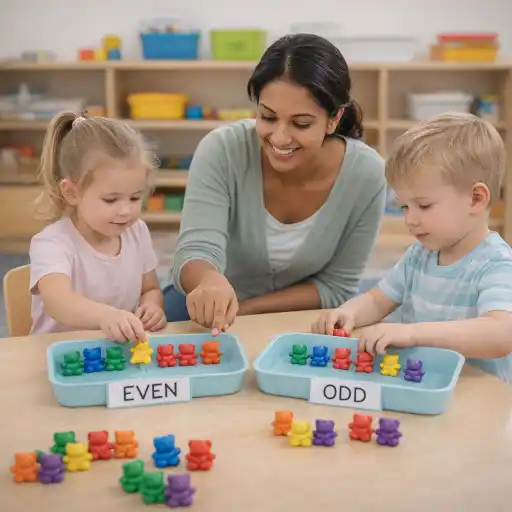
For variety, use the mat with dot cards or pictures as well as numerals. A child might sort a group of six dots, then find the numeral 6. This helps children connect representations instead of assuming that odd-and-even sorting only applies to one kind of card.
- 🎲 Roll, count, pair, and then sort the resulting quantity.
- Invite children to predict whether adding one object will change the category.
- Use a partner explanation: one child pairs the objects while another describes the evidence.
For a broader professional learning experience, Early Mathematics Through Play Buy Now $24.00 explores number sense and hands-on mathematical experiences across the classroom day.
How can teachers adapt the activity for different learners?
Children may differ in counting fluency, fine-motor control, language, attention, and familiarity with numerals. Differentiation means adjusting the materials and support while keeping the central idea—complete pairs or one leftover—within reach. Begin with just two or three objects when counting is still developing; offer larger pieces, clear work spaces, and adult modeling as needed.
- Beginning: The adult models pairs while the child counts, points, or notices partners.
- Developing: The child pairs small sets and names odd or even with prompts.
- Ready for a challenge: The child predicts before pairing, checks the result, or explains what changes when one object is added.
Language access matters too. Pair gestures with short phrases—“two together,” “one left,” and “no leftover”—and welcome explanations in a child’s home language. Children can show understanding by pointing, moving objects, drawing, speaking, or working with a peer. A child who can identify the lone object may understand the central relationship even before using the words “odd” and “even” independently.
Notice and respond to each child’s strategy rather than treating different pacing as a problem. If a child loses track, reduce the quantity or place objects in a structured layout. If the child pairs confidently, offer another representation or ask for a prediction.
How can providers observe understanding and avoid common pitfalls?
Watch what children do, not only whether the final category is correct. A child might recall a label without understanding pairs; another might reason accurately with objects but not yet recognize the numeral. Brief, specific observations help you choose a useful next experience.
- Does the child count each object once?
- Can the child make pairs and notice an unpaired object?
- Can the child explain or demonstrate the sorting rule?
- Can the child predict what might happen after adding or removing one object?
For example, note: “Sam paired six bears and said there were three pairs with no one left out.” A next step could be to show the same quantity with dot cards or ask Sam to test seven. Treat mistakes as invitations to investigate: “Let’s check by making partners,” rather than simply supplying the answer.
Common pitfalls include teaching the last-digit shortcut before children understand pairing, emphasizing speed, and relying on a worksheet as the first experience. Introduce numerals and digit patterns gradually, after children have handled quantities. Use age-appropriate materials and supervise closely; small parts can pose choking risks. State requirements vary - check your state licensing agency when documenting learning or determining whether professional development hours apply.
Conclusion: What helps kindergarteners understand odd and even through sorting?
Kindergarteners build an initial understanding of odd and even when they count objects, make pairs, and notice whether one remains without a partner. Sorting mats can extend this concrete exploration by connecting quantities to numerals and categories, but they are most useful when paired with conversation, manipulatives, and time to reason.
Start with small, familiar collections; model pairing; invite children to explain their choices; and adapt the experience to each child’s needs. Observe strategies rather than focusing only on correct answers, then offer a next step that builds on what each child can already do. With thoughtful play, a simple sorting activity can nurture number sense, confidence, and curiosity about math.
- CDA Home Visitor Subject Area 3 Part 3 Birth to 5
- CDA Home Visitor Subject Area 2 Part 3 Birth to 5
- Engaging Families During a Pandemic
- 45-Hour Infant and Toddler Curriculum
- No Such Thing as Boring Math
- Texas Director Credential
- Classroom Tools for Emergent Literacy
- Letter & Number Planning in Child Care
- Classroom Tools for Emergent Literacy
- CDA Certification en Español: Recursos y Consejos para Educadores Bilingües
- 💛🧩 ¿Cómo puedo hacer que mi enseñanza sea inclusiva para los niños con autismo?
- 👶 ¿Cuáles son las proporciones y grupos requeridos en Dakota del Norte? 🏫
- Recursos en Español sobre el Sueño Seguro del Bebé
- ¿Cómo empiezo mi certificación CDA en Florida en línea?
- 10 Ejemplos de Cómo la Cultura Influye en el Desarrollo Infantil
- Cómo Crear Tu Portafolio CDA Paso a Paso
- Proporciones de Cuidado Infantil y Tamaños de Grupo por Edad en Maryland (Guía Rápida para Centros y Hogares)
- Proporciones de Cuidado Infantil y Tamaños de Grupo por Edad en Nueva Jersey (Guía Rápida para Centros y Hogares)
- Proporciones de Cuidado Infantil y Tamaños de Grupo por Edad en Virginia (Guía Rápida para Centros y Hogares)
- Cómo Celebrar el Día Nacional del Kindergarten
- Lista para Guardería en Casa en Texas: Cómo Iniciar una Guardería en el Hogar
- Cómo Trabajar en el Cuidado Infantil en Carolina del Norte: Requisitos y Pasos
- Celebrando la amistad en el cuidado infantil durante el Día de los Mejores Amigos
- Canciones, juegos y preguntas de círculo para niños
- Cómo simplificar la capacitación para sus empleados de daycare
- How Can Even vs. Odd Sorting Introduce Early Number Sense?
- How Can Child Care Providers Introduce Even and Odd Numbers Through Visual Patterns?
- How Can Sorting Help Kindergarteners Understand Odd and Even Numbers?
- Why Does a Child Think Odd Numbers Are Always Smaller—and How Can Providers Help?
