A child’s “How many?” can become the beginning of a rich investigation—not just a quick answer. With thoughtful observation, playful materials, and open-ended prompts, educators can extend children’s questions into counting, comparison, and discovery; ChildCareEd’s Emergent Learning & Development  Buy Now $24.00 course offers a helpful foundation for connecting children’s interests with developmentally appropriate learning goals for ages 3–5. Explore the course as a next step toward strengthening your classroom practice, then use the ideas below to follow a number question wherever children’s thinking takes it.
Why can a counting question become the start of an investigation?
When a child asks how many shells, blocks, or ocean animals there are, they are doing more than requesting a number. The question may reveal an emerging idea about quantity, fairness, order, or how groups relate. If educators pause to listen and notice what prompted the question, they can plan an experience that builds on children’s existing ideas instead of interrupting play with an unrelated exercise.
Early mathematics develops through meaningful experiences: children notice quantities, count objects, compare sets, and use mathematical language in everyday activity. Counting becomes more than reciting a sequence when children coordinate one number word with one object and understand that the final number names the total. Questions such as “Which group has more?” or “How could we check?” encourage children to explain and test their thinking.
Following a question also supports agency. The educator brings knowledge of learning progressions and materials; children bring curiosity, theories, and lived experience. Together, they can turn a small moment into a shared inquiry. This is one practical way to connect emergent learning with intentional teaching while keeping play meaningful.
How can educators notice and clarify the mathematical idea?
Begin with careful observation. Note what children say, point to, count, compare, or repeat. A question like “Are there more fish or crabs?” might come from an I Spy scene, a book, or children’s pretend play. Rather than rushing to count for them, ask what they are wondering and invite them to show how they would find out.
Use prompts that make children’s reasoning visible without steering them toward one fixed answer:
- “What are you noticing?”
- “How could we find out how many there are?”
- “What might help us keep track as we count?”
- “How do you know this group has more?”
- “What would change if we added one?”
Listen for the concept beneath the words. A child may be exploring one-to-one correspondence, cardinality, comparison, or the idea that a quantity stays the same when objects move. Avoid assuming that every counting error means a child is not capable; losing track can show that they need a concrete tracking strategy, such as moving each object into a counted group.
Document brief, objective examples. “Nico touched each shell once and said there were five” is more useful for planning than “Nico understands counting.” These observations help educators choose a next step and recognize growth over time.
How can you turn the question into hands-on counting and comparison?
Choose accessible materials that connect directly to the children’s question: counters, blocks, shells, animal figures, or pictures. If children ask about animals in an underwater picture, the ChildCareEd Ocean Animal I Spy Buy Now $1.49 printable can provide a shared scene for searching, counting, and discussing what children find. Use the page as an invitation to investigate—not as an endpoint or speed task.
Model a simple process: look carefully, point to each item once, say one number word for each item, and state the total. Then represent quantities in another way, such as placing a counter beside each picture, building a matching set with cubes, or drawing a quick record. Moving between seeing, touching, saying, and representing strengthens children’s connections between number words and quantities.
Extend counting into comparison with real questions:
- “Which animal did we find most often? Which did we find least often?”
- “Are the fish and turtles the same number, or is one group larger?”
- “How many more shells would make these groups equal?”
- “Can you show the same number in a different arrangement?”
Encourage children to explain how they know. If they disagree, count together or organize the groups so the quantities can be compared. The emphasis is on reasoning, not speed or a single preferred counting strategy.
How can educators extend the investigation beyond the first count?
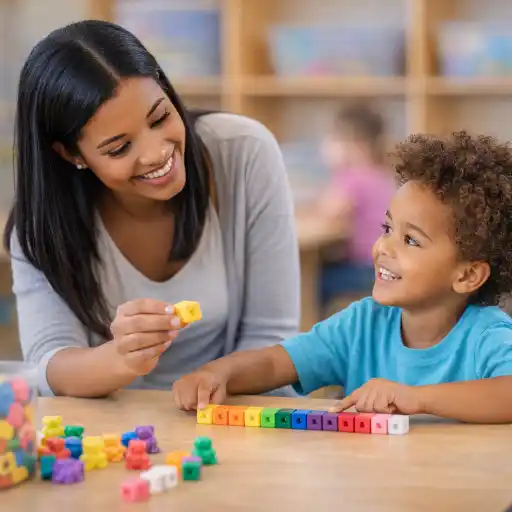
A strong investigation evolves from children’s responses. After counting ocean animals, children might wonder which group is largest, whether animals can be sorted by body features, or how an animal moves. These questions create natural connections among math, science, language, and creative play. Keep the children’s original interest in view while offering materials and experiences that deepen it.
Possible extensions include:
- Sort animal pictures by features such as fins, shells, claws, or tentacles, then count each set.
- Make a simple picture graph of children’s favorite ocean animals and compare the totals.
- Build a habitat with blocks or loose parts and count how many animals fit in each area.
- Use counters or linking cubes to model “one more,” “one less,” or two groups combined.
- Read a nonfiction book together and revisit the children’s questions with new information.
Keep math language present across the day: more, fewer, equal, altogether, one more, and the same number. Early math learning can also emerge during snack, transitions, block play, and routines. When a child notices that one table has more cups, educators can invite a check and discuss how to make the sets equal.
Support participation in varied ways. Children can point, gesture, use counters, dictate, draw, or write numerals according to their current abilities and communication preferences. Offer smaller sections of a busy image or a partner activity when that makes the investigation more accessible.
How can educators assess learning while keeping the inquiry playful?
Assessment can be woven into the investigation through observation rather than a formal test. Notice whether a child points to each object once, keeps track of counted items, identifies the total, compares sets, or explains a strategy. Record specific actions and language, then use the evidence to decide what materials or questions could support the next step.
For example, one note might read: “Mila counted six fish, touching each picture once, then said six was the total.” Another might say: “Omar located the animals but skipped some when counting; covering each section helped him track his search.” Both records identify strengths and a practical direction for support.
Common pitfalls are easy to avoid when the purpose stays clear:
- ⚓ Avoid turning the investigation into a race; give children time to look, count, and explain.
- Do not correct every mistake immediately. Invite children to check their strategy and try again.
- Keep the number of materials and questions manageable; one focused learning goal is often enough.
- Use worksheets sparingly and pair them with concrete objects, conversation, and play.
- Do not compare children with one another; notice each child’s strategies and progress.
Share an observation with colleagues or families when it can support continuity, while following your program’s documentation and privacy practices. State requirements vary - check your state licensing agency when determining applicable training or documentation expectations.
Conclusion: How do educators follow children’s counting questions into an investigation?
Educators can turn children’s number questions into meaningful investigations by listening closely, identifying the mathematical idea beneath the question, and offering materials that invite children to count, compare, represent, and explain. A question about ocean animals might lead from a careful search to one-to-one counting, comparing groups, sorting by features, or making a class graph.
The central practice is to balance intentionality with children’s agency: set a clear learning purpose, then let their ideas shape the path. Use open questions, concrete representations, flexible participation options, and brief observations to decide what comes next. When children’s curiosity guides the investigation, counting becomes a way to explore and make sense of their world.
For additional professional learning, ChildCareEd’s Emergent Learning & Development Buy Now $35.00 course focuses on developmentally appropriate experiences and emergent skills for preschool-age children. The Early Mathematics Through Play Buy Now $24.00 course offers further strategies for integrating counting and mathematical reasoning into hands-on classroom experiences.
Frequently asked questions
What should I do when a child loses track while counting?
Offer a tracking strategy, such as pointing to each object once, moving counted items aside, or covering parts of a busy picture. Count together if the child welcomes support.
Does every child need to write numerals during the activity?
No. Children can show their thinking by pointing, using counters, building a set, drawing, selecting a numeral card, dictating, or writing, depending on their developmental readiness.
How do I keep an I Spy activity from becoming a worksheet drill?
Make it interactive: invite children to search, touch or move counters, compare quantities, ask questions, and connect what they see to books, play, or science exploration.
What if children count the same objects differently?
Ask them to show their methods. Reorganize or point to the objects together, then discuss how they can check the total. Different strategies offer useful evidence of children’s thinking.
How can I include children with different communication or motor needs?
Provide adapted materials and multiple ways to respond, such as larger counters, a pointer, partner counting, picture choices, gestures, or a smaller visual field. Keep the goal focused on meaningful participation.
- 45 Hour Child Growth and Development
- Lesson Planning for Preschoolers
- From Play to Planning: Building Culturally Competent, Child-Centered Curriculum
- Children at the Wheel: Emergent Curriculum
- Math Foundations in Early Childhood
- Art from the Heart for Preschoolers: Open Ended Art Projects that Build Self-Esteem
- Brighter Futures: Social Emotional Development
- Texas Director Credential
- Spaces that Support Discovery
- CDA Certification en Español: Recursos y Consejos para Educadores Bilingües
- How Can Child Care Providers Encourage Preschoolers’ Growing Curiosity?
- STEM for Preschoolers: Fun Activities That Encourage Curiosity
- How Can You Turn a Superhero Theme Into a Full Week of Preschool Learning Centers?
- What’s Happening Outside? Fall Science Adventures for Preschoolers
- Count It, Sort It, Find It! Fall Math Games for Preschoolers
- How Do Light vs. Heavy Activities Build Early Measurement Skills?
- What Makes a Preschool Curriculum Meaningful, Inclusive, and Effective?
- How Can Children’s Questions Shape Next Week’s Curriculum?
- How Can Dinosaur Coloring Become a Science and Language Experience?
- How Can You Follow a Preschool Interest Without Turning It into a Month of Busywork?
- How Can Teachers Turn Everyday Play Into Learning Opportunities?
- What Questions Keep a Preschool Science Conversation Going?
- How Can One Plant Help Children Notice Gradual Change Outdoors?
- How Can Teachers Use Children’s Questions to Create Meaningful Learning Experiences?
- What Are Simple Ways to Encourage Curiosity and Question-Asking in Young Children?
- How Can Family Knowledge Shape Meaningful Community Learning Experiences?
- Following Children's Counting Questions into an Investigation: How Can Educators Turn Curiosity into Meaningful Math?
- How Can Classroom Recycling Questions Grow into a Meaningful Learning Project?
