Halloween can spark rich math learning without putting candy at the center of the classroom: children can count monster eyes, sort pumpkins, and compare pretend potion ingredients as they play. Explore Lesson Planning for Preschoolers  Buy Now $24.00 to strengthen your ability to shape playful interests into developmentally appropriate learning goals, and consider Early Mathematics Through Play Buy Now $24.00 for practical ways to weave number sense and other math concepts into everyday experiences. The ideas below offer a starting point; the courses provide a more complete framework for planning and teaching with purpose.
Why does no-candy Halloween math matter?
Halloween themes can make early math inviting, but candy is not necessary for children to enjoy counting. Using pretend or reusable materials keeps the focus on mathematical thinking and avoids making sweets the default reward or classroom tool. It also makes activities easier to adapt for children with food allergies, dietary restrictions, family preferences, or different relationships to Halloween.
The purpose is not to add a themed worksheet to an already busy day. It is to notice math inside children’s ideas and play. A child building a monster may count its eyes; a group pretending to run a haunted shop may sort objects or share supplies; a potion game can invite comparisons of more and fewer. These experiences support #number-sense and communication as children act, talk, test an idea, and revise it.
Play-based math is most meaningful when adults have a clear intention but remain responsive. Research on guiding preschool mathematical understanding emphasizes recognizing what children demonstrate during play, using mathematical language to extend their thinking, and observing systematically. One-to-one correspondence—matching one number word to one object—is a useful goal, but children may also be exploring classification, pattern, quantity, or spatial relationships.
- Use seasonal interest as an invitation, not as a requirement that every child participate in Halloween activities.
- Choose materials that are accessible, safe, and familiar to your group.
- Let the mathematical idea—not the spooky decoration—guide your planning.
For additional ideas on playful seasonal counting, see early math activities that build children’s mathematical thinking.
Which math skills can children explore through monster play?
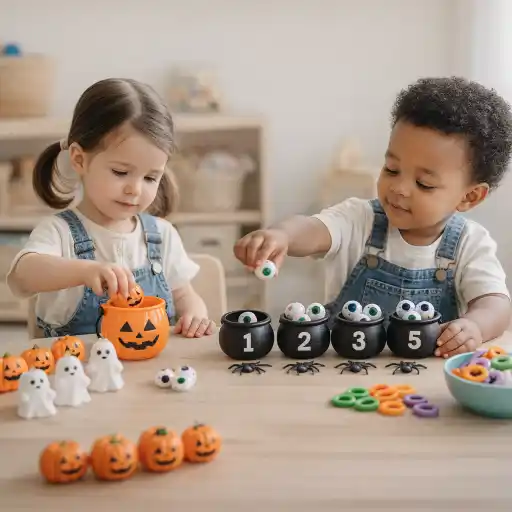
A friendly monster is an open-ended invitation. Children can add eyes, arms, spots, or paper teeth and count each feature as they build. The same materials can support several connected math concepts, depending on a child’s readiness and interest. Start with a manageable set and keep manipulatives large enough for the children using them.
- Counting and one-to-one correspondence: Move one feature at a time while saying one number word for each piece. Invite the child to count the finished set again.
- Numeral and quantity matching: Provide numeral or dot cards and ask children to build a monster with that many features.
- Comparing: Place two monsters side by side and ask, “Which has more eyes?” or “Do they have the same number?”
- Sorting and classifying: Sort features by color, shape, or type, then invite children to explain their sorting rule.
- Patterns: Arrange colored spots in a simple repeating pattern and invite children to continue or invent one.
A commercially prepared option for this kind of activity is the Halloween counting activity for ages 3–5 Buy Now $1.50; educators can also make a simple version from paper shapes, large counters, and numeral cards. Whichever materials you choose, treat each child’s creation as evidence of thinking. Ask, “How did you decide how many to add?” rather than focusing on whether the monster looks a certain way.
How can educators turn classroom play into seasonal math?
Look for children’s natural play themes and add a small, purposeful math invitation. At the block area, children can build a haunted house and count windows, compare tower heights, or place figures beside, inside, and behind the structure. In dramatic play, a pretend Halloween shop can use picture menus, baskets, and large counters to sort items or distribute one item to each customer. A potion station can invite children to count pretend ingredients, sort them by type, and compare which container holds more.
These experiences connect naturally with skills such as one-to-one counting with hands-on materials. The key is to join children’s play without taking it over. Comment on what you notice, model useful math words, and offer a question that invites thinking. For example: “You gave each monster one hat. How many hats did you use?” or “What could we change so both groups have the same amount?”
- Place a few numerals, picture cards, counters, and sorting trays near the play area.
- Use words such as more, fewer, same, next to, under, and between in conversation.
- Keep the activity flexible; children can explore, build, count, or simply observe.
- 🎃 Invite children to count pretend pumpkins in a story or block-play scene, then decide together how to arrange them.
Brief math moments can be especially effective when repeated in different contexts. The same quantity can appear in a monster game, a classroom graph, a cleanup routine, and a picture book. Repetition helps children revisit an idea without making play feel like a test.
How can you plan an inclusive, developmentally appropriate activity?
Start with one observable learning goal, such as “children will count up to five objects by moving each object once.” Then choose materials, prompts, and a manageable challenge. A useful plan includes an invitation, opportunities for child choice, adult language, adaptations, and a way to notice what children understand. For more guidance on turning interests into intentional experiences, see lesson planning for preschoolers.
Children in one group may have different experiences with number words, fine-motor tasks, pretend play, or Halloween itself. Offer more than one way to participate: a child might place a counter, point to a numeral, describe a quantity, or watch before joining. Dual-language learners can benefit from gestures, visuals, and number words in the home language as well as English. Avoid making Halloween participation compulsory; seasonal math can use pumpkins, leaves, shapes, or friendly creatures without emphasizing costumes or scary imagery.
- For children just beginning to count, offer one to three large pieces and model moving each piece once.
- For children who count small sets reliably, invite matching to a numeral, comparing groups, or adding one more.
- For children ready for greater challenge, ask them to create a repeating pattern or explain two ways to sort the same pieces.
- Offer adaptive tools, larger materials, or verbal and visual response options when helpful.
Safety is part of planning. Avoid small loose parts when children may mouth them, supervise closely, and follow program practices for choking prevention and material use. Keep the room calm and predictable, and make space for children who prefer not to engage with a particular seasonal theme.
How can providers observe progress and avoid common pitfalls?
Observation during play can reveal more than a completed worksheet. Notice whether the child says number words in sequence, moves one object for each word, identifies the total after counting, matches a numeral to a set, or compares quantities. Write down a specific behavior and a possible next step rather than a broad judgment. For example: “Riley counted four monster eyes, touching each once; next time, offer five and ask how many altogether.”
Allow time for children to think and try again. If a child counts an item twice or skips one, model a strategy—such as moving each counted piece to a separate space—rather than rushing to correct the answer. Ask one clear question and wait. Children may show their reasoning through actions, gestures, home-language words, or drawing, not only through a spoken response.
Common pitfalls include using too many materials or objectives at once, treating speed as mastery, and directing every step of a child’s play. Keep the focus narrow, provide a manageable quantity, and value children’s strategies. Avoid relying on candy as a manipulative; large reusable counters, paper shapes, and pretend ingredients can accomplish the same math goal while supporting a broader range of needs and preferences.
Directors can support consistency by inviting educators to share brief observations during planning meetings and identify a next step for each child. State requirements vary - check your state licensing agency when aligning activities, documentation, or training with local expectations.
Conclusion: How can Halloween math stay playful without candy?
Child care providers can build meaningful Halloween math around children’s play by using familiar seasonal materials, setting a clear but flexible learning goal, and joining children’s ideas with thoughtful math talk. Monster building, pretend shops, pumpkin counting, sorting, and potion play can all support counting, comparison, patterns, and mathematical language without candy.
Remember the essentials: offer safe and accessible materials, adjust the challenge to each child, observe the process rather than judging only the answer, and make participation responsive to children’s interests. A short, joyful experience can offer rich evidence of learning when educators notice what children do and plan a useful next step. With purposeful planning, Halloween becomes a playful context for growing #curiosity, #counting, #patterns, and confidence in mathematical exploration.
For a deeper professional learning experience, explore Lesson Planning for Preschoolers Buy Now $24.00 and Early Mathematics Through Play Buy Now $24.00. Both can help you build your understanding and bring more intentional, play-based learning into the preschool day.
Additional ChildCareEd courses for continued learning
- What Makes Me Special: An Overview of Autism and ADHD
- Children at the Wheel: Emergent Curriculum
- Math Foundations in Early Childhood
- CDA Bridge Bundle: Family Child Care without Portfolio Review
- CDA Bridge Bundle: Infant/Toddler without Portfolio Review
- CDA Bridge Bundle: Preschool without Portfolio Review
- Connections That Count: Building Relationships in Child Care
- Early Mathematics Through Play
- Montessori Cultural Activities: Exploring the World Through Play and Learning
- Enhancing STEM Education for Infants and Toddlers
- CDA Certification en Español: Recursos y Consejos para Educadores Bilingües
- 👶 ¿Cuáles son las proporciones y grupos requeridos en Dakota del Norte? 🏫
- Curso de Comunicación de 9 Horas de Maryland
- 10 Ejemplos de Cómo la Cultura Influye en el Desarrollo Infantil
- Capacitación en Salud y Seguridad Preventiva en Línea para Proveedores de Cuidado Infantil
- Regulaciones de Licenciamiento de Cuidado Infantil en California para Centros y Hogares de Cuidado Infantil Familiar
- Proporciones de Cuidado Infantil y Tamaños de Grupo por Edad en Maryland (Guía Rápida para Centros y Hogares)
- Proporciones de Cuidado Infantil y Tamaños de Grupo por Edad en Nueva Jersey (Guía Rápida para Centros y Hogares)
- Proporciones de Cuidado Infantil y Tamaños de Grupo por Edad en Virginia (Guía Rápida para Centros y Hogares)
- Cómo Trabajar en el Cuidado Infantil en Carolina del Norte: Requisitos y Pasos
- Cómo Trabajar en el Cuidado Infantil en California: Requisitos y Pasos
- Capacitación Previa al Servicio para Proveedores de Cuidado Infantil en Wisconsin
- Requisitos para Guarderías en Casa en Georgia
- Celebrando la amistad en el cuidado infantil durante el Día de los Mejores Amigos
- Canciones, juegos y preguntas de círculo para niños
- Cómo simplificar la capacitación para sus empleados de daycare
- What are safe, engaging non-candy Halloween ideas for daycares?
- How Can Child Care Programs Plan a Halloween Celebration Where Food Is Optional?
- How Can Halloween Pretend Play Teach Children to Say “Stop” and “Ask First”?
- How Can Child Care Providers Build Halloween Math Around Children’s Play—Without Candy?
