When preschoolers move shapes around to build a haunted house, they do more than name circles and triangles: they test how parts fit, where they belong, and what changes when a piece turns. Explore Early Mathematics Through Play Buy Now $24.00 for practical ways to weave geometry into hands-on classroom experiences, and consider Math Foundations in Early Childhood  Buy Now $16.00 for additional strategies that can strengthen your math teaching practice. Then use the ideas below to turn a simple building mat into a lively invitation to think, talk, and create.
Why move beyond shape flashcards?
Flashcards can help children become familiar with shape names, but matching a picture is only one part of geometric thinking. When children select loose pieces, rotate them, and arrange them into a picture, they explore how shapes relate to one another. A triangle might become a roof, a rectangle a door, and a small circle a window—or a child may invent a very different design. That active decision-making makes geometry visible and meaningful.
Construction also invites children to notice attributes and spatial relationships. They can compare sides and corners, decide whether a piece belongs beside or above another, and observe how an empty space changes as shapes move. These playful investigations connect mathematical ideas to children’s own plans and discoveries. Research summarized by the OECD describes spatial play with shapes, blocks, puzzles, and similar materials as a meaningful context for developing spatial skills related to STEM learning.
For providers, this approach offers a practical way to observe more than recall. A child who does not yet name a triangle may still demonstrate careful reasoning by turning pieces until they fit. Such moments give teachers useful information about children’s strategies, vocabulary, persistence, and next steps. The aim is not a perfect picture; it is an engaging opportunity to explore, explain, and try again.
How can a haunted-house mat invite geometric thinking?
The Haunted House Shape-Building Mats for Preschool Buy Now $1.50 provide a visual starting point for children to arrange movable shapes into a themed image. A familiar, slightly spooky scene can spark curiosity, while the pieces invite children to build rather than simply point to a printed answer. The mat may be used in a small group, a math center, or as an optional extension during a seasonal theme.
Before children begin, name the purpose in simple language: “Let’s use shapes to build a house. You can decide where each piece goes.” Offer a manageable selection of appropriately sized pieces and give children room to experiment. The picture is a prompt, not a test with only one acceptable solution. Encourage children to try different arrangements and describe what they notice.
As children work, invite them to identify features without overwhelming them with terminology. “This piece has three straight sides,” or “The door is below the window” pairs useful math words with visible actions. The Illinois Early Learning Project recommends incorporating geometric vocabulary and everyday position words such as inside, top, and angle into preschool experiences.
- Ask children to choose a shape for a roof, window, door, or path.
- Invite them to turn or slide a piece to see whether it fits another way.
- Let children create their own version when they finish the suggested picture.
Which shape and position words should educators model?
Precise language helps children communicate what they are doing and notice relationships between pieces. Start with a small group of familiar shape names—circle, triangle, square, and rectangle—and pair them with attributes children can see or trace. For example, a triangle has three straight sides and three corners; a circle has a continuous curved boundary and no corners. Examples in different sizes and orientations help children learn that a shape remains the same when it is turned.
Position words are just as valuable. In a picture-building task, children have a concrete reason to use words such as above, below, beside, between, inside, outside, and next to. Rather than asking only, “What shape is this?” try questions that connect shape and location: “Which piece is above the door?” “Can you put a triangle beside the rectangle?” or “What is inside the house?” Pre-K Pages notes that positional vocabulary supports children’s understanding of spatial relationships and following directions.
Model language conversationally and accept multiple ways of communicating. A child might answer aloud, point, gesture, move a piece, or use a home-language term. You can restate the idea with a target word: “You put the small circle above the door.” Avoid correcting every phrase; make the vocabulary available, then invite children to use it when they are ready. Repeated, meaningful language during play is more supportive than a rapid-fire naming quiz.
- Shape words: side, corner, straight, curved, triangle, rectangle.
- Position words: above, below, beside, between, inside, outside.
- Action words: turn, flip, slide, fit, overlap, build.
How can providers scaffold play without taking over?
Begin by observing before stepping in. Notice which pieces a child selects, whether they compare the mat and the movable shapes, and what they do when a piece does not fit. A pause can be a useful teaching move: it allows the child time to inspect the picture, test an idea, and revise it independently. If support is needed, offer the smallest prompt that might help.
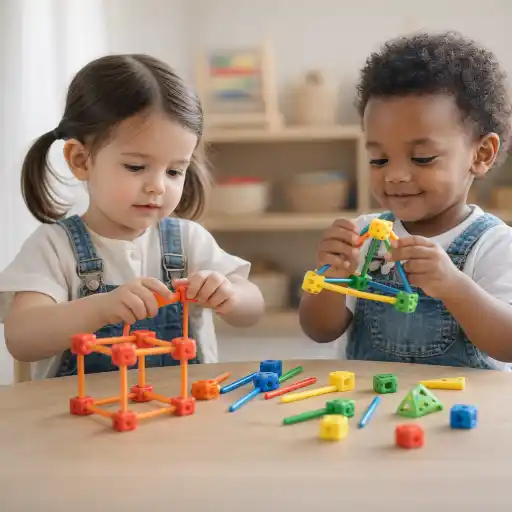
Open-ended questions encourage reasoning without prescribing the answer. Try, “What do you notice about this space?” “What could you try if you turn that piece?” or “Which shape might fit beside the door?” If a child seems stuck, reduce the number of available pieces, point to the relevant area, or model rotating one shape before returning the materials for the child to continue. The OECD’s discussion of guided play emphasizes that adults can support spatial learning through carefully chosen materials, spatial language, commentary, and questions while keeping children active in the play.
Adapt the invitation to children’s varied abilities and interests. Larger pieces, high-contrast outlines, a stable work surface, fewer choices, or extra time can make the experience more accessible while preserving the geometric challenge. Children may participate by speaking, pointing, signing, or demonstrating. Keep loose materials age-appropriate and supervise them in line with your program’s safety practices.
- Notice effort and strategy: “You turned the piece and checked the space again.”
- Offer one clue at a time, then wait for the child’s response.
- 🧩 Celebrate inventive solutions—even when the house looks different from the example.
How can the activity extend into richer math talk?
Once children have explored the mat, build on their interest rather than ending the learning when the picture is complete. Invite them to compare two arrangements: “How did you make the roof fit?” “Which pieces did you use for the windows?” or “What changed when you moved the door?” Children can describe their reasoning, listen to a peer’s idea, and discover that there may be several ways to compose a picture.
Extend the experience with simple variations. Ask children to build a new house using only a few selected shapes, make a path from the house to a tree, or create a picture with one shape placed inside another. Connect the mat to blocks, large foam shapes, paper cutouts, or playdough so children explore the same ideas through different materials. The NAEYC article on playful math instruction illustrates how intentional questions and hands-on activities can integrate mathematical goals with children’s play, discussion, and collaboration.
Use brief observations to guide what comes next. Record a specific action or phrase, such as, “Placed a triangle above a rectangle after turning it,” or, “Used ‘beside’ while describing the window.” A short note is more useful for planning than a broad label like “knows shapes.” Directors can support staff by sharing one observation during planning and agreeing on a small next step—perhaps introducing a new position word or offering varied triangle examples.
Conclusion: What should providers remember about geometry through play?
Preschool geometry grows when children do more than recognize pictures: they select, move, rotate, combine, and describe shapes. Haunted-house building mats can turn that process into an inviting, hands-on experience in which children explore basic forms and position words while making a picture of their own. The adult’s role is to offer purposeful materials, model useful language, ask responsive questions, and protect children’s opportunity to experiment.
Keep the challenge manageable, include varied ways to participate, and value the process as much as the finished design. Observe children’s strategies to plan an appropriate next invitation, and carry spatial language into blocks, stories, routines, and everyday classroom conversations. With playful repetition and supportive guidance, a movable shape can become much more than a match—it can be a tool for children to reason about how their world fits together.
For a broader professional learning experience, explore Early Mathematics Through Play Buy Now $24.00, Math Foundations in Early Childhood Buy Now $16.00, No Such Thing as Boring Math Buy Now $24.00, The Best Promotion is Play Buy Now $35.00, and Lesson Planning for Preschoolers Buy Now $24.00. Training applicability and requirements vary; state requirements vary - check your state licensing agency.
- Turning Behavior Around for Toddlers and Preschoolers
- Moving About the Classroom: Effective Transitions for Everyday
- Building Equity: Inclusionary Practices in Preschool
- From Tantrums to Triumphs: Equipping Preschoolers with Self-Regulation Skills
- CDA Bridge Bundle: Preschool
- CDA Bridge Bundle: Preschool without Portfolio Review
- Texas Director Credential
- Building Vocabulary
- Families, Communities, and Classrooms: Working Together for Children
- Effective Coaching & Mentoring in ECE
- CDA Certification en Español: Recursos y Consejos para Educadores Bilingües
- Actividades de Otoño Fáciles para Preescolares esta Temporada
- Celebrando la amistad en el cuidado infantil durante el Día de los Mejores Amigos
- Canciones, juegos y preguntas de círculo para niños
- Count It, Sort It, Find It! Fall Math Games for Preschoolers
- How Can Fun Bingo Games Teach Colors, Shapes, and Animals to Preschoolers?
- How Can Early Math Activities Build Young Children’s Mathematical Thinking?
- How Does Counting Shapes Build Early Number Sense Through Play?
- How Can Child Care Providers Make Counting and Simple Operations Playful?
- How Can Child Care Providers Move Beyond Shape Names to Attributes and Comparisons?
- How Can Listening and Movement Games Build Children’s Shape Recognition?
- How Does Building from Another Photograph Angle Change Children’s Thinking?
- Why Can a Child Match a Shape but Struggle to Rebuild It with Pieces?
- How Can Preschool Bingo Build Shape Reasoning Beyond Naming?
- How Can Preschool Bingo Build Reasoning Beyond Naming Shapes?
- What Are Simple Ways to Strengthen Spatial Awareness in Young Children?
- Can a Floor-Sized City Fit on a Table? Exploring Scale Through Reconstruction
- How Can Child Care Providers Use Everyday Objects to Support Early Math Learning?
- How Can Sweater Patterns Help Preschoolers Build Early Math Reasoning Before Kindergarten?
- How Can Preschoolers Learn Geometry Through Building and Play?
