When a child can name a triangle but recognizes it only when it points up, there is a wonderful next step: helping them notice what makes it a triangle. Shape bingo can become more than a matching game when educators invite children to compare, describe, and explain. For practical strategies to make play intentional while preserving its joy, explore The Best Promotion is Play  Buy Now $24.00; this course offers a fuller professional learning experience about play’s role in children’s development.
Why move beyond naming shapes?
Shape names are useful, but a label alone does not tell us whether a child understands the form. A child may match a familiar upright triangle without recognizing the same triangle when it is tilted, larger, or narrower. Reasoning grows when children attend to defining attributes—such as straight sides and corners—and use those attributes to explain a choice.
This matters because geometry is part of children’s everyday thinking. They sort, build, fit objects together, notice patterns, and describe where things are. These experiences support mathematical language, visual discrimination, and flexible problem-solving. NAEYC’s discussion of playful early math emphasizes that meaningful exploration, conversation, and active participation can connect mathematical ideas with children’s interests and experiences.
Bingo offers a familiar structure for this work: listen, look, compare, decide, and respond. The board is a starting point, not the whole lesson. Pair it with conversation and hands-on exploration, and children can begin to explain not only what a shape is called but how they know.
- Move from identifying a picture to noticing its attributes.
- Invite children to compare examples that differ in size, color, or orientation.
- Connect printed shapes to blocks, classroom objects, and children’s own constructions.
How can you plan bingo around shape attributes?
Choose one clear mathematical goal before preparing the game. For example, children might identify shapes with three straight sides, compare figures with four corners, or notice which outlines are curved. Start with a small set of familiar shapes and use precise, age-appropriate language. “Side,” “corner,” “straight,” and “curved” are useful words when paired with a gesture or demonstration.
ChildCareEd’s Bingo Cards - Shapes Edition Buy Now $1.99 is a print-and-play activity that invites children to cut, color, and paste picture cards onto a bingo grid before playing. Those preparation steps can themselves spark discussion about what the children see. The cards can support recognition practice; educators can add reasoning by changing the clues they call.
- Instead of “triangle,” try “Find the shape with three straight sides.”
- Instead of “square,” ask children to locate a shape with four equal sides and four corners, if that description fits the examples provided.
- Pause after each clue so children have time to scan and think.
- Ask children to point, trace the outline in the air, or use a marker to check each side or corner.
Use varied examples whenever possible. A triangle can be turned, narrow, wide, or unequal-sided and still be a triangle. When the aim is geometry, avoid letting color or orientation do all the work.
What questions turn a match into mathematical reasoning?
Children’s ideas become visible when adults ask questions that invite explanation rather than a one-word answer. A bingo call can lead to a quick exchange: “What do you notice?” “How could we check?” “What stayed the same when I turned the card?” These prompts make room for children to reason aloud, gesture, or demonstrate with materials.
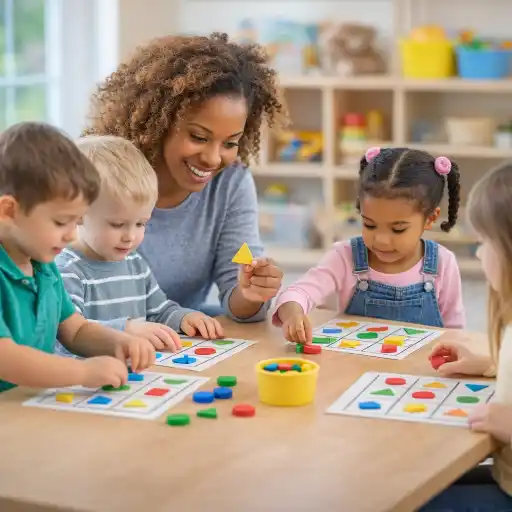
Research and professional guidance on educator questioning during play highlight the value of listening closely and extending children’s own thinking. Keep the interaction reciprocal: offer a prompt, notice the child’s response, and build on it without taking control of the game. A child who says “It has pointy bits” may be ready for support in counting corners; another may already compare side lengths.
- “How are these two shapes alike? What is different?”
- “Which shapes have four corners? Do they all look the same?”
- “How do you know this is a triangle, even though it is turned?”
- “Can you find another shape that follows the same rule?”
- “Would this card still belong if it were bigger? Why?”
There is often more than one reasonable way to sort a group. If children choose different answers to “Which one doesn’t belong?”, invite each child to describe a rule and provide evidence. The aim is not to guess the adult’s answer; it is to practice explaining a mathematical idea. The NAEYC article on teacher questioning and math learning through play offers helpful context for using questions to make children’s thinking visible while respecting their agency.
How can you adapt bingo to include every child?
Preschoolers vary in their language, attention, motor skills, visual processing, and comfort in group games. Inclusion does not require every child to respond in the same way. A child may identify a shape by pointing, touching, signing, using eye gaze, selecting a picture, communicating through AAC, or describing it in a home language. Each can be a meaningful way to show thinking.
Adjust the access points while keeping the central goal. Use a smaller board or fewer choices for children who benefit from a simpler visual field. Provide larger images, tactile outlines, high contrast, or a slanted board when appropriate. If listening is difficult in a noisy room, show the clue card as you name it. Offer wait time and repeat a prompt calmly rather than rushing to the next call.
- Begin with a brief demonstration and a predictable routine: listen, find, mark, check.
- Let children participate as callers, partners, observers, or card selectors.
- Try a cooperative class board when competition adds pressure.
- Use markers that are easy to grasp, safe for the children’s age, and large enough to reduce choking risk.
- 🟦 Offer a point, gesture, or spoken response—children need not say “Bingo” to participate.
Pay attention to representation and language, too. Connect shapes to objects children encounter at home and in the community, and welcome family vocabulary. State requirements vary - check your state licensing agency when aligning professional development or documentation with local expectations.
How can you observe progress and extend the game?
Notice the process rather than recording only who finishes a row. Does a child listen to the clue, scan the board, compare options, or explain a match? Do they count sides by tracing, rotate a card to check, or ask a peer for help? Brief, specific observations are more informative than a broad note such as “knows shapes.”
For instance, you might document: “Sam matched a triangle from a spoken clue and counted three sides by tracing the outline.” That note points to a possible next step: compare triangles that look different, or invite Sam to find a triangle in the block area. Use patterns across several play opportunities, not a single game, to guide planning.
- After bingo, invite children to build a called shape with craft sticks, blocks, or dough.
- Go on a classroom or outdoor shape hunt and discuss how children decided what counted.
- Sort the cards again using a new rule, such as number of corners or curved boundaries.
- Use a “turn and check” round: rotate a shape and ask what changed and what stayed the same.
- Share one observation with your team and agree on a manageable follow-up invitation.
For additional professional learning focused on playful mathematics—including geometry, patterns, and reasoning—consider Early Mathematics Through Play Buy Now $24.00. To strengthen your planning practice, Lesson Planning for Preschoolers Buy Now $24.00 explores developmentally appropriate lesson planning, while Inclusive Lessons for Preschoolers Buy Now $16.00 offers strategies for adapting activities for varied learners. These courses complement, rather than replace, local guidance about training requirements.
Conclusion: How can preschool bingo build shape reasoning?
Preschool bingo builds reasoning when educators turn shape names into invitations to notice attributes, compare examples, and explain a choice. Use varied shapes, clear clues, thoughtful questions, and accessible response options. Let children handle, rotate, sort, construct, and search for shapes beyond the board, and use brief observations to plan what comes next.
The central goal is not simply for children to call out the right label. It is for them to grow more confident saying, in their own way, “I know because…” With playful facilitation and an appropriately chosen bingo resource, a familiar game can become a welcoming space for mathematical thinking.
- 45 Hour Child Growth and Development
- CDA Preschool Credential with Portfolio Review
- Birth to Five CDA Credential with Portfolio Review
- CDA Family Child Care Credential with Portfolio Review
- 45 Hour Infant and Toddler Methods and Materials
- CDA Bridge Bundle: Preschool
- CDA Bridge Bundle: Family Child Care without Portfolio Review
- CDA Bridge Bundle: Infant/Toddler without Portfolio Review
- CDA Bridge Bundle: Preschool without Portfolio Review
- ❤️ ¿Cómo ayudan los educadores a las familias a acceder a los servicios que necesitan?
- 👶 ¿Cuáles son las proporciones y grupos requeridos en Dakota del Norte? 🏫
- Celebra El Cumpleaños de Dr. Seuss En Tu Guardería Con Actividades Fáciles y Divertidas!
- Curso de Comunicación de 9 Horas de Maryland
- 10 Ejemplos de Cómo la Cultura Influye en el Desarrollo Infantil
- Proporciones de Cuidado Infantil y Tamaños de Grupo por Edad en Virginia (Guía Rápida para Centros y Hogares)
- Cómo Trabajar en el Cuidado Infantil en Carolina del Norte: Requisitos y Pasos
- Cómo Ser Maestra de Preescolar en Wisconsin
- Cómo Ser Maestra de Preescolar en Maryland
- Celebrando la amistad en el cuidado infantil durante el Día de los Mejores Amigos
- Canciones, juegos y preguntas de círculo para niños
- Cómo simplificar la capacitación para sus empleados de daycare
- How Can Fun Bingo Games Teach Colors, Shapes, and Animals to Preschoolers?
- Why Is Animal Bingo a Great Way to Introduce Habitats and Classification?
- How Can Bingo Games Make Learning Feel Like Play?
- How Can Interactive Group Play Build Ocean Vocabulary in Preschool?
- How Can Animal-Themed Bingo Build Descriptive Language in Preschoolers?
- How Can Listening and Movement Games Build Children’s Shape Recognition?
- How Can Preschool Bingo Build Shape Reasoning Beyond Naming?
- How Can Preschool Bingo Build Reasoning Beyond Naming Shapes?
