When preschoolers crawl through a tunnel, step over a line, or move around a cone, words such as “through,” “over,” and “around” become experiences they can see and feel. A short movement route can build spatial vocabulary while giving children purposeful practice with balance, coordination, and navigating space. For a ready-to-use classroom activity, explore ChildCareEd’s Tunnel Adventure Teaching Guide: Preschool Movement and Positional Words Buy Now $1.49; to deepen your planning of hands-on spatial and geometry learning, consider the Early Mathematics Through Play Buy Now $24.00 course.
Positional words—also called spatial words—describe where people and objects are in relation to one another. “The toy is there” is vague; “The toy is under the chair” gives a clear, useful relationship. Preschoolers learn these ideas gradually, through repeated opportunities to hear the words, notice what they describe, act them out, and use them in meaningful situations.
Movement is especially valuable because space is not merely an idea children encounter on a page: it is part of their everyday experience. When educators pair a word with a body action or a movable object, they connect language, perception, and action. The result is an integrated learning opportunity—not a vocabulary drill—where children can explore, communicate, and develop large-muscle abilities together.
Why do movement and positional words work so well together?
Words such as over, under, and through describe relationships that can be difficult to understand in the abstract. In a safe obstacle route, a child can step over a floor marker, crawl under a stable arch, or guide a toy through a wide tunnel. The adult’s language names what the child is experiencing, helping connect the spoken word to a visible and physical reference.
Research on early spatial learning describes children’s bodily engagement with spaces, manipulation of objects, and representation of spatial experiences as important aspects of spatial thinking. A review of early childhood mathematics research likewise highlights movement and gesture as ways children express and explore spatial ideas. NAEYC recommends combining books, spatial language, and physical movement to support children’s developing spatial thinking.
Movement can also involve gross-motor practice. A simple route may invite children to bend, crawl, step, reach, balance, stop, and change direction. These actions challenge children to coordinate their bodies and judge how they fit within a space. The learning is not about making every child move in the same way; it is about offering intentional, welcoming opportunities to participate.
- Language: Children hear and begin to use precise location words.
- Spatial thinking: Children notice where bodies and objects are in relation to landmarks.
- Physical development: Children practice changing body positions, direction, and pace.
How can you set up a safe “through, around, over” route?
A useful movement activity can be simple and low-cost. Choose a clear area with enough room for children to move without crowding. Use stable, age-appropriate materials, such as floor markers, a wide play tunnel, or a low obstacle designed for children’s use. Avoid furniture or unstable items as climbing equipment, and never create narrow spaces that could trap or restrict a child.
Before inviting children to begin, walk the route yourself. Check for slipping and tripping hazards, ensure visibility across the activity area, and plan where adults will stand to supervise. Explain the start and finish points, demonstrate each action, and give one direction at a time. Invite children to move at a comfortable pace; this is not a race.
For instance, set out a floor marker to step over, a clear path around a cone, and a wide tunnel to move through. Let children take turns guiding a toy animal from the start to a destination. They can say, show, or choose a picture for the route: “Go around the cone, then through the tunnel.” A guide such as the ChildCareEd Tunnel Adventure teaching resource Buy Now $1.49 offers a focused starting point for planning this kind of positional-word play.
- Start with two or three familiar words; introduce additional words as children are ready.
- Use a gesture or demonstration alongside the spoken direction.
- Offer children turns to follow, give, or choose a direction.
What educator language helps children make the connection?
Short, specific narration is often more useful than repeated quizzing. As a child acts, name the action: “You crawled through the tunnel,” or “You walked around the cone.” Then pause. The child might repeat the word, respond with a gesture, move a toy, or simply continue the game. Each response can offer a meaningful glimpse of understanding.
Questions can extend the play without turning it into a test. Try asking, “Where should the animal go next?” or “How could we get around the marker?” Children can also direct a peer or describe a route they have already completed. If a child says “there,” you can warmly expand the idea: “Yes, the animal is under the bridge.” This provides a richer model while respecting the child’s contribution.
Pair words with opposites or contrasts when it makes sense. Move a toy over a line and then under an arch; place it inside a box and then outside. Contrast helps make differences noticeable, but keep the number of new terms manageable. As NAEYC notes in its discussion of books and movement for spatial thinking, pairing spatial words with meaningful action and representation helps children explore relationships in multiple ways.
- Model the word while the child or object is in the described position.
- Allow time for the child to respond in their own way.
- Invite children to explain or show a route, rather than expecting only a spoken answer.
How does this activity support gross-motor development?
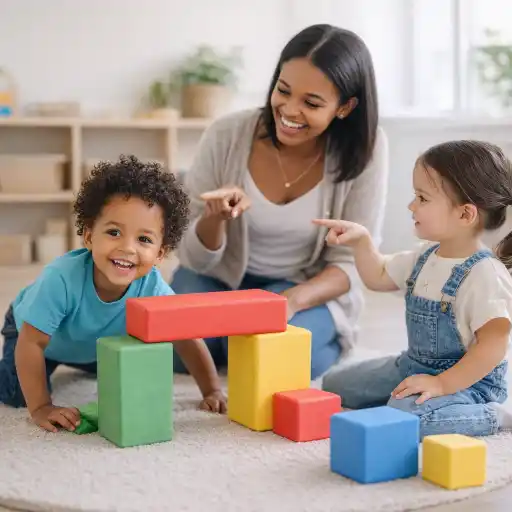
A positional-word route can bring language learning into active play. Bending to go under, stepping across a line, walking around an obstacle, and pausing at a destination all require children to coordinate body movements with the surrounding space. Repeated practice gives children chances to plan an action, adjust their movement, and notice where their bodies are in relation to objects and peers.
Keep the physical challenge appropriate for the children, the space, and the materials available. Some children may be eager to crawl or step; others may prefer a smaller movement, a seated gesture, or to direct a toy or partner. A child who points to the tunnel and tells a peer to go “through” is still engaging with the positional concept. The purpose is meaningful participation, not a particular motor performance.
Movement also creates natural opportunities for children to practice listening, waiting, and taking turns. A cooperative route can invite peers to guide one another, share space, and solve a playful problem together. Avoid assessing success by speed, distance, or comparison with other children. Notice strategies and effort: “You slowed down and found a way around the cone.”
For broader ideas about balancing active experiences with other parts of the day, explore ChildCareEd’s Balancing Active Play in Child Care  Buy Now $16.00. It can complement positional-word activities by helping providers think about structured and unstructured movement within the classroom rhythm.
How can you adapt the route and build learning over time?
Children differ in their movement abilities, communication, sensory preferences, and familiarity with positional language. Make accessibility part of the plan from the beginning. Widen pathways, reduce the number of steps, use picture cues, or let children choose between moving themselves and moving a toy. A child may participate by observing first, pointing to a location, using a communication device, signing, or directing a partner.
Begin with words children can explore clearly, such as in, on, and under; then add terms such as around, between, or through as opportunities arise. Revisit the words in books, block play, cleanup, outdoor exploration, and ordinary transitions. Children benefit when vocabulary appears across varied contexts, not only during one planned game.
Watch what children do and record concrete observations. For example: “After a gesture and verbal cue, Sam guided the animal through the tunnel.” Such notes help you choose an appropriate next step and communicate specific learning to colleagues and families. Avoid treating one missed direction as proof that a child does not understand; fatigue, attention, unfamiliarity, or language differences can affect a response.
- Keep routes clear, materials stable, and supervision active.
- Offer multiple ways to show understanding: moving, pointing, speaking, signing, or directing.
- Repeat useful words naturally and add complexity gradually.
- State requirements vary - check your state licensing agency for applicable safety and supervision guidance.
Conclusion: How can movement make positional words meaningful?
Movement makes positional words meaningful by connecting language to what children see, feel, and do. When preschoolers step over a line, crawl through a safe tunnel, or guide a toy around an obstacle, they encounter spatial relationships in a concrete context. These playful experiences can support vocabulary, spatial thinking, coordination, and confidence at the same time.
Begin with a simple, well-supervised route and a few clear words. Model the language, allow children time and choice, and welcome responses through speech, gesture, movement, or communication supports. Keep activities accessible and focused on exploration—not speed or identical performance. Over time, weave the same words into stories, play, and routines so children can use them in increasingly flexible ways.
For additional professional learning, explore these relevant ChildCareEd courses:
- Early Mathematics Through Play Buy Now $24.00 — connect hands-on play with early mathematical ideas, including geometry and spatial reasoning.
- Balancing Active Play in Child Care Buy Now $16.00 — consider ways to plan structured and unstructured movement in the daily schedule.
- Building Vocabulary Buy Now $16.00 — strengthen strategies for supporting children’s vocabulary through intentional learning experiences.
- Inclusive Lessons for Preschoolers Buy Now $16.00 — explore ways to adapt materials and activities for varied learner needs.
- The Best Promotion is Play Buy Now $24.00 — deepen your understanding of play’s role in children’s physical, cognitive, language, and social development.
In short, the answer to “How does movement help preschoolers learn positional words?” is that it turns vocabulary into lived experience. Thoughtful routes and everyday movement give children practical, joyful ways to explore space while developing their bodies and communication.
- CDA: Special Needs: Understanding the Whole Child
- CDA Preschool Credential with Portfolio Review
- Birth to Five CDA Credential with Portfolio Review
- CDA Bridge Bundle: Preschool
- CDA Preschool Renewal
- CDA Bridge Bundle: Family Child Care without Portfolio Review
- CDA Bridge Bundle: Infant/Toddler without Portfolio Review
- CDA Bridge Bundle: Preschool without Portfolio Review
- Texas Director Credential
- DAP for Preschool
- CDA Certification en Español: Recursos y Consejos para Educadores Bilingües
- Cómo Abrir Una Quardería En Casa Sin Dinero?
- Cómo Trabajar en el Cuidado Infantil en Carolina del Norte: Requisitos y Pasos
- Celebrando la amistad en el cuidado infantil durante el Día de los Mejores Amigos
- Crunch, Stomp, Scoop! Fall Activities Toddlers Can’t Resist
- Animal Relay Race for Kids: 10 Wild Ways to Race Without Running
- How Can Fun Bingo Games Teach Colors, Shapes, and Animals to Preschoolers?
- How Can Preschool Movement Build Stronger, More Inclusive Learning?
- How Can You Add Simple Movement to the Preschool Day?
- What Skills Can Preschoolers Build Through Bingo?
- How Can Early Math Activities Build Young Children’s Mathematical Thinking?
- How Does Counting Shapes Build Early Number Sense Through Play?
- How Can Camping Themes Expand Preschool Vocabulary?
- What Are Simple Ways to Strengthen Spatial Awareness in Young Children?
- How Can Movement and Positional Words Make Classroom Transitions Fun?
- How Can Preschoolers Learn Geometry Through Building and Play?
- How Can Position Words Improve Preschoolers’ Communication and Spatial Thinking?
- Can Everyone Reach the Apples? How Can Fall Pretend Play Teach Positional Words?
- How Can Leaf Rubbings Become Maps for Imaginative Play?
- How Does Movement Help Preschoolers Learn Positional Words?
