A familiar block structure can become a fresh challenge when children see it from a different angle: what looked like a flat row may suddenly reveal height, depth, and hidden relationships. For practical ways to build geometry, measurement, and reasoning into playful classroom experiences, explore Early Mathematics Through Play Buy Now $24.00; it offers strategies you can use across centers and routines. Keep reading to see how a photograph—and a thoughtful change in viewpoint—can turn rebuilding into meaningful mathematical inquiry.
Why does another viewpoint make a photograph challenge more than copying?
A photograph is a representation, not the structure itself. Children must interpret what they see, decide which parts are near or far, and translate a two-dimensional image into a three-dimensional construction. When a second image shows the same object from another direction, children have to coordinate information that may initially seem inconsistent: the long side visible in one image may be hidden in the other, or a doorway may appear in a different place.
This mental work supports spatial reasoning: understanding position, dimensions, shape, and how objects relate in space. The Early Childhood Mathematics Group describes spatial reasoning as thinking about where things are, their size, and their properties. Building and puzzles are natural contexts for developing those ideas. Research on spatial play also suggests these skills can be supported early, and spatial thinking is connected to mathematical learning.
Most importantly, the task is not simply “make it look exactly right.” Children make predictions, compare evidence, notice what is missing, and revise a design. Those steps cultivate problem-solving and a flexible stance toward mistakes. A structure that does not match the image on the first attempt is not a failure; it is useful information for the next try.
What do children learn when they compare front, side, and overhead views?
Different angles invite different questions. A front view may highlight symmetry and openings; a side view can reveal depth and the relative height of sections; an overhead view may clarify the footprint, boundaries, or arrangement of parts. Children begin to understand that an object can look different without changing its identity—a foundation for perspective-taking and visualization.
As children investigate, they use concepts such as behind, beside, between, above, longer, shorter, wider, and closer. They may count blocks, compare lengths, identify shapes, and reason about which pieces will support a roof or bridge. These are authentic mathematical experiences embedded in meaningful play. OECD’s discussion of spatial play notes that blocks and puzzles give children opportunities to perceive, manipulate, label, visualize, and remember objects in space.
- Invite children to describe what each photograph shows and what it leaves out.
- Ask them to locate a feature in one image, then predict where it will appear from another angle.
- Notice when children rotate a block or move their bodies to inspect a structure.
- Encourage children to explain their strategies in words, gestures, drawings, or home languages.
Children will not all approach the challenge identically. Some may start building immediately; others may study the image, draw a plan, or tell a story about who uses the structure. The research on design play highlights the value of open-ended challenges that welcome different play orientations. Respecting those approaches helps more children find a meaningful way into the task.
How can providers set up a classroom-ready “build it from another view” challenge?
Choose a simple, sturdy structure with clearly visible features—a small bridge, familiar building, playground tower, or block arrangement. Take or select two or three photographs from distinct viewpoints. For a first experience, use photographs of the same structure rather than different structures, so the challenge focuses on perspective rather than visual comparison alone. Keep the images accessible at children’s eye level, and prepare a generous range of blocks and safe, open-ended materials.
Begin with a short invitation: “These pictures show the same structure from different places. What do you notice? What might be behind this part?” Give children time to inspect and discuss before building. They may sketch a plan, point to features, or simply begin. Then invite them to reconstruct the object and use the second view to check their ideas.
- Offer unit blocks, foam blocks, cardboard pieces, tubes, and small figures where appropriate.
- Provide a stable work surface and enough space for children to move around the model and view it from several sides.
- Keep a camera or tablet available for documenting children’s versions and process.
- For young children or those who benefit from a smaller challenge, use two views and a few defining features.
- For children ready to extend the task, add a third view, a drawing, or a simple top-down plan.
Photographing children’s work helps preserve a structure that may need to be dismantled and makes revision visible over time. As the Science in Pre-K guidance on preparing for building-structure investigations notes, photographs can record constructions that take up space or may be knocked over. Follow program policies for photo consent and use.
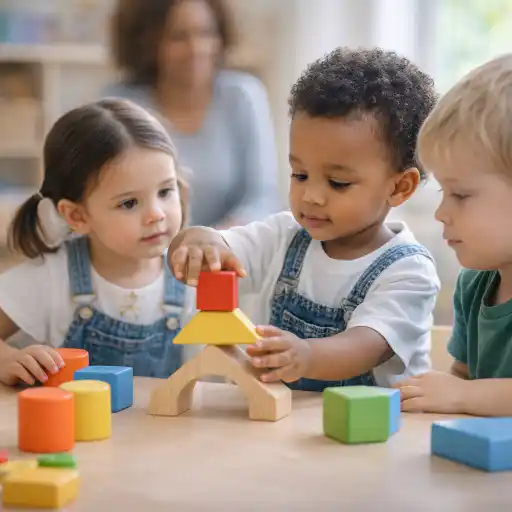
Which adult prompts support thinking without taking over the design?
Observe first. Notice where children look, which pieces they choose, and when they change their plan. Then offer a small amount of language or a question that helps them examine evidence while preserving their ownership of the project. The goal is not to quiz children about a “correct” perspective, but to help them articulate and test their ideas.
- “What can you see in this picture that you cannot see in the other one?”
- “Where do you think that doorway is when we look from this side?”
- “How could we check whether the bridge is long enough?”
- “What might we change if we want the roof to show from this view?”
- “You moved the tall block. What did you notice?”
Use precise but accessible spatial language naturally: “The narrow side is facing us now,” or “That piece is behind the tower.” If children disagree about what a photograph shows, invite them to point to clues and compare interpretations. Their conversation is part of the learning, not a detour from it.
When frustration appears, validate the effort and reduce the task without removing the challenge: “It’s tricky to see what is hidden. Let’s look at the side photograph together.” You might rotate the child’s model, place an image beside the structure, or ask a peer to describe what they notice. Research on open-ended design play supports challenges that invite children to imagine, construct, and revise, rather than activities with only one predetermined answer.
How can the activity be adapted, documented, and extended?
Use observation to adjust the level of support. Some children may benefit from matching one visible feature at a time; others may be ready to coordinate several views and make a plan. Offer photographs with clear contrast, larger materials, visual cues, or a partner role such as photographer, builder, or image describer. Children can demonstrate understanding through speech, pointing, gestures, construction, or drawing. Ensure materials and workspaces are accessible, and offer vocabulary in children’s home languages when possible.
Document the process rather than judging only how closely the finished model resembles the photograph. Capture a starting attempt, a child’s comment, and a revision. A short note might say: “Kai noticed the side view showed a second support and added a block after walking around the structure.” This offers useful evidence of observation, spatial language, persistence, and strategy. The NAEYC article on what children learn from block play also highlights problem-solving, imagination, mathematics, creativity, and collaboration.
Extend the challenge by inviting children to photograph their own creations from two angles and trade images with a classmate. They can also draw a map of the block area, compare a building with a nearby real structure, or invent a story about who lives or travels there. The No Such Thing as Boring Math  Buy Now $24.00 course can complement this work with ideas for connecting intentional play and early mathematical thinking.
Summary: What changes when children rebuild from another angle?
When children see another view, they must look beyond the obvious, coordinate information, and imagine how parts relate in space. Rebuilding from photographs gives them concrete practice with geometry, position, comparison, language, planning, and revision—all within a playful activity that allows many valid solutions.
- Offer two or more photographs of the same structure from meaningfully different viewpoints.
- Provide open-ended materials, sufficient time, and room to inspect the model from multiple sides.
- Use curious prompts and spatial vocabulary while leaving design decisions with children.
- Notice process, explanations, and revisions—not just resemblance to the picture.
- Adapt images, materials, communication supports, and task complexity to include each learner.
The practical answer to the article’s question is that another angle changes the work from straightforward copying into interpretation and inquiry. A photograph challenge can make children’s thinking visible while giving providers a supportive way to nurture spatial learning through everyday construction play. State requirements vary - check your state licensing agency when aligning activities or professional learning with local expectations.
Explore related ChildCareEd courses
- Early Mathematics Through Play Buy Now $24.00 — connect geometry, measurement, and reasoning with play and daily routines.
- No Such Thing as Boring Math Buy Now $24.00 — explore intentional play and developmentally appropriate math experiences.
- Math Foundations in Early Childhood Buy Now $16.00 — strengthen classroom strategies for hands-on math learning.
- Enhancing STEM Education for Infants and Toddlers Buy Now $16.00 — consider developmentally appropriate STEM exploration with younger learners.
- The Best Promotion is Play Buy Now $35.00 — deepen understanding of how play supports learning and development.
- 45 Hour Child Growth and Development
- Early Mathematics Through Play
- CDA Home Visitor Subject Area 3 Part 3 Birth to 5
- From Tantrums to Triumphs: Equipping Preschoolers with Self-Regulation Skills
- 45 Hour School Age Methods and Materials
- CDA Bridge Bundle: Family Child Care without Portfolio Review
- Art from the Heart for Preschoolers: Open Ended Art Projects that Build Self-Esteem
- CDA Bridge Bundle: Infant/Toddler without Portfolio Review
- CDA Bridge Bundle: Preschool without Portfolio Review
- 🥦✨ ¿Cómo apoyar a los niños selectivos a probar nuevos alimentos sin presión?
- 🩺 Cumplimiento de Salud e Inmunización en Cuidado Infantil de Nevada ✔️
- 🚌 ¿Qué Significan las Regulaciones de Transporte de Illinois para las Excursiones Infantiles? 🚦
- Cómo Abrir Una Quardería En Casa Sin Dinero?
- Curso de Comunicación de 9 Horas de Maryland
- Apoyo en Español para Capacitaciones Grupales Presenciales y por Zoom en Cursos Selectos
- ¿Cuáles son las mejores actividades del Día de la Tierra para niños en casa o en el aula?
- 10 Ejemplos de Cómo la Cultura Influye en el Desarrollo Infantil
- Normas de Licenciamiento de Cuidado Infantil en Virginia para Centros Diurnos Infantiles y Hogares Diurnos Familiares
- Requisitos de Cuidado Infantil en Nueva Jersey para Centros y Proveedores de Cuidado Infantil Familiar
- Lista para Abrir una Guardería en Casa en Virginia: Cómo Empezar
- Cómo Trabajar en el Cuidado Infantil en Carolina del Norte: Requisitos y Pasos
- Cómo Trabajar en el Cuidado Infantil en California: Requisitos y Pasos
- Capacitación Previa al Servicio para Proveedores de Cuidado Infantil en Nevada
- Capacitación Previa al Servicio para Proveedores de Cuidado Infantil en Texas
- Celebrando la amistad en el cuidado infantil durante el Día de los Mejores Amigos
- How can we encourage scientific thinking through hands-on exploration?
- How Can Child Care Providers Move Beyond Shape Names to Attributes and Comparisons?
- How Does Building from Another Photograph Angle Change Children’s Thinking?
