What if a few colorful cards could turn skill practice into an eagerly anticipated game? Purposeful bingo supports language, visual discrimination, early mathematics, attention, and social learning while keeping preschoolers active participants; Lesson Planning for Preschoolers  Buy Now $24.00 can help you connect playful activities to developmentally appropriate goals and strengthen your classroom planning.
Bingo works especially well in early childhood settings because it is flexible. Children can point, name, match, move, listen, and explain, while educators can adjust the pace, images, and expectations. The goal is not simply to finish first. The goal is to create repeated, joyful opportunities to notice and use new concepts.
Why does bingo matter in a preschool classroom?
Young children often need repeated encounters with a concept before they can recognize and use it consistently. A bingo game provides that repetition without making learning feel like a drill. Each card becomes an invitation to compare features, listen carefully, communicate with peers, and make a decision.
For example, a child may first identify a red object, then later distinguish a red triangle from a blue triangle. An animal game may move from naming “dog” to describing where a dog lives or how it moves. These small shifts show how play can support increasingly complex thinking.
Use bingo as one experience within a broader curriculum, not as a high-pressure test. Let children talk, make predictions, and sometimes help lead the game. This approach respects different developmental rates and creates a welcoming space for #preschoolers.
How can you prepare meaningful bingo materials?
Begin with a clear learning focus. A color bingo board might include four to six familiar colors; a shape board could feature circles, squares, triangles, and rectangles; an animal board might use recognizable photographs or illustrations. Keep visual elements large, uncluttered, and easy to distinguish.
- Choose durable cards with rounded edges and non-toxic materials.
- Use consistent images and labels, while avoiding reliance on color alone.
- Prepare markers such as large buttons, foam pieces, or laminated counters.
- Offer picture-based and object-based versions for varied learners.
- Invite children to help sort, count, and distribute the materials.
Representation matters. Include animals from different habitats and images that reflect children’s families and communities. For children with visual, motor, language, or attention differences, enlarge images, provide tactile symbols, use a slanted board, or allow pointing, eye gaze, or verbal responses. An inclusive game preserves the learning goal while varying the way children participate.
Prefer ready-made boards to making your own? Building durable, well-designed bingo cards from scratch takes time most educators don't have. Print-and-play bingo sets give you clear, uncluttered images sized for little hands — print once, laminate, and reuse all year. For the color and shape work described below, a set like Shapes Bingo supports visual discrimination and early geometry, while themed animal sets such as Farm Animals Buy Now $1.99Bingo Buy Now $1.99 and Ocean Animals Buy Now $1.99Bingo Buy Now $1.99 bring the habitat, sound, and classification games to life. A Fruits Bingo Buy Now $1.99 set adds vocabulary and healthy-food conversations. Each pairs naturally with the follow-up hunts, sorts, and constructions this article recommends.
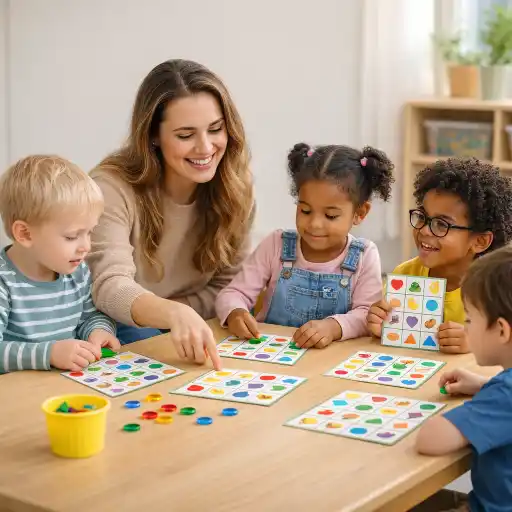
Which color bingo games build deeper learning?
Color bingo is most effective when children do more than match identical patches of color. Start by naming colors during ordinary routines: “You chose the blue cup,” or “The yellow block is beside the green one.” Repeated language in meaningful contexts supports recognition and vocabulary, as reflected in practical color-learning activities from Mulberry Learning and Stay At Home Educator.
For “Color Call,” hold up a color card or object. Children cover that color on their boards and explain their choice. For “Color Hunt Bingo,” call a color and invite children to find a matching classroom object before covering the square. For “Mix and Predict,” include a few color combinations and ask what might happen when colors are combined through paint, play dough, or translucent tiles.
- Ask, “What makes these two objects the same color?”
- Invite children to find shades that are lighter or darker.
- Use movement: hop to something red, touch something blue, or carry a yellow object.
- Accept descriptive language such as “sky blue” or “dark green.”
Remember that color names can be culturally and linguistically diverse. Offer home-language support and avoid treating one label as the only valid response.
How can shape bingo support mathematical thinking?
Shape bingo can strengthen visual discrimination, spatial vocabulary, classification, and early geometry. Use real objects alongside two-dimensional cards so children discover that a circle may appear as a plate, wheel, or clock face. A square block and a square card look different in size and material but share defining attributes.
In “Shape Detective Bingo,” call a shape and ask children to trace its outline in the air before covering it. In “Feature Bingo,” describe the shape without naming it: “Find the shape with three straight sides.” In “Build It,” children use craft sticks, magnetic tiles, or dough to construct a called shape. These variations turn recognition into reasoning.
- Use positional words: above, below, beside, inside, and between.
- Ask children to rotate cards and decide whether the shape remains the same.
- Compare attributes: straight or curved sides, corners, and size.
- Invite children to find shapes in the classroom or outdoors.
Do not correct too quickly. Ask, “What do you notice?” or “How could we check?” Such prompts encourage children to explain their thinking and learn from one another. Shape exploration can also connect naturally to art, block play, construction, and emergent writing.
What makes animal bingo engaging and educational?
Animal bingo naturally combines #vocabulary, listening, science, movement, and imaginative play. Instead of simply calling an animal’s name, provide clues: “I have feathers, I can fly, and I build nests.” Children can identify the animal, imitate its movement, or describe its habitat before covering the picture.
Try “Sound Bingo” with recorded or teacher-created sounds, “Habitat Bingo” with forest, ocean, farm, and desert settings, or “Baby Animal Bingo” that pairs young animals with adults. After a round, invite children to group animals by characteristics such as number of legs, covering, diet, or movement. These conversations introduce classification while honoring children’s curiosity.
Use accurate, respectful information and avoid presenting stereotypes as facts. Not every bird flies, and not every animal lives in only one environment. When a child offers an unexpected idea, investigate together rather than dismissing it.
- Pair animal images with simple signs or gestures.
- Include animals familiar to families and animals from around the world.
- Use books, natural objects, and dramatic play as follow-up experiences.
- Ask open questions: “How might this animal stay safe?”
Animal bingo can also support empathy. Discuss gentle treatment, habitats, and responsible care without turning the game into a frightening lesson.
How can educators adapt bingo for participation and assessment?
A strong facilitator balances structure with flexibility. Explain the rules briefly, model one turn, and provide visual reminders. Some children may prefer individual boards; others may enjoy a shared class board. You can play cooperatively by challenging the group to complete one large board together rather than competing for a winner.
Adjust complexity by changing the number of squares, using fewer choices, adding descriptive clues, or asking children to produce a category rather than recognize one. For dual language learners, pair pictures with home-language words, gestures, and peer models. For children who need additional support, provide extra processing time and alternative response methods.
Observation during play is more useful than requiring a formal worksheet. Note whether a child:
- recognizes and names the target concept;
- matches an object or image accurately;
- uses comparative or descriptive language;
- waits, takes turns, and responds to peers;
- explains a classification or strategy.
Use these observations to plan the next experience. A child who recognizes colors but confuses shapes may need more hands-on shape exploration. A child who knows animal names but rarely speaks may benefit from gestures, partner play, or picture choices. For deeper professional practice, Preschool Assessments & Observations Buy Now $24.00 explores objective observation and individualized learning. State requirements vary - check your state licensing agency.
Summary: What makes bingo a powerful preschool learning game?
Fun bingo games teach colors, shapes, and animals most effectively when they are purposeful, conversational, inclusive, and connected to children’s real experiences. Use clear materials, repeat important language, add movement and investigation, and adjust participation so every child can contribute.
The strongest games do not end when someone calls “Bingo.” Follow the game with a color hunt, shape construction, animal story, drawing, sorting activity, or classroom conversation. Observe what children understand and use those insights to plan the next challenge. With thoughtful facilitation, bingo becomes more than a pastime: it becomes a joyful tool for #learning, communication, classification, and belonging.
- 45 Hour Child Growth and Development
- Many Colors, One Canvas: MD ECE Conference
- 45 Hour Preschool Methods and Materials
- Power of Art: Bldg Self-Esteem & Positive Behavior for ALL Abilities
- From Tantrums to Triumphs: Equipping Preschoolers with Self-Regulation Skills
- CDA Bridge Bundle: Family Child Care without Portfolio Review
- CDA Bridge Bundle: Preschool without Portfolio Review
- Texas Director Credential
- ¿Cómo hacer actividades navideñas inclusivas para todas las familias?
- Actividades de Motricidad Gruesa que Desarrollan el Equilibrio, la Coordinación y la Fuerza
- Proporciones de Cuidado Infantil y Tamaños de Grupo por Edad en Nueva Jersey (Guía Rápida para Centros y Hogares)
- Proporciones de Cuidado Infantil y Tamaños de Grupo por Edad en Virginia (Guía Rápida para Centros y Hogares)
- Actividades de Otoño Fáciles para Preescolares esta Temporada
- Cómo Trabajar en el Cuidado Infantil en Carolina del Norte: Requisitos y Pasos
- Cómo Trabajar en el Cuidado Infantil en California: Requisitos y Pasos
- Cómo Ser Maestra de Preescolar en Maryland
- Cómo Ser Maestra de Preescolar en Virginia
- Gross Motor Games for Preschool and Kindergarten
- How can I teach colors, shapes & numbers through play in Michigan classrooms?
- Celebrando la amistad en el cuidado infantil durante el Día de los Mejores Amigos
- Canciones, juegos y preguntas de círculo para niños
- What No-Prep Activities Can Busy Early Childhood Teachers Use Tomorrow?
- How Can Fun Bingo Games Teach Colors, Shapes, and Animals to Preschoolers?
- How Can Bingo Games Support Turn-Taking and Social Skills?
- Why Is Wild vs. Farm Animal Sorting a Favorite Preschool Activity?
- How Can Color Bingo Reinforce Vocabulary and Visual Discrimination?
- How Can Bingo Games Make Learning Feel Like Play?
- What Skills Can Preschoolers Build Through Bingo?
