When preschoolers play shape bingo, are they only matching pictures—or learning to notice, compare, and explain? With a few intentional prompts, bingo can turn familiar shape names into meaningful early geometry and conversation. Explore The Best Promotion is Play  Buy Now $24.00 to deepen your strategies for using play to foster problem-solving, cooperation, and development; then use the ideas below to bring that approach to your next game.
Why move beyond naming shapes?
Recognizing and naming a circle or triangle is a useful starting point, but mathematical reasoning grows when children examine what makes a shape recognizable. They can notice sides and corners, compare forms, test whether a shape changes when turned, and explain how they decided on a match. This shift—from recalling a label to describing evidence—builds richer geometry and language.
A bingo game offers a comfortable structure for this work. Children listen to a clue, scan a board, make a choice, and often hear how peers reached a different answer. Those repeated turns create opportunities for visual discrimination, attention, vocabulary, and shared thinking. NAEYC’s guidance on discovering shapes and space in preschool emphasizes giving children varied experiences with shapes in different sizes and orientations, as well as opportunities to compare, create, and describe them.
Keep the purpose low-pressure: the goal is not to identify the fastest winner, but to invite curiosity. If a child chooses a different card, that response can open a useful question: “What do you notice about this one?” Such exchanges treat children’s ideas as starting points for investigation and make #reasoning part of ordinary play.
How can you prepare bingo materials for mathematical thinking?
Start with a clear, manageable goal. For example, focus on identifying circles, squares, triangles, and rectangles by their attributes rather than trying to cover every shape in one sitting. Use uncluttered boards and make sure the images are large enough for children to distinguish. Before playing, offer real objects, blocks, or cutouts so children can see and touch the ideas represented on the cards.
The Bingo Cards - Shapes Edition Buy Now $1.99 provides a printable, hands-on option: children can color and cut out picture cards, paste them onto a bingo grid, and then play as the educator calls each name. That preparation can itself support fine-motor practice, vocabulary, and ownership. Adapt the process if cutting or pasting is a barrier; prepared cards, larger pieces, or a partner role can preserve the learning goal.
- Offer counters that are easy for small hands to grasp and move.
- Pair pictures with tactile shapes or classroom objects when possible.
- Use words for attributes—straight, curved, side, corner, longer, shorter—along with shape names.
- Include home-language labels or invite children to share another familiar word for a shape.
Materials do not need to be elaborate. Clear visuals and accessible ways to respond matter more than a perfect set. The aim is to help children attend to geometry, not to the mechanics of managing a board.
What prompts turn a shape call into reasoning?
Instead of calling only “triangle,” describe an attribute: “Find the shape with three straight sides.” Pause, give children time to scan, and invite them to explain their choice. Prompts should encourage children to observe rather than guess what the adult wants. NAEYC’s article on how teachers’ questioning affects math concepts during play highlights the value of listening to children and using thoughtful questions to make their ideas visible.
- Notice: “What do you see on this shape?”
- Compare: “How are these two shapes alike? How are they different?”
- Justify: “What helped you decide that this is a rectangle?”
- Test: “If we turn the card, is it still the same shape? How can we check?”
- Extend: “Where might we find a shape like this in our room?”
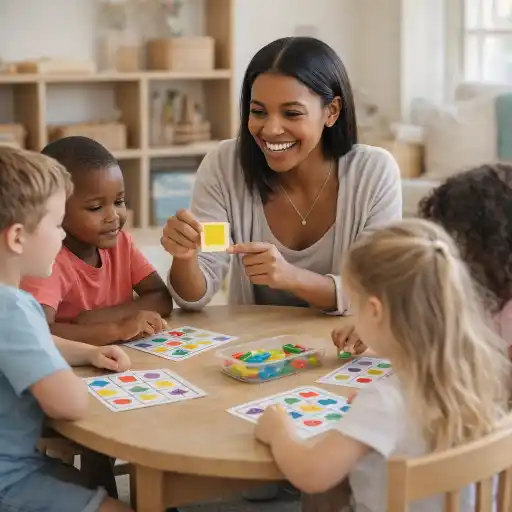
Questions do not have to make every turn longer. One carefully chosen prompt can deepen a round, while other turns can remain quick. Accept pointing, gestures, home-language responses, or demonstrations as valid ways to show thinking. The focus is the child’s process: noticing a feature, comparing possibilities, and communicating an idea.
How can you adapt bingo to include every learner?
Preschoolers bring different language, sensory, motor, attention, and prior-learning strengths to a group game. Inclusion does not mean lowering the learning goal; it means offering more than one route to participate. A child might point to a card, use a gesture, choose between two options, direct a partner, or name a shape aloud. Allow processing time and repeat a clue calmly when needed.
Adjust the challenge to match children’s experience. Beginners may use a smaller board with two or three familiar shapes. Children ready for more can respond to descriptive clues, compare squares and rectangles, or become the caller. A cooperative class board can also reduce pressure: invite the group to complete one row together and celebrate shared observations rather than speed.
- Use large, high-contrast images and avoid relying on color alone.
- Offer a quiet space or smaller group if noise makes listening difficult.
- Pair spoken instructions with pictures, gestures, or a quick demonstration.
- For children who find fine-motor tasks challenging, allow pointing or use larger markers.
Follow children’s interests and keep their play agency intact. A child who starts comparing a card with a block may be making a valuable connection; make room for the observation instead of rushing to the next call. Play-based geometry and spatial sense develop through varied opportunities to explore shapes, positions, and directions. A responsive game can offer one such opportunity for every child.
How can you observe learning and extend the game?
Bingo gives educators a natural chance to notice children’s strategies without turning play into a test. Look beyond whether a child covers the “right” square. Does the child listen to the clue, scan the board, compare options, identify an attribute, or revise a choice after discussion? A brief, objective note can help guide the next experience: “Matched triangle by counting three sides with a prompt,” for example.
Use those observations to plan a manageable next step. If children confidently name shapes but do not yet describe attributes, bring in blocks and ask what they notice. If a child recognizes a shape on a card but not in the room, take a short shape hunt together. The NRICH early-years shape and space activities offer related invitations, including tactile shape exploration, building, and positional-language play.
- After bingo, invite children to build the called shape with craft sticks or blocks.
- Look for classroom objects that share a shape, then compare size or orientation.
- Ask children to draw or construct a new picture using shapes from the game.
- Record an observation and use it to choose a question or material for another day.
Avoid making speed, silence, or a single verbal answer the measure of learning. Notice persistence, peer explanations, and attempts to check an idea. If you are documenting activities or professional development, state requirements vary - check your state licensing agency.
Conclusion: What does reasoning-rich shape bingo look like?
Shape bingo builds reasoning beyond naming when children have repeated chances to notice attributes, compare shapes, test ideas, and communicate how they know. A clear learning focus, accessible materials, open-ended questions, and inclusive response options help providers turn a familiar game into a warm, purposeful math experience.
Keep the game brief and flexible, and let children’s thinking guide what comes next. Pair a shape card with a block, a classroom object, or a new construction challenge; observe strategies instead of ranking performance. The central question—how can preschool bingo build reasoning beyond naming shapes?—has a practical answer: make each call an invitation to look closely, explain, and explore together.
For a broader professional-learning experience on play’s role in children’s development, consider The Best Promotion is Play Buy Now $24.00. The printable Bingo Cards - Shapes Edition Buy Now $1.99 can provide an easy starting point for your next playful geometry conversation.
- 45 Hour Child Growth and Development
- Lesson Planning for Preschoolers
- Roots & Resilience: Understanding What Shapes a Child
- Tracking Progress, Shaping Futures: Observation & Assessment Skills
- Birth to Five CDA Credential with Portfolio Review
- Art from the Heart for Preschoolers: Open Ended Art Projects that Build Self-Esteem
- Texas Director Credential
- 45 hour Growth and Development Birth-age 12 ONLINE
- Families, Communities, and Classrooms: Working Together for Children
- ❤️ ¿Cómo ayudan los educadores a las familias a acceder a los servicios que necesitan?
- 👶 ¿Cuáles son las proporciones y grupos requeridos en Dakota del Norte? 🏫
- Celebra El Cumpleaños de Dr. Seuss En Tu Guardería Con Actividades Fáciles y Divertidas!
- Curso de Comunicación de 9 Horas de Maryland
- 10 Ejemplos de Cómo la Cultura Influye en el Desarrollo Infantil
- Proporciones de Cuidado Infantil y Tamaños de Grupo por Edad en Nueva Jersey (Guía Rápida para Centros y Hogares)
- Proporciones de Cuidado Infantil y Tamaños de Grupo por Edad en Virginia (Guía Rápida para Centros y Hogares)
- Cómo Trabajar en el Cuidado Infantil en Carolina del Norte: Requisitos y Pasos
- Cómo Ser Maestra de Preescolar en Illinois
- Cómo Ser Maestra de Preescolar en Wisconsin
- Cómo Ser Maestra de Preescolar en Maryland
- Celebrando la amistad en el cuidado infantil durante el Día de los Mejores Amigos
- Canciones, juegos y preguntas de círculo para niños
- Cómo simplificar la capacitación para sus empleados de daycare
- How Can Fun Bingo Games Teach Colors, Shapes, and Animals to Preschoolers?
- Why Is Animal Bingo a Great Way to Introduce Habitats and Classification?
- How Can Bingo Games Make Learning Feel Like Play?
- How Can Animal-Themed Bingo Build Descriptive Language in Preschoolers?
- How Can Listening and Movement Games Build Children’s Shape Recognition?
- How Can Preschool Bingo Build Reasoning Beyond Naming Shapes?
