When a preschooler notices that stripes repeat or predicts which shape belongs next, a cozy sweater design can become a small but meaningful math investigation. The Early Mathematics Through Play Buy Now $24.00 course offers providers broader strategies for teaching patterns, geometry, and reasoning through hands-on activities and classroom routines. Read on for practical ways to turn familiar clothing designs into accessible learning—and explore the course for a more complete foundation in play-based early math.
Why do clothing patterns make a meaningful starting point for early math?
Patterns are easier to notice when they are made from familiar, concrete details. Preschoolers see stripes on shirts, repeating shapes on socks, and color sequences on sweaters; these designs invite children to compare, describe, and anticipate. As the National Association for the Education of Young Children explains in its discussion of sorting activities for preschoolers, sorting encourages children to observe similarities and differences—important foundations for mathematical thinking.
A sweater activity can bring sorting and patterning together without requiring children to begin with abstract symbols. First, children might group sweater pieces by color or shape. Then they can arrange the pieces in a repeating sequence, such as leaf-acorn-leaf-acorn. In making those choices, they practice noticing attributes, identifying a rule, and using evidence to decide what comes next.
This is valuable preparation for kindergarten, but it is not a race toward formal worksheets. Pattern play gives children a low-pressure way to develop #reasoning, language, attention, and confidence. Providers can build on children’s everyday knowledge while respecting different developmental paces and ways of communicating.
What mathematical ideas can children explore with sweater designs?
Familiar clothing motifs give educators a convenient collection of attributes to compare: colors, shapes, lines, sizes, and pictures. Start by inviting children to observe a few sweater cards or paper shapes. Ask what looks alike and what looks different. Children may sort by color, such as red and gold, or by shape, such as circles and triangles. The National Association for the Education of Young Children notes that children can sort objects in different ways and explain their choices; one attribute at a time is a useful starting point.
Once children have explored the pieces, introduce repeating patterns. An AB pattern might be leaf-acorn-leaf-acorn; an AAB pattern could be stripe-stripe-circle, repeated. Children can copy a model, continue a sequence, identify a missing piece, or design their own sweater. These steps—copy, extend, and create—make their developing understanding visible.
Pattern work also connects naturally to other areas:
- Geometry: Identify and compare circles, squares, triangles, and other shapes.
- Fine-motor practice: Place, draw, color, cut, or glue sweater decorations, with safe tools and adult supervision.
- Language: Use words such as repeat, next, same, different, stripe, and shape.
- Creative choice: Invite children to invent a design and explain its rule in their own way.
The goal is not a perfectly decorated sweater; it is the thinking children do as they notice and organize visual information.
How can providers set up a playful sweater-pattern activity?
A simple setup is enough. Use paper sweater outlines and large, easy-to-handle decorations such as printed leaves, circles, squares, triangles, and wide paper strips. You can also use the ChildCareEd Cozy Autumn Sweater Patterns activity pack Buy Now $2.00, which includes tiered pattern challenges, shape sorting, sweater-design pages, and an observation checklist. Check pieces for size and suitability, supervise scissors and glue, and avoid small parts for children who may mouth materials.
Begin with a short invitation rather than a long demonstration. Place two or three types of pieces on a tray and model one simple sequence, such as circle-square-circle-square. Say the sequence aloud, then pause before the final space: “Circle, square, circle—what might come next?” Give children time to look, touch, point, or respond verbally.
For a practical progression, offer several ways into the same activity:
- Explore: Sort decorations by one visible attribute, such as shape or color.
- Copy: Reproduce a short pattern that an adult or peer has made.
- Continue: Add pieces to an unfinished sequence and describe what repeats.
- Create: Design a sweater pattern and invite a partner to identify its repeating part.
Keep the activity flexible. A child may make a meaningful arrangement that differs from the planned example. Ask what the child intended before assuming it is an error.
What questions help children explain and extend their thinking?
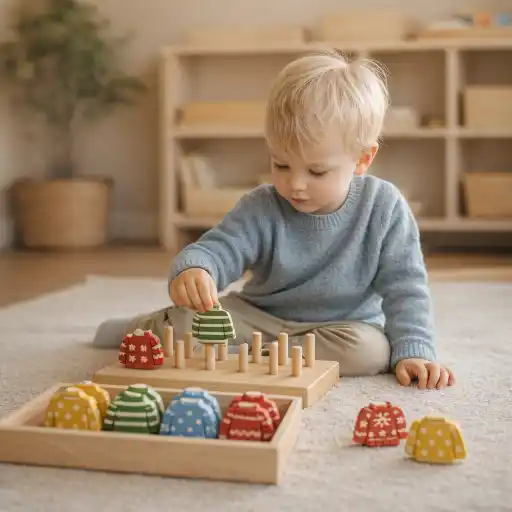
Well-timed questions help children move from simply placing pieces to noticing the relationship between them. Begin with observation: “What do you notice about these decorations?” Then invite children to describe the order: “Which part happens again?” or “What comes next? What helped you decide?” Open prompts communicate that the educator is interested in children’s thinking, not only in a correct answer.
Offer a brief model or a choice if a child is unsure. You might point to the first two pieces and say, “Leaf, acorn; leaf, acorn. What do you see?” Then pause and let the child respond through speech, gesture, movement, or placement. Pattern learning can include many forms of participation; spoken explanations are only one way to show understanding.
Try questions that deepen the investigation:
- “Can you make the same pattern with different shapes?”
- “What would happen if we changed the color but kept the order?”
- “Can you show me the part that repeats?”
- “Would you like to make a pattern for me to follow?”
These exchanges also support vocabulary and peer conversation. Model words such as #sort, repeat, match, next, and different in context, and welcome children’s home languages and communication supports. The ECE Resource Hub’s guidance on patterning similarly emphasizes helping children label characteristics, recognize patterns, and extend them. Keep prompts curious and conversational rather than turning the center into a quiz.
How can educators adapt the activity and observe progress?
Children may be at different points in their pattern learning, even when they are the same age. One child may enjoy matching identical shapes; another may copy an AB sequence; a peer may invent a longer pattern and explain its repeating unit. Offer varied levels of challenge without treating one attempt as a fixed measure of ability. A shorter sequence, fewer choices, larger pieces, picture cues, or adult modeling may make participation more accessible.
Support different sensory, motor, language, and communication needs. Children can place pieces, point to a choice, direct an adult where to put a piece, draw a sequence, or use communication tools. For children who are ready for additional challenge, change one attribute at a time—perhaps use both shape and color—or ask them to create a pattern for a partner to continue.
Observe during play rather than interrupting it for a formal test. Make a brief note about the child’s action and the support provided:
- “Copied circle-square sequence after hearing it named aloud.”
- “Sorted shapes by color, then changed the rule to sort by shape.”
- “Created a repeating design and invited a peer to continue it.”
Use the observation to choose a small next step. State requirements vary - check your state licensing agency when aligning documentation or training with local expectations. A useful record describes what the child did, not a broad judgment about what the child can or cannot do.
What common pitfalls can staff avoid?
Seasonal crafts are engaging, but the finished product can sometimes take priority over the mathematical process. If adults focus mainly on making every sweater look alike, children have fewer opportunities to test ideas, make choices, and explain their reasoning. Keep the learning intention clear: children are exploring classification and repeated relationships, and the artwork is one possible way to represent that thinking.
Other common pitfalls are easy to prevent with a few intentional choices:
- Starting with a complex sequence: Begin with a visible, short pattern and add complexity when children are ready.
- Giving too many directions at once: Offer one step, then let children act and respond.
- Correcting before listening: Ask children to explain their design; their rule may differ from the adult’s example.
- Relying on worksheets alone: Pair paper activities with handling, sorting, conversation, and choice.
- Expecting verbal answers only: Accept pointing, arranging, drawing, and other communication modes.
- Overlooking safety: Select age-appropriate materials, supervise tools, and keep small loose parts away from children who mouth objects.
For directors, a helpful support is to make safe, varied pattern materials available and give staff time to share brief observations. A small collection of templates, large decorations, and simple question prompts can help educators offer consistent, playful math experiences across the week.
Conclusion: How can sweater patterns support kindergarten readiness?
How can familiar clothing designs help preschoolers recognize patterns before kindergarten? They give children an approachable way to sort by attributes, notice repetition, predict what comes next, and create designs that express their own ideas. With sweater shapes and seasonal motifs, educators can connect abstract mathematical relationships to something children can see, handle, and talk about.
Start small: offer a few safe pieces, model one short pattern, and invite children to copy, continue, or invent. Ask open questions, accept multiple ways of communicating, and use observations to plan the next challenge. The strongest learning comes from the process—children comparing, explaining, revising, and delighting in what they discover. For broader professional learning about integrating patterns and other math concepts through daily play, explore ChildCareEd’s Early Mathematics Through Play Buy Now $24.00 course.
Further ChildCareEd courses:

- 45 Hour Child Growth and Development
- Early Mathematics Through Play
- Lesson Planning for Preschoolers
- CDA Preschool Credential with Portfolio Review
- CDA Preschool Renewal
- No Such Thing as Boring Math
- Texas Director Credential
- 45 hour Growth and Development Birth-age 12 ONLINE
- Every Moment Matters: Schedules and Transitions
- CDA Certification en Español: Recursos y Consejos para Educadores Bilingües
- 🎉STEM-sational Fun: How Can You Spark Preschoolers’ Curiosity with Engaging STEM Activities? 🔬🧪🔢
- 👶 ¿Cuáles son las proporciones y grupos requeridos en Dakota del Norte? 🏫
- Apoyo en Español para Capacitaciones Grupales Presenciales y por Zoom en Cursos Selectos
- Proporciones de Cuidado Infantil y Tamaños de Grupo por Edad en Maryland (Guía Rápida para Centros y Hogares)
- Cómo Celebrar el Día Nacional del Kindergarten
- Cómo Trabajar en el Cuidado Infantil en Carolina del Norte: Requisitos y Pasos
- Cómo Ser Maestra de Preescolar en Illinois
- Celebrando la amistad en el cuidado infantil durante el Día de los Mejores Amigos
- Cómo simplificar la capacitación para sus empleados de daycare
- How Can I Help Children Understand Shapes and Patterns?
- STEM for Preschoolers: Fun Activities That Encourage Curiosity
- Count It, Sort It, Find It! Fall Math Games for Preschoolers
- How Can Child Care Programs Build Meaningful School Readiness?
- What Are the Best Print-and-Play Activities for Substitute Teachers?
- How Can Child Care Providers Teach Children to Choose Clothing for Weather and Activities?
- ¿Cómo puede la retroalimentación visual apoyar la fluidez en la multiplicación?
- How Can Simple Fall Activities Support Kindergarten Readiness Through Play?
- How Can November Classroom Activities Help Preschoolers Build School Readiness Skills?
- How Can Sweater Patterns Help Preschoolers Build Early Math Reasoning Before Kindergarten?
