When children can name a triangle but only recognize it when it points upward, they are ready for a deeper kind of geometry. The No Such Thing as Boring Math  Buy Now $24.00 course helps providers connect intentional play with young children’s mathematical thinking, offering ideas to strengthen classroom practice. Explore the course for a fuller professional learning experience, then use the strategies below to help children describe, compare, and reason about shapes.
Why does learning shape attributes matter more than memorizing names?
Shape names give children useful labels, but labels alone do not show whether a child understands what makes a shape a shape. Attribute knowledge means noticing features such as the number of straight sides, corners, equal-length sides, and curved edges. A child who recognizes a triangle in different sizes and orientations because it has three straight sides is building a more flexible concept than a child who matches only one familiar triangle picture.
This shift matters because geometry is a way of organizing and interpreting the world. Children compare objects, notice patterns, sort materials, build structures, and explain how parts fit together. These experiences also encourage precise language and reasoning: “These both have four corners, but one has sides that are all the same length.” NAEYC’s guidance on discovering shapes and space in preschool emphasizes opportunities to recognize, compare, create, and compose shapes through meaningful classroom experiences.
Providers do not need to abandon shape names. Instead, names become the starting point for inquiry. A visual Shapes Chart can serve as a handy reference, but children benefit most when they use it alongside real objects, hands-on materials, and conversation.
Which attributes should children notice and describe?
Choose attributes that children can see, touch, count, and compare. Start with familiar two-dimensional figures, then introduce additional examples as children show interest and readiness. Keep the language accurate but accessible; it is fine to introduce words like “side” and “corner” while also using child-friendly explanations.
- Sides: Are they straight or curved? How many straight sides can you count?
- Corners: How many corners does the shape have? Do the corners look square or pointed?
- Length: Are some sides longer, shorter, or the same length?
- Angle and relationship: Do any corners look like a square corner? Are any sides parallel?
- Orientation and size: Does the shape remain the same when it is turned, flipped, made larger, or made smaller?
Introduce one or two features at a time rather than presenting a long vocabulary list. Model noticing aloud: “I see three straight sides. I can turn the triangle, and it still has three sides.” Invite children to trace each side with a finger or place a counter at each corner as they count. A circle offers a useful contrast: it has a continuous curved boundary and no corners.
Keep examples varied. Triangles can be narrow, wide, tilted, or have sides of different lengths and still be triangles. Avoid relying only on color, size, or position as clues; those features can distract from defining attributes.
How can educators move from identification to comparison?
Comparison asks children to attend to more than one figure and explain how the figures are alike or different. Offer two or three shapes at a time and invite children to sort them using a chosen rule. Once children understand the rule, change it: a set sorted by shape can be re-sorted by number of sides, side length, or whether the figure has curved lines.
Use open questions that make thinking visible without turning the activity into a quiz:
- “What do you notice about these two shapes?”
- “How are they alike? What is different?”
- “Which shapes have four corners? Do they all look the same?”
- “Can you find another shape that fits this rule?”
- “How do you know this is a triangle even though it is turned?”
Hands-on comparison keeps the thinking concrete. Children can match shapes to classroom objects, build outlines with craft sticks or playdough, or use pattern blocks to make and take apart designs. A window and a book may both look rectangular, though they differ in size and material. Encourage children to explain the feature they used rather than simply announcing a match.
Try a “Which one doesn’t belong?” prompt with three or four figures. There may be several defensible answers, depending on the attribute children choose. The goal is not to guess the adult’s intended answer; it is to support children in stating a rule and using evidence.
What playful activities help children reason about attributes?
Movement, construction, art, and classroom hunts make attributes memorable because children act on their observations. Adapt the number of shapes and complexity of the rule to the group, and let children watch, discuss, or point before they are expected to move or explain independently.
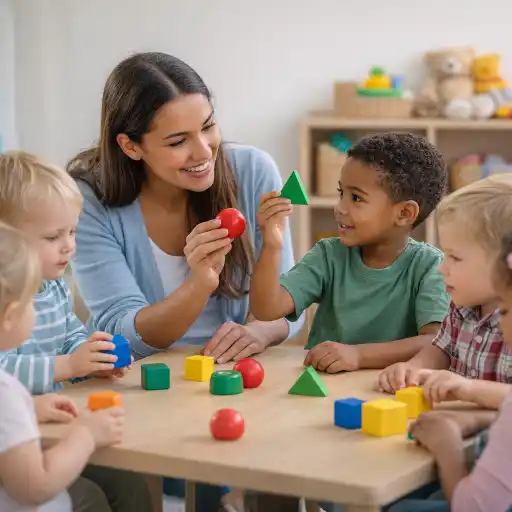
- Shape sorting: Provide varied cutouts or blocks. Sort first by shape name, then by a property such as number of sides or equal sides. Ask children to describe the sorting rule.
- Shape hunt: Look for rectangles, circles, and triangles in the room or outdoors. Compare examples by size, orientation, and use.
- Build and trace: Use craft sticks, blocks, or playdough to create outlines. Count sides and corners as the shape takes form.
- Shape collage: Combine paper shapes to make a picture. Invite children to identify which pieces they used and how the pieces fit together.
- “Don’t Burn Your Feet”: Place large shapes on the floor and say a rule, such as “Step on every shape with four corners.” Children identify the matches and explain their choices.
- 🟦 Turn-and-check: Rotate a shape card and ask, “Is it still the same shape? What stayed the same?”
For the movement game, begin with familiar shapes and one clear attribute. Children who need more processing time can point first; children ready for a challenge can follow an “and” rule, such as finding shapes with more than three sides and at least one right angle. Stanford’s DREME activity Shape Properties and Attributes offers a structured version with ways to adjust the challenge.
How can teachers scaffold learning and notice progress?
Scaffolding is a responsive sequence: observe what children already do, model a useful strategy, offer a manageable next challenge, and give time to try. A child who is still learning familiar names might match identical shapes or point to a named figure. A child who names shapes reliably may be ready to describe sides and corners. Another child may be ready to sort by two attributes or explain why a turned figure still belongs in a group.
Observe during play rather than relying only on a worksheet. Record the child’s words, gestures, strategy, and level of support. A useful note might say, “Lina counted three sides by tracing them, then found a triangle turned on its side.” This is more informative than a general note that she “knows shapes,” and it suggests a next step: compare triangles with different side lengths.
Use responsive supports so every child can participate. Offer larger or tactile pieces, reduce the number of choices, pair a spoken prompt with a picture, or allow a response by pointing, building, signing, or using a home language. Keep materials safe and age-appropriate, particularly when small loose parts are present.
Avoid three common pitfalls: teaching only prototypical examples, introducing too many new terms at once, and correcting children before hearing their reasoning. Instead, rotate examples, focus on a small set of words, and prompt children to check by tracing or counting. State requirements vary - check your state licensing agency when aligning documentation or training with local expectations.
How can programs keep shape learning visible throughout the day?
Shape learning is strongest when it is not confined to a single math lesson. Directors can help staff make geometry a shared, manageable goal by keeping a few useful materials accessible and weaving one target attribute into different parts of the day. A Shapes Chart can support a center or conversation, especially when it displays more than one example of each figure and does not suggest that shape identity depends on a single size or orientation.
Build naturally on what children are already doing:
- During block play, ask which pieces have matching sides or can fit together.
- At snack, compare the shape and size of foods or plates, as appropriate.
- During a read-aloud, notice shapes in illustrations and ask how children know what they see.
- Outdoors, photograph shapes and revisit the images to compare their features.
- At team planning, share one observation and agree on a small next step for the group.
Invite families to notice shapes in familiar places—doors, signs, containers, sidewalks—and share the words they use at home. These everyday connections help children see that geometry belongs to their world, not just to classroom materials.
Conclusion: How do providers move beyond shape names?
To move beyond shape names, teach children to notice attributes, compare examples, and explain how they know. Use varied shapes in different sizes and orientations; introduce a few precise words at a time; and provide opportunities to sort, build, hunt, turn, and compose shapes. Open-ended questions and brief observations help you identify each child’s strengths and plan a sensible next challenge.
A Shapes Chart can be a useful visual anchor, but the richest learning happens when children connect it to real objects, play, movement, and thoughtful conversation. When providers treat children’s ideas as worthy of investigation, children begin to see themselves as capable mathematical thinkers.
Further learning: Which courses support playful early math?
- No Such Thing as Boring Math Buy Now $24.00 — play, exploration, and developmentally informed math activities.
- Early Mathematics Through Play Buy Now $24.00 — geometry alongside counting, patterns, measurement, and reasoning.
- Math Foundations in Early Childhood Buy Now $16.00 — practical strategies for building a math-friendly environment.
- Letter & Number Planning in Child Care Buy Now $24.00 — planning early math and literacy experiences with children’s individual needs in mind.
- Lesson Planning for Preschoolers Buy Now $24.00 — developmentally appropriate planning and activity design.
- 45 Hour Child Growth and Development
- Birth to Five CDA Credential with Portfolio Review
- CDA Family Child Care Credential with Portfolio Review
- 45 Hour School Age Methods and Materials
- CDA Bridge Bundle: Family Child Care without Portfolio Review
- CDA Bridge Bundle: Infant/Toddler without Portfolio Review
- CDA Bridge Bundle: Preschool without Portfolio Review
- No Such Thing as Boring Math
- Texas Director Credential
- CDA Certification en Español: Recursos y Consejos para Educadores Bilingües
- Capacitación en Salud y Seguridad Preventiva en Línea para Proveedores de Cuidado Infantil
- Regulaciones de Licenciamiento de Cuidado Infantil en California para Centros y Hogares de Cuidado Infantil Familiar
- Proporciones de Cuidado Infantil y Tamaños de Grupo por Edad en Maryland (Guía Rápida para Centros y Hogares)
- Proporciones de Cuidado Infantil y Tamaños de Grupo por Edad en Nueva Jersey (Guía Rápida para Centros y Hogares)
- Proporciones de Cuidado Infantil y Tamaños de Grupo por Edad en Virginia (Guía Rápida para Centros y Hogares)
- Lista para Abrir una Guardería en Casa en Georgia: Cómo Empezar
- Lista para Guardería en Casa en Texas: Cómo Iniciar una Guardería en el Hogar
- Cómo Trabajar en el Cuidado Infantil en California: Requisitos y Pasos
- Cómo Trabajar en el Cuidado Infantil en Wisconsin: Requisitos y Pasos
- Canciones, juegos y preguntas de círculo para niños
- Cómo simplificar la capacitación para sus empleados de daycare
- How Can Child Care Providers Build Strong Early Math Skills Every Day?
- How Can Early Math Activities Build Young Children’s Mathematical Thinking?
- How Does Counting Shapes Build Early Number Sense Through Play?
- How Can Shape Vocabulary Strengthen Early Reading Practice?
- How Can Child Care Providers Move Beyond Shape Names to Attributes and Comparisons?
- How Can Child Care Providers Build Food Vocabulary and Word Recognition Together?
- How Can Preschool Bingo Build Shape Reasoning Beyond Naming?
- How Can Preschool Bingo Build Reasoning Beyond Naming Shapes?
