A blank flag can become a child’s map of ideas, relationships, and identity. By inviting children to design rather than copy, providers can build language, pattern awareness, fine-motor coordination, and confidence; Art from the Heart for Preschoolers: Open Ended Art Projects that Build Self-Esteem Buy Now $35.00 offers deeper professional learning for turning creative choices into meaningful classroom practice.
Why does flag design matter in early childhood?
Flags are compact visual systems: colors, shapes, lines, and images communicate belonging, history, community, or celebration. For young children, however, the most valuable outcome is not memorizing a national emblem. It is learning that marks and designs can carry meaning—and that their own ideas deserve a place in the classroom.
A flag invitation also connects several developmental domains at once. Children make decisions about color and layout, compare repeated elements, explain symbols, and coordinate cutting, gluing, drawing, or arranging materials. These experiences strengthen #creativity while supporting #language, visual-spatial reasoning, and social-emotional growth.
The activity is particularly effective when teachers frame it as open-ended art. The ChildCareEd guidance on open-ended art activities that build confidence emphasizes that children gain agency when they are not required to produce identical projects. A flag may represent a family, a classroom, a favorite animal, a feeling, or an imagined place. Each interpretation gives educators an authentic opportunity to listen.
How can educators introduce symbols without over-directing?
Begin with concrete examples children already know. Ask what a stop sign, classroom label, logo, or picture schedule communicates. Then show several flags—not to require copying, but to notice design features: stripes, blocks of color, repeated shapes, borders, and central images.
- Ask, “What do you notice first?” rather than “What is the correct meaning?”
- Invite children to identify a symbol that represents something important to them.
- Model thinking aloud: “I might choose a sun because it reminds me of warmth and outdoor play.”
- Accept abstract explanations, gestures, home-language responses, and dictated descriptions.
When discussing the United States flag, use accurate, age-appropriate information: the 13 stripes represent the original colonies, and the 50 stars represent the states. Avoid turning the project into a test of patriotic knowledge. Children can learn about a national symbol while also designing a personal or classroom flag. This distinction supports inclusion and prevents one cultural interpretation from becoming the only acceptable answer.
For multilingual learners, pair visuals with short phrases such as “This means…” and “I chose…” Encourage families to contribute symbols, colors, or design traditions from their own cultures. Respectful comparison makes the activity broader and more meaningful.
What materials and invitations support exploration?
Offer a manageable selection of materials so children have genuine choice without becoming overwhelmed. The 4th of July Design Your Own Flag Buy Now $0.25 resource can provide a simple starting template, while additional materials can transform the page into an open-ended design studio.
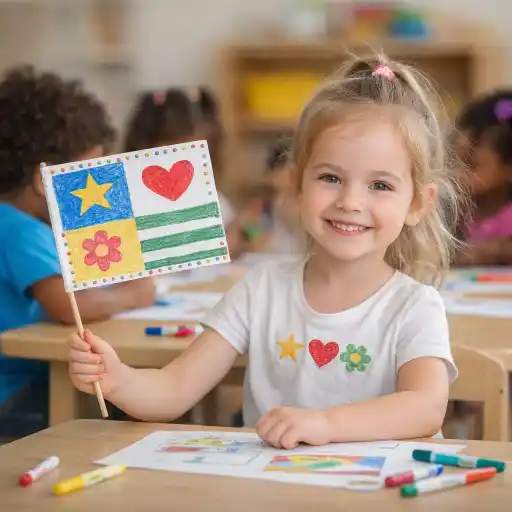
- Paper rectangles, cardstock, crayons, markers, paint, and glue.
- Pre-cut strips, circles, triangles, stars, and other geometric shapes.
- Fabric scraps, yarn, tissue paper, stickers, and safe recycled materials.
- Rulers, sponges, rollers, cotton swabs, or adapted tools for varied mark-making.
- Craft sticks or paper straws for optional flagpoles, used with appropriate supervision.
Try several invitations across the week:
- My meaning flag: Children select colors and symbols that communicate something about themselves.
- Classroom community flag: Each child contributes one symbol, then the group discusses how to combine the ideas.
- Pattern flag: Children create an AB, AAB, or more complex repeating arrangement with shapes or colors.
- Texture flag: Children explore how fabric, paper, foil, or yarn change the surface.
- Flag gallery: Children dictate or record a sentence explaining one design choice.
🖍️ Keep the materials accessible, but establish clear boundaries: scissors are used safely, glue stays on the work surface, and small parts are selected according to age and supervision needs. State requirements vary - check your state licensing agency.
How do patterns and geometry emerge through flag design?
Flag design creates a natural context for mathematical thinking because children work with repetition, symmetry, position, shape, and quantity. A child who arranges red-blue-red-blue pieces is exploring an AB pattern; a child who places matching symbols on both sides is noticing symmetry; a child who divides a rectangle into sections is reasoning about space.
Use mathematical language during the process without turning the art into a worksheet:
- “What repeats in your design?”
- “What comes next?”
- “How could you make the two sides look alike?”
- “Which shape has corners? Which one has no corners?”
- “How many stars or circles did you choose?”
Children can build a pattern with loose parts before transferring it to paper. This tactile rehearsal supports those who benefit from movement and manipulation. For older preschoolers or kindergarteners, invite them to represent a pattern using letters such as ABAB, or to explain what would happen if one element were removed.
Do not insist that every flag contain a repeating pattern. Some children may prefer a single large symbol or an intentionally irregular arrangement. The educational goal is to notice, describe, and experiment—not to make every product mathematically uniform. The ChildCareEd discussion of shapes and patterns similarly recommends hands-on exploration before formal worksheets.
How can teachers support individual expression and inclusion?
Individual expression grows when children experience real ownership. Present the flag as an invitation, not a model to reproduce. Instead of displaying a finished sample, show materials and ask, “What could these become?” If a child wants to make a flag about a pet, a favorite food, a family tradition, or an imaginary planet, that choice is meaningful. This kind of autonomy is one practical part of supporting children's self-esteem in early childhood.
Use descriptive, non-evaluative feedback:
- “You placed three large shapes across the center.”
- “You chose colors that remind you of the ocean.”
- “You changed your plan when the paper tore.”
- “Tell me about the symbol you created.”
Avoid guessing what a child’s image represents or praising only realistic products. Ask permission before adding marks or “fixing” a design. If motor demands create a barrier, offer larger pieces, adhesive dots, stampers, digital drawing, vertical surfaces, or adult-assisted cutting while preserving the child’s decisions. Visual choices, gestures, and communication devices can support children who are still developing spoken language.
Directors can strengthen practice by documenting process rather than displaying only polished flags. Photograph a child arranging shapes, record a short quote, and note the skill being demonstrated. Families may be surprised by how much learning is embedded in a seemingly simple craft; a brief caption makes that learning visible. For more comprehensive preparation, Open Heart, Open Art  Buy Now $16.00 focuses on open-ended art and social-emotional development, while Power of Art: Building Self-Esteem and Positive Behavior for All Abilities Buy Now $24.00 addresses confidence and inclusive guidance through art.
How can a flag project become a thoughtful learning sequence?
A single design activity can become a short inquiry cycle. Begin by observing what children already notice about flags. Introduce vocabulary and examples, invite experimentation, and then revisit the designs through conversation, movement, writing, or display.
- Notice: Collect children’s questions about colors, shapes, symbols, and patterns.
- Explore: Provide real flags, photographs, books, blocks, and loose parts for comparison.
- Create: Offer the design template or blank paper, allowing children to choose their level of structure.
- Explain: Invite each child to name or dictate the meaning of one design element.
- Extend: Use the flags in a parade, story, map activity, dramatic-play center, or classroom display.
Integrate literacy by creating a class book titled “Our Flags and Their Meanings.” Integrate movement by having children wave fabric flags to music or follow a pattern of movements. Integrate social learning by asking groups to negotiate a shared classroom flag. Integrate science by observing how different materials move in air.
Common mistakes include requiring identical results, presenting too many materials, teaching symbolism as a list of facts, and correcting children’s interpretations. Avoid these pitfalls by narrowing the material choices, asking open questions, and documenting children’s reasoning. If the project relates to Independence Day, remain attentive to the difference between celebrating a holiday and assuming that all families experience national symbols in the same way.
Conclusion
Flag design answers the central question through action: children explore symbols, patterns, and individual expression when they are trusted to make meaningful choices. A carefully planned invitation can support geometry, early mathematics, vocabulary, fine-motor development, cultural responsiveness, and #selfesteem without sacrificing playfulness.
Use the 4th of July Design Your Own Flag Buy Now $0.25 resource as a practical launch point, then expand it with open materials, child-created meanings, and inclusive conversation. Offer structure where it helps, freedom where it matters, and documentation that honors the process. For deeper staff learning, explore the linked ChildCareEd courses—especially Art from the Heart for Preschoolers Buy Now $35.00 and Open Heart, Open Art Buy Now $16.00—to strengthen classroom practices that help every child feel capable, heard, and proud of their ideas.
- Building Bridges for Dual Language Learners: For Workforce Solutions
- Planning for Every Child: Responsive Strategies in Action
- From Play to Planning: Building Culturally Competent, Child-Centered Curriculum
- Recognize, Respond, Respect: Supporting Diverse Learners
- 45 Hour School Age Methods and Materials
- CDA Bridge Bundle: Family Child Care without Portfolio Review
- CDA Bridge Bundle: Infant/Toddler without Portfolio Review
- Texas Director Credential
- Environments That Inspire Independence and Exploration
- Supporting Families and Caregivers in Language and Literacy
- CDA Certification en Español: Recursos y Consejos para Educadores Bilingües
- 🔍 ¿Qué ves cuando observas a un niño aprender?
- 💛🧩 ¿Cómo puedo hacer que mi enseñanza sea inclusiva para los niños con autismo?
- 🤯 ¿Por qué este niño está teniendo un comportamiento difícil de repente?
- Capacitación en Salud y Seguridad Preventiva en Línea para Proveedores de Cuidado Infantil
- Proporciones de Cuidado Infantil y Tamaños de Grupo por Edad en Maryland (Guía Rápida para Centros y Hogares)
- Proporciones de Cuidado Infantil y Tamaños de Grupo por Edad en Nueva Jersey (Guía Rápida para Centros y Hogares)
- Proporciones de Cuidado Infantil y Tamaños de Grupo por Edad en Virginia (Guía Rápida para Centros y Hogares)
- Cómo Trabajar en el Cuidado Infantil en Carolina del Norte: Requisitos y Pasos
- Celebrando la amistad en el cuidado infantil durante el Día de los Mejores Amigos
- Canciones, juegos y preguntas de círculo para niños
- Cómo simplificar la capacitación para sus empleados de daycare
- Reglas y regulaciones de guarderías en Minnesota 2026: Requisitos actuales y próximos cambios
- ¿Demasiado inquietos para sentarse? Actividades de movimiento de otoño que les encantarán a los niños pequeños
- How Can Child Care Providers Support Children Who Learn at Different Speeds?
- How Can Open-Ended Summer Art Encourage Planning and Creativity?
- How Can Flag Design Help Children Explore Symbols, Patterns, and Individual Expression?
- How Can Child Care Providers Integrate Counting into Seasonal Art Activities?
- How Can Child Care Providers Teach Holiday Vocabulary with Context and Care?
- ¿Todos los niños deben participar en el tiempo de círculo?
