When a child calls every tilted shape a “diamond” or recognizes a triangle only when it points up, the next step is not more flashcards—it is closer looking. The Early Mathematics Through Play Buy Now $24.00 course offers practical ways to weave geometry, reasoning, and hands-on exploration into the Pre-K day; it can help you strengthen classroom practice while building broader early-math knowledge. Read on for simple ways to help kindergarten and early elementary children explain what makes a shape what it is.
Why does understanding attributes matter more than memorizing names?
Knowing a shape’s name is a useful beginning, but recognition alone does not show that a child understands its defining features. A child may identify a familiar triangle picture yet reject the same figure when it is rotated, enlarged, or drawn with unequal sides. Geometry learning deepens when children notice properties that stay constant across examples—such as three straight sides and three corners—rather than relying only on color, size, or position.
This shift supports more than a single math unit. Children use geometric reasoning when they sort classroom materials, plan structures in block play, compare objects, and explain how pieces fit together. Attribute talk also strengthens language and reasoning: “These both have four corners, but only one has four equal sides.” Early experiences with comparing and classifying can lay groundwork for later work with polygons, angles, area, and spatial relationships.
The goal is not to replace shape names. Names give children a shared vocabulary; attributes give those names meaning. A progression from visual recognition toward analyzing shape properties helps educators see why children need varied examples and supported opportunities to describe what they observe. When a child is unsure, that is an invitation to explore together—not a sign that the child has failed.
Which features should children learn to notice and describe?
Begin with features children can see, touch, count, and compare. Keep vocabulary focused and connect each word to an action. For two-dimensional shapes, children can trace straight sides, place a finger at each corner or vertex, and compare the number of sides and corners. They can also notice whether a boundary is curved or straight and whether a figure is closed.
- Sides: How many straight sides do you see? Are they equal or different in length?
- Corners or vertices: How many places do two sides meet?
- Faces: On a solid, which surfaces are flat? What 2D shapes do those faces resemble?
- Edges: Where do two faces meet on a solid object?
- Other properties: Does it roll, slide, or stack? Does turning it change its properties?
Use precise language without making terminology a barrier. For example, say, “This corner is also called a vertex,” while allowing children to use “corner” as they build understanding. A cube has flat faces and edges where those faces meet; a circle is a flat 2D figure with a curved boundary and no corners. Objects such as cans and boxes make the distinction between a flat shape and a solid object easier to investigate. The relationship between plane shapes and solid shapes becomes clearer when children handle objects and explore their faces.
How can educators help children look beyond a shape’s appearance?
Offer sets that vary in size, color, and orientation, then ask children to decide which features matter for a particular group. Include less typical examples: a narrow triangle, a sideways square, a large rectangle, or a hand-drawn figure. A shape remains the same shape when it is turned or made larger, as long as its defining properties remain. This helps children shift from “it looks like the picture” toward “I can explain why it belongs.”
Sorting is an especially useful bridge. First, invite children to group pieces in any way they choose. Ask them to explain their rule, then suggest a new one: “Can you make a group with four corners?” or “Which pieces have curved boundaries?” Children may sort the same pieces in several valid ways, and listening to their explanations shows what they are attending to.
- Show examples and non-examples, including open figures and shapes with curved sides.
- Rotate a shape together and count the same features before and after turning it.
- Ask, “What stayed the same? What changed?” rather than simply asking for a label.
- Connect an object to its visible shape: a book is a solid object with rectangular faces, not itself a flat rectangle.
These practices align with the early-grade expectation that children compare shapes in different sizes and orientations using informal language about their parts and attributes. A summary of early geometry standards highlights this movement from naming figures toward analyzing, creating, and composing them. Keep the tone curious: children’s initial ideas are valuable evidence of how they are reasoning.
What playful activities make attribute thinking concrete?
Children often understand a property more readily when they can act on it. Provide simple materials, a clear focus, and time to experiment; the activity does not need to feel like a formal lesson. The adult’s role is to make mathematical noticing visible through a few purposeful prompts.
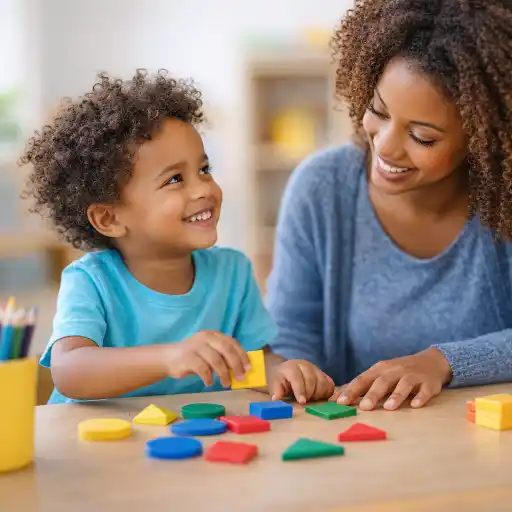
- Shape detectives: Hide a shape in a bag. Invite a child to feel it, describe its features, and make a guess before revealing it.
- Build and count: Use craft sticks and dough, or playdough and safe connectors, to make outlines. Count each side and mark each corner as the shape takes form.
- Classroom hunt: Find shapes in books, windows, blocks, and outdoor spaces. Compare examples that differ in size, color, or orientation.
- Solid-shape exploration: Test which objects roll, slide, or stack, then examine their faces and edges. Trace a solid’s face to connect it with a flat figure.
- 🟦 Turn-and-check: Rotate a shape card and ask, “Is it still a triangle? How can we check?”
For a slightly greater challenge, offer shape riddles: “I have four corners and four straight sides. Two sides are longer than the other two. What might I be?” Accept evidence-based explanations, and let children inspect more than one possible answer. A resource such as 2D & 3D Shape Attributes: Sides, Vertices, Faces, Edges & Shape Riddles Buy Now $1.99 can provide printable prompts and activity ideas to support this kind of investigation. Choose materials that are safe and appropriate for the group, and supervise small parts carefully.
How can teachers scaffold learning and notice progress?
Scaffolding means responding to what a child can already do and offering a manageable next step. One child may be ready to match identical shapes; another may name common figures and count their sides; a peer may compare two solids by their faces and edges. These differences are expected. Keep the shared goal meaningful while adjusting the number of choices, the language, and the level of adult support.
Observe children during play as well as during planned activities. Notice whether a child traces each side, counts corners one at a time, relies on a familiar orientation, or explains a sorting rule. Record specific evidence—for example, “turned the square and still identified four equal sides”—rather than a broad conclusion such as “knows shapes.” Brief observations help educators choose a useful next invitation and share progress with colleagues and families.
- Model one feature at a time and think aloud: “I traced three straight sides, so I have evidence this is a triangle.”
- Use tactile or larger pieces, reduce the number of options, or pair spoken prompts with pictures when helpful.
- Accept responses through pointing, building, gestures, signing, or a child’s home language.
- Ask open questions: “What do you notice?” “How could we check?” “What else belongs in this group?”
Avoid teaching only upright, textbook-perfect examples or introducing many new terms at once. Also resist correcting a child before hearing the reasoning; a question may reveal a productive idea or misconception to explore. As research on guiding preschoolers’ mathematical understanding through play emphasizes, adults can mediate learning by noticing children’s thinking, using mathematical language, and planning appropriately challenging experiences.
How can geometry become part of the whole day?
Geometry need not be confined to a math center. Directors and teachers can keep a small collection of blocks, shape cards, and everyday objects available, then weave one focused feature into routines and play. During block building, ask which pieces have faces that fit together. At a read-aloud, notice a shape in an illustration. Outdoors, photograph a pattern or structure and revisit it later to describe its parts.
Short, repeated conversations can be more useful than an occasional worksheet because children encounter the same ideas in new contexts. Encourage families to notice shapes in familiar places—doors, signs, containers, sidewalks—and share the words they use at home. Children may describe the same object differently across languages; that variety can enrich classroom discussion and help connect learning to their lives.
For program teams, a shared focus keeps planning practical. Choose one target—such as counting vertices or distinguishing flat faces from edges—and agree on a few prompts staff can use. Then compare observations at a team meeting and decide whether to repeat, extend, or adapt the experience. If documentation or professional learning must align with local rules, state requirements vary - check your state licensing agency.
A useful rule of thumb is to invite children to name, inspect, compare, build, and explain. The sequence is flexible: play may begin with an object, lead to a shape, and circle back to a new question. This approach keeps geometry connected to children’s curiosity and everyday discoveries.
Conclusion: How do we move beyond shape names?
Naming shapes is a foundation, not the finish line. Children build stronger geometric understanding when they investigate the properties that define figures: sides and corners on flat shapes, and faces and edges on solids. Varied examples, hands-on exploration, accurate but accessible vocabulary, and open-ended questions help them recognize shapes beyond a familiar picture or orientation.
Start with one small step: place a few shapes or solid objects where children can handle them, choose one feature to notice, and ask how they know. Observe the strategies children use, then offer a next challenge that meets them where they are. When children can explain what they see and why it matters, shape learning becomes genuine geometric reasoning—not just memorized names.
For further professional learning, explore Early Mathematics Through Play Buy Now $24.00, Math Foundations in Early Childhood  Buy Now $16.00, No Such Thing as Boring Math Buy Now $24.00, CDA Subject Area 2 Buy Now $80.00, and Lesson Planning for Preschoolers Buy Now $24.00. Review each course description and check applicable training requirements for your location.
- 45 Hour Child Growth and Development
- CDA Preschool Credential with Portfolio Review
- What Makes Me Special: An Overview of Autism and ADHD
- 45 Hour Infant and Toddler Methods and Materials
- CDA Bridge Bundle: Family Child Care
- CDA Bridge Bundle: Family Child Care without Portfolio Review
- CDA Bridge Bundle: Infant/Toddler without Portfolio Review
- CDA Bridge Bundle: Preschool without Portfolio Review
- CDA Infant/Toddler Credential with Portfolio Review
- Recursos en Español sobre el Sueño Seguro del Bebé
- Cómo Ser Maestra de Preescolar en Texas
- Cómo Ser Maestra de Preescolar en Carolina del Norte
- Capacitación CDA gratuita en Illinois
- Horas de capacitación para daycare en Carolina del Norte: ¿cuántas necesita?
- Cómo simplificar la capacitación para sus empleados de daycare
- How Can Early Math Activities Build Young Children’s Mathematical Thinking?
- How Does Counting Shapes Build Early Number Sense Through Play?
- How Can Shape Vocabulary Strengthen Early Reading Practice?
- How Can Listening and Movement Games Build Children’s Shape Recognition?
- ¿Todos los niños deben participar en el tiempo de círculo?
- How Can One Shape Exploration Engage a Mixed-Age Montessori Group?
- Why Can a Child Match a Shape but Struggle to Rebuild It with Pieces?
- How Can Preschool Bingo Build Shape Reasoning Beyond Naming?
- How Can Montessori Shape Activities Welcome Different Learners?
- How Can Preschool Bingo Build Reasoning Beyond Naming Shapes?
- How Can Preschoolers Learn Geometry Through Building and Play?
- How Can Fall Nature Frames Help Preschoolers Discover More Than Leaf Shapes?
- Why Isn’t Naming Shapes Enough for Early Geometry Learning?
