What if snack time, block building, and outdoor exploration could become meaningful math learning without adding another worksheet to your day? Thoughtfully designed #math experiences help children develop number sense, reasoning, language, and confidence through play. For a deeper professional learning experience, explore Early Mathematics Through Play Buy Now $24.00, which offers practical strategies for integrating counting, patterns, geometry, measurement, and problem-solving into the preschool day.
Why do early math activities matter in child care?
Early math is not limited to reciting numbers or identifying numerals. It includes noticing quantity, comparing groups, recognizing patterns, describing position, exploring shape, measuring, and solving problems. Infants and toddlers begin developing these ideas as they fill and dump containers, reach for more food, stack objects, and explore how materials fit together. Preschoolers continue this development through increasingly intentional play and conversation.
Research summarized by NAEYC and Head Start connects frequent math language and playful experiences with stronger early mathematical understanding. Preschool skills such as counting, patterning, and understanding relative quantities are also associated with later mathematics achievement. These findings affirm what providers observe every day: ordinary moments can become powerful learning opportunities when adults notice and name the mathematics already present.
Early math activities also support broader development. Children practice attention, language, fine-motor coordination, collaboration, persistence, and executive function while they count objects, negotiate turns, or revise a tower that has fallen. A warm, low-pressure approach helps children view mathematics as something they can explore rather than a test they might fail.
- Use concrete materials before expecting symbolic answers.
- Repeat concepts across routines, centers, stories, and outdoor play.
- Invite children to explain their thinking instead of focusing only on accuracy.
- Offer multiple entry points so every child can participate.
Which early math concepts should providers prioritize?
A balanced program develops several connected strands rather than treating counting as the only goal. Illinois Early Learning Project benchmarks, NAEYC guidance, and Head Start resources emphasize number sense, operations, comparison, measurement, patterns, data, geometry, and spatial relationships. These concepts build over time, so educators should observe what children already understand and introduce a manageable next step.
Number sense and operations include counting with one-to-one correspondence, connecting numerals to quantities, recognizing small groups, combining and separating objects, and understanding “how many.” A child may recite numbers accurately yet still need support touching each object once and naming the final total.
Measurement and comparison involve words such as more, fewer, same, longer, shorter, heavier, lighter, full, and empty. Nonstandard units—cubes, blocks, scoops, or footsteps—are developmentally appropriate ways to compare before formal units are introduced.
Geometry and spatial reasoning grow through puzzles, block construction, shape hunts, and positional language such as under, beside, between, behind, and on top. Patterns and data emerge when children copy rhythms, sort objects, vote for a favorite book, or represent results with stickers.
Directors can support consistency by selecting one or two weekly goals and asking teachers to practice them in several contexts. State requirements vary - check your state licensing agency when aligning activities, documentation, or training with local expectations.
What hands-on early math activities can children try?
Effective activities are simple enough to repeat and flexible enough to adapt. Everyday materials—including blocks, cups, buttons, toy animals, dice, paper plates, stickers, and natural objects—can become mathematical tools. The most important ingredient is responsive adult interaction. For another classroom-ready way to strengthen number recognition, explore ideas for adding math to the early childhood classroom, including number-fishing activities.
- Count and move: Invite children to move one counter into a cup for each number word. Ask, “How do you know how many there are?”
- Roll and build: Children roll a die, build a tower with that many blocks, and compare towers. Extend the activity by adding a second roll.
- Sort it two ways: Provide a mixed collection and invite children to sort by color, then by shape, size, or function. Ask them to explain the rule.
- Pattern paths: Create an AB movement pattern such as clap, stomp, clap, stomp. Children continue it and eventually invent their own.
- Measure with cubes: Children measure a book, table, or stuffed animal with linking cubes and record the result with drawings or numerals.
- Shape hunt: Search the classroom or playground for circles, rectangles, triangles, and three-dimensional forms. Discuss attributes rather than relying only on labels.
- 📊 Graph a classroom question: Vote on a story, fruit, or outdoor activity using stickers, then compare which group has more, fewer, or the same.
For infants and toddlers, use large, safe materials and emphasize sensory exploration, simple comparisons, filling and dumping, stacking, and math talk. Never use small loose parts with children who may mouth objects, and follow supervision and choking-safety requirements.
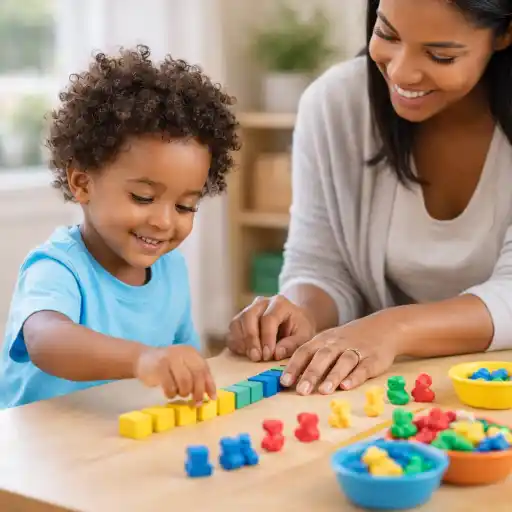
How can teachers embed math in routines and classroom play?
Routines provide frequent, authentic practice. During arrival, children can place their name cards on an attendance graph and count how many friends are present. At snack, they can distribute one item to each plate, compare portions, and discuss whether everyone has the same amount. During cleanup, teachers can use positional language: “Put the red car behind the truck.” At transitions, children can count steps, claps, or children waiting in line.
Block play is especially rich. Ask, “Which tower is taller?” “How could we make it wider?” or “What could go underneath to make it stable?” At the sensory table, children explore capacity with cups, scoops, and funnels while hearing words such as full, empty, more, less, and overflowing. In dramatic play, menus, price tags, calendars, recipes, and delivery routes connect mathematical ideas to children’s interests.
High-quality math talk is conversational rather than interrogative. Instead of repeatedly asking for the correct answer, describe what you notice and invite reasoning: “You put three bears here and two bears there. What do you notice?” “You said this shape is a triangle. What makes you think so?” Accept different strategies and model mathematical language in children’s home languages when possible.
Keep learning playful and brief. Several one- to five-minute interactions across the day may be more meaningful than a long, adult-directed lesson. The goal is not to interrupt play but to make children’s mathematical thinking visible within it.
How can providers differentiate and assess early math learning?
Differentiation begins with observation. Children in the same group may be working on very different skills: one child may be learning to count objects accurately, another may be comparing two quantities, and another may be ready to create a pattern or solve a “one more” problem. Adjust the number of objects, representation, tools, vocabulary, and level of challenge.
- Beginning learners: Offer quantities of one to three, large manipulatives, dot cards, gestures, and a teacher model.
- Developing learners: Increase quantities gradually, use ten-frames, and ask children to state the total after counting.
- Extending learners: Add estimation, two-step problems, multiple sorting rules, measurement records, or pattern creation.
- Children needing motor support: Provide larger pieces, magnetic materials, scoops, stickers, or verbal and visual response options.
- Dual language learners: Pair gestures, photographs, numerals, and key vocabulary in English and the child’s home language when possible.
Assessment can remain low burden. Record one specific observation and one possible next step: “Maya counted seven counters, touching each once, but needed a prompt to name the final total. Tomorrow, invite her to move the last counter and describe how many are in the group.” Photographs of towers, patterns, graphs, and children’s explanations can preserve evidence of thinking.
Avoid confusing memorization with understanding. A child who can say “one, two, three” may not yet connect each word to an object. Watch the strategy, listen to the explanation, and plan from evidence.
What common mistakes should early childhood programs avoid?
Even well-intentioned math instruction can become stressful when adults prioritize speed, neat products, or compliance. The following adjustments keep activities developmentally appropriate and inclusive.
- Too many worksheets: Use print selectively and pair it with manipulatives, movement, conversation, or real objects.
- Rote counting without meaning: Connect number words to quantities children can touch, move, share, or compare.
- Too many new terms: Choose two or three words—such as more, fewer, and same—and repeat them in meaningful contexts.
- One-size-fits-all pacing: Offer different quantities, tools, prompts, and levels of adult support.
- Correcting too quickly: Ask, “Tell me how you figured that out,” and treat mistakes as useful information.
- Competition as the main motivator: Emphasize collaboration, strategy, persistence, and personal growth rather than speed.
- Ignoring cultural and family knowledge: Invite families to share games, songs, recipes, patterns, and everyday counting practices.
Directors can sustain improvement by creating a shared math shelf, protecting planning time, and using short team huddles to discuss observations. Useful materials do not need to be expensive; loose parts, recycled containers, blocks, fabric, and natural objects can support rich inquiry when teachers add thoughtful language.
For professional development focused on playful, constructive math experiences, consider No Such Thing as Boring Math  Buy Now $24.00 or Math Foundations in Early Childhood Buy Now $16.00. Providers who want support planning integrated math and literacy experiences may also explore Letter & Number Planning in Child Care Buy Now $24.00.
Conclusion: How can early math activities become part of every day?
Early math activities are most effective when they are concrete, playful, repeated, and connected to children’s real experiences. Count during snack, compare towers in the block area, sort materials during cleanup, find shapes outdoors, measure with cubes, and discuss patterns in music and routines. Across these moments, use precise vocabulary, ask children to explain their thinking, observe individual strategies, and adjust the challenge.
The central question is not whether children completed a worksheet; it is whether they are developing flexible mathematical ideas and confidence. Begin with one goal, embed it in three daily routines, prepare a few accessible materials, and document one brief observation per child. Small, consistent actions create a classroom where children learn that mathematics belongs to them—and that curiosity, persistence, and multiple solutions are valued.
Frequently asked questions
When should early math learning begin?
From infancy. Counting, comparing, filling, dumping, stacking, and using spatial words during responsive care routines all support emerging mathematical understanding.
Are worksheets appropriate for preschoolers?
They may be used sparingly as one representation, but hands-on materials, movement, conversation, and play should remain central.
How often should teachers assess early math skills?
Brief observations during ordinary play can occur weekly, with more focused checks every few weeks as needed for planning.
How can families support early math at home?
Invite families to count stairs, sort laundry, compare grocery items, measure ingredients, find shapes, and talk about patterns during familiar routines.
What if a child avoids number activities?
Follow the child’s interests. Begin with construction, sensory play, music, movement, cooking, or dramatic play and weave in one small mathematical idea.
Where can staff receive additional training?
ChildCareEd offers focused English-language courses such as Early Mathematics Through Play Buy Now $24.00, Math Foundations in Early Childhood Buy Now $16.00, No Such Thing as Boring Math Buy Now $24.00, Letter & Number Planning in Child Care Buy Now $24.00, and Enhancing STEM Education for Infants and Toddlers Buy Now $16.00. Review course details and confirm whether a course meets your local professional-development requirements.
- Early Mathematics Through Play
- CDA Home Visitor Subject Area 3 Part 3 Birth to 5
- CDA Home Visitor Subject Area 2 Part 3 Birth to 5
- Math Foundations in Early Childhood
- Emergent Learning & Development
- No Such Thing as Boring Math
- Texas Director Credential
- Building Vocabulary
- Letter & Number Planning in Child Care
- Environments That Inspire Independence and Exploration
- Preschool Arithmetic Activity
- Mathematical Skill Development
- Counting Candy Canes: The STEM of Holiday Fun for Early Learners
- CDA Certification en Español: Recursos y Consejos para Educadores Bilingües
- 🎉STEM-sational Fun: How Can You Spark Preschoolers’ Curiosity with Engaging STEM Activities? 🔬🧪🔢
- Cómo Trabajar en el Cuidado Infantil en Carolina del Norte: Requisitos y Pasos
- Canciones, juegos y preguntas de círculo para niños
- How Can Preschool Math Become Meaningful, Playful, and Part of Every Day?
- How Can Child Care Providers Build Strong Early Math Skills Every Day?
- How Can Early Math Activities Build Young Children’s Mathematical Thinking?
- How Does Counting Shapes Build Early Number Sense Through Play?
- How Can Child Care Providers Integrate Counting into Seasonal Art Activities?
- How Can Patterned Practice Help Young Children Master Subtraction Facts?
- Why Can a Child Match a Shape but Struggle to Rebuild It with Pieces?
- What Are Simple Ways to Build Early Math Skills During Daily Classroom Routines?
- How Can Toddler Classroom Jobs Build Early Math Beyond Counting?
- How Can You Adapt Greater-Than and Less-Than Activities Without Giving Children the Answer?
- How Can Child Care Providers Use Everyday Objects to Support Early Math Learning?
