How can children rebuild a sprawling floor city on a tabletop without losing the ideas that made it theirs? A reconstruction challenge turns that question into hands-on learning about scale, spatial reasoning, geometry, measurement, and collaboration. For practical strategies to weave these concepts into everyday play, explore Early Mathematics Through Play Buy Now $24.00 and Math Foundations in Early Childhood  Buy Now $16.00; both can help you make mathematical thinking visible while preserving children’s agency.
Why does rebuilding a floor-sized city matter?
Children’s floor constructions often become elaborate communities: roads connect homes, parks sit near schools, and favorite figures have places to go. Asking children to recreate that city on a table invites them to consider how a large arrangement can be represented in a smaller space. This is more than a construction project. It is an approachable introduction to scale, the relationship between a real or imagined space and a representation of that space.
As children compare the two versions, they notice position, distance, orientation, and proportion. They may debate which features must remain, decide what can be simplified, and use language such as beside, across from, farther, shorter, and same size. These exchanges make spatial concepts concrete and foster mathematical #reasoning.
Construction also naturally supports engineering habits: plan, build, test, discuss, and revise. NAEYC’s description of the preschool engineering design process emphasizes imagining and planning, creating a model, and improving it through reflection. A city reconstruction gives children a meaningful reason to cycle through those steps.
For providers, the activity offers a window into children’s thinking without requiring a formal test. Listen for the strategies children use and notice how they negotiate a shared design. The aim is not a perfect miniature, but a richer experience of representing and explaining space.
How can you introduce the scale-and-reconstruction challenge?
Begin with a city the children have already built on the floor, or invite them to make one together. Before dismantling anything, give children time to look closely, talk about important features, and record the layout. Photographs taken from above are especially useful, but a child’s drawing or dictated description can also capture the plan.
Next, introduce the challenge: “Can we make a tabletop version of our city that keeps the places and connections we care about?” Avoid prescribing a single scale or insisting that every building be copied exactly. The central question is how children can make a smaller representation that communicates the original city’s important relationships.
- Choose a sturdy table or large tray and agree on its edges as the city boundary.
- Offer blocks, cardboard pieces, roads made from paper strips, and a few figures or vehicles.
- Use a photo, sketch, or simple grid as a reference, while allowing children to choose their building strategies.
- Ask children to identify key landmarks and relationships before moving materials.
- 📐 Invite children to predict which parts may need to become smaller, closer together, or simpler.
For a small group, assign flexible roles such as city planner, builder, or photographer, then rotate them so everyone can contribute. A resource on preschool engineering from NAEYC’s design process describes how plans and models help children make ideas visible and revise them. Keep the atmosphere playful: the miniature city is a new interpretation, not a pass-or-fail copy.
Which mathematical ideas emerge as children work with scale?
Scale can be introduced informally through comparison rather than formal ratios. Children may decide that a tabletop road should be shorter than the floor road, or that several floor-sized blocks need to be represented by one smaller piece. These decisions involve relative size and spatial relationships, even when children do not use standard units or precise numerical scales.
Measurement can make comparisons more deliberate. Children might measure a road with identical blocks, compare the length of two routes, or use a paper strip to represent a distance. The key is consistency: when using nonstandard units, children need to repeat the same unit without gaps or overlaps. DREME’s overview of the mathematics of measurement highlights the importance of shared starting points and consistent units when comparing objects.
- Geometry: Which shapes can represent buildings, parks, or intersections?
- Position: Is the library behind the park or across from the school?
- Measurement: How can we compare the length of a floor road with its tabletop version?
- Proportion: What should be smaller, and what needs to remain recognizable?
- Mapping: How can a drawing or photograph help us represent a three-dimensional layout?
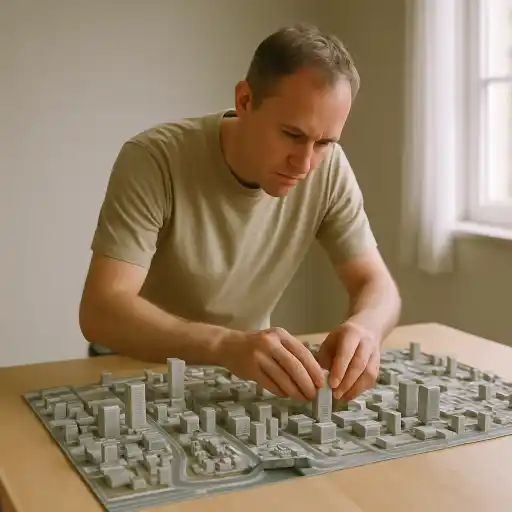
Adults can prompt thinking with questions such as “How will we know where the park belongs?” or “What could stand for this long road?” Children might answer through speech, gesture, drawing, or moving materials. The emphasis is on #measurement and explanation, not on requiring young children to calculate an exact ratio.
How can educators scaffold the work without taking over?
Children may be excited to move pieces quickly, while others may want to plan in detail. Start by observing what they already do: Do they use the photograph? Compare distances? Place landmarks first? Invite the next step with a brief, open-ended prompt rather than rebuilding or correcting for them. “What do you notice about the road on the table?” gives children room to inspect and make a decision.
Use spatial and comparative vocabulary naturally and in context: near, far, beside, between, longer, shorter, larger, smaller, same, and different. Gestures can help clarify meaning, and home-language terms can support children who are learning English. Make participation accessible by offering larger pieces, clear visual references, a stable work surface, or a partner role for children who benefit from additional motor or communication support.
- Model one strategy only when it helps children get started, then let them take the lead.
- Offer choices: “Would you like to place the landmarks first or build the road?”
- Welcome multiple solutions; a city can be scaled down in more than one reasonable way.
- Pause for children to explain a choice, show it with materials, or revise it after a comparison.
- Connect their ideas to everyday maps, neighborhood routes, and familiar places.
Research summarized by the Association for Psychological Science reports an association between frequent block, puzzle, and board-game play and children’s spatial reasoning. This does not mean one activity guarantees a particular outcome, but it supports providing regular opportunities for spatial play. The educator’s role is to extend children’s ideas with responsive prompts while protecting their sense of ownership and collaborative #play.
How can you document learning and avoid common pitfalls?
Keep documentation focused on what children actually do and say. A photograph of the original floor city and the reconstructed tabletop model can preserve the process. Add a short observation that captures a strategy: “The group placed the school and park first, then shortened the road to fit the table while keeping the same order of landmarks.” Such notes are more useful for planning than a general label such as “understands scale.”
- Observe: How does the child use the reference, compare positions, or choose a representative object?
- Listen: Does the child explain that a feature is farther, smaller, or in the same place?
- Plan: Offer a next challenge, such as rebuilding one neighborhood from a simple grid.
- Share: Invite children to describe the model to families or show how it differs from the floor version.
Common pitfalls are manageable. Avoid imposing an exact scale before children understand what the representation is for. Don’t judge the reconstruction only by visual accuracy; children may be exploring relationships rather than producing a precise map. Avoid taking over when a design does not fit. Instead, ask what could be changed, and allow children to try.
Use age-appropriate materials and supervise small pieces as needed. If activities, observation, or training must align with local expectations, state requirements vary - check your state licensing agency.
How can you extend the city challenge into ongoing learning?
A single reconstruction can grow into a sequence of playful investigations. Children might draw a map of the tabletop city, create a key for symbols, or use toy figures to travel from one landmark to another. They can compare routes, identify the shortest path, or change one feature and discuss how the city works differently. These extensions connect geometry and measurement with language, storytelling, and social problem-solving.
Directors can support continuity by making construction materials and documentation accessible across the week. A few photographs, blank paper, blocks, recycled boxes, and simple measuring tools can sustain the project without an elaborate setup. Brief team reflections help staff notice which questions invited children’s reasoning and which materials made participation easier.
The No Such Thing as Boring Math Buy Now $24.00 course offers another play-centered professional learning option, while Enhancing STEM Education for Infants and Toddlers Buy Now $16.00 focuses on STEM exploration with younger children. Together with the featured Early Mathematics Through Play Buy Now $24.00 course, these options can help providers connect hands-on building with purposeful mathematical talk.
Conclusion: What should providers take away from the city reconstruction?
Can a floor-sized city fit on a table? It can, when children treat the tabletop version as a smaller representation rather than an exact replica. Give children time to study the original, choose important landmarks, test materials, and explain how they preserve spatial relationships as they build.
The challenge supports geometry, measurement, mapping, comparison, collaboration, and engineering habits. Use photographs or drawings as references, ask open questions, and document one meaningful strategy rather than expecting a polished result. Most of all, let children’s ideas guide the reconstruction. A miniature city is not simply a smaller build; it is a chance for young learners to make their thinking about space visible.
- 45 Hour Child Growth and Development
- Early Mathematics Through Play
- The ABCs of Behavior: Turning Challenges into Learning Opportunities
- 45 Hour Infant and Toddler Methods and Materials
- CDA Bridge Bundle: Preschool
- Pediatric RSV First Aid & CPR/AED
- CDA Bridge Bundle: Family Child Care
- CDA Bridge Bundle: Infant/Toddler
- Every Moment Matters: Schedules and Transitions
- CDA Certification en Español: Recursos y Consejos para Educadores Bilingües
- 🚌🌄 Ideas de excursiones atractivas en Nevada
- Que es Título 22 en California?
- 10 Ejemplos de Cómo la Cultura Influye en el Desarrollo Infantil
- Cómo Empezar una Guardería en Casa: Requisitos y Pasos
- Normas de Licenciamiento de Cuidado Infantil en Virginia para Centros Diurnos Infantiles y Hogares Diurnos Familiares
- Proporciones de Cuidado Infantil y Tamaños de Grupo por Edad en Maryland (Guía Rápida para Centros y Hogares)
- Proporciones de Cuidado Infantil y Tamaños de Grupo por Edad en Virginia (Guía Rápida para Centros y Hogares)
- Horas de Capacitación Anual para Proveedores de Cuidado Infantil en Maryland
- Lista para Abrir una Guardería en Casa en Georgia: Cómo Empezar
- Lista para Guardería en Casa en Illinois: Cómo Iniciar una Guardería en el Hogar
- Guías del Clima para el Juego al Aire Libre en el Cuidado Infantil
- Lista para Guardería en Casa en Texas: Cómo Iniciar una Guardería en el Hogar
- Cómo Trabajar en el Cuidado Infantil en Carolina del Norte: Requisitos y Pasos
- Cómo Trabajar en el Cuidado Infantil en California: Requisitos y Pasos
- Cómo Trabajar en el Cuidado Infantil en Virginia: Requisitos y Pasos
- Celebrando la amistad en el cuidado infantil durante el Día de los Mejores Amigos
- Canciones, juegos y preguntas de círculo para niños
- Cómo simplificar la capacitación para sus empleados de daycare
- Can a Floor-Sized City Fit on a Table? Exploring Scale Through Reconstruction
