When children count the corners of a block, compare two groups of pattern pieces, or hunt for circles outdoors, they are building more than shape vocabulary—they are developing #numbersense through meaningful play. For practical strategies that connect counting, geometry, patterns, and reasoning across the preschool day, explore Early Mathematics Through Play Buy Now $24.00, which can strengthen classroom practice and support relevant professional learning goals. Educators can also extend this learning with Task Cards - Count the Shapes Buy Now $2.49, a simple hands-on resource that gives children additional opportunities to practice counting, shape recognition, and early mathematical thinking.
Why does counting shapes matter for early mathematical thinking?
Shapes give children a concrete way to experience quantity. A triangle has three sides and three corners; a square has four equal sides; a rectangle may have four corners even when its sides differ in length. When children count these attributes, they begin connecting spoken number words to observable sets. This supports one-to-one correspondence, cardinality, comparison, and mathematical language.
Shape counting also broadens the meaning of early math. Children are not merely memorizing that a circle is “round.” They are noticing attributes, classifying objects, comparing figures, and explaining how they know two shapes are alike or different. Research on playful mathematics emphasizes that children learn more deeply when they can manipulate materials, make decisions, and communicate their reasoning.
For child care providers, the approach is practical because shapes are already present in blocks, puzzles, signs, dishes, art materials, and outdoor environments. A short conversation during play can become a powerful learning opportunity without interrupting children’s engagement.
- Counting sides, corners, faces, or objects strengthens quantity concepts.
- Comparing shapes develops precise vocabulary such as more, fewer, same, longer, and shorter.
- Building and composing shapes supports spatial reasoning and problem-solving.
- Explaining ideas helps children connect actions, language, and representation.
How do shapes help children connect counting with quantity?
Number sense develops when children understand that counting describes a quantity, not simply a sequence of words. Shape activities naturally invite this connection. Give a child a triangle and ask, “How many corners can you find?” Encourage the child to touch each corner once while counting. Then ask, “How many corners did you count altogether?” The final number should represent the total.
Begin with clear, familiar examples and gradually introduce variation. Children might count the corners of a square, then compare it with a rectangle. Although the figures look different, both have four corners. This comparison helps children recognize that an attribute can remain constant even when appearance changes.
Use concrete materials before expecting written numerals. Children can place a counter on each corner, match a shape to a numeral card, or build a collection of three triangles. The sequence might move from action to language, then to drawing or symbolic representation.
- Offer one to three shapes for emerging counters.
- Invite children to touch or mark each attribute as they count.
- Ask children to show the quantity with counters, fingers, dots, or a numeral.
- Extend learning with “one more,” “one fewer,” or “How many altogether?”
Remember that recognizing a numeral does not automatically demonstrate quantity understanding. Observe whether the child coordinates one object or attribute with each number word and whether the final number is understood as the total.
Which playful activities connect shapes and number sense?
Effective activities are brief, repeatable, and adaptable. The same materials can support different levels of challenge, making them especially useful in mixed-age classrooms.
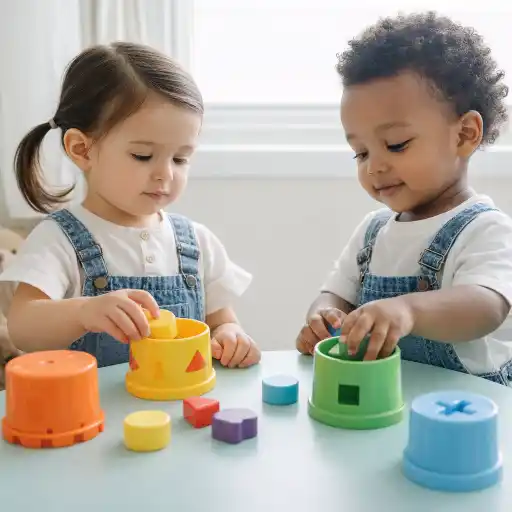
- Corner counters: Children choose a shape, place one counter on each corner, and count the total. Ask, “Which shape has more corners?”
- Shape collections: Provide assorted blocks or cutouts. Children make groups by shape, count each group, and compare which has more or fewer.
- Build and count: Invite children to create a picture with pattern blocks, then count how many triangles, squares, or rhombi they used.
- Shape paths: Place large shapes on the floor. Children follow a path, counting each shape they step on while using positional language such as beside, between, and behind.
- Shape gardens: Children plant paper shapes in rows and count how many are in each row. They can determine whether rows are equal.
- Roll, find, and graph: Children roll a large die, find that many shapes, and represent the result with stickers or cubes.
- 🔷 Shape hunt: Search indoors or outdoors for circles, rectangles, triangles, and three-dimensional forms. Count examples and discuss how children know they belong in each group.
For younger children, use large, safe materials and emphasize matching, filling, stacking, and simple comparisons. For older preschoolers, add pattern rules, measurement, symmetry, or simple story problems. Always inspect materials and avoid small loose parts with children who may mouth objects.
How can teachers use math talk to deepen shape play?
Adult language helps children move from noticing to reasoning. Rather than naming every answer, describe what you observe and invite children to explain their thinking. For example, say, “You chose two triangles and one square. What do you notice about your design?” or “You said these shapes are the same. What makes them alike?”
Purposeful questions should be open enough to encourage strategies but focused enough to support the learning goal:
- “How could we find out how many corners this shape has?”
- “Which group has more shapes? How can we check?”
- “Can you make a shape with four corners?”
- “What shape could fit in this space?”
- “How many pieces would we need if one more child joined?”
- “Can you show the same quantity another way?”
Use accurate but accessible vocabulary: side, corner, edge, face, curved, straight, equal, longer, shorter, inside, outside, above, and beneath. Home-language support is valuable; children can reason mathematically while developing English. Gestures, photographs, real objects, and drawings provide additional entry points for dual language learners and children who communicate nonverbally.
Allow wait time. Children may need to handle a shape, count quietly, or test an idea before responding. When an answer is incorrect, avoid immediate correction. Invite the child to check by touching each corner or comparing the shapes directly. This keeps mistakes informative rather than discouraging.
How can providers differentiate, assess, and extend learning?
Observation should guide the next step. One child may recognize common shapes but not count their attributes accurately. Another may count reliably and be ready to compose shapes or solve “how many more?” problems. Adjust the materials, quantity, representation, and question rather than expecting every child to complete the same task.
- Beginning learners: Use large shapes, quantities from one to three, matching cards, gestures, and adult modeling.
- Developing learners: Count sides or corners on familiar shapes, match quantities to numerals, and compare two groups.
- Extending learners: Combine shapes, identify multiple attributes, create patterns, estimate, or solve simple addition stories.
- Children needing motor support: Offer magnetic shapes, larger pieces, stickers, verbal responses, or partner-assisted counting.
- Dual language learners: Pair visuals, gestures, home-language terms, and repeated English vocabulary.
Document specific strategies rather than broad judgments. A useful note might read: “Jordan counted four corners on a rectangle by touching each one, then matched it to the numeral four. Next, invite Jordan to compare the rectangle with a square.” Photographs of constructions, sorted collections, or children’s explanations can preserve mathematical thinking.
Common mistakes include focusing only on shape names, using worksheets before concrete exploration, introducing too many terms at once, and correcting too quickly. Choose two or three target words, repeat them in routines and centers, and connect every numeral to a meaningful quantity. State requirements vary - check your state licensing agency when aligning documentation, curriculum, or training with local expectations.
How can directors sustain shape-based number learning across the program?
Program consistency grows from shared goals and accessible materials. Directors can select one monthly focus—such as counting attributes or comparing collections—and help teachers identify three daily opportunities to practice it. A small math shelf might include pattern blocks, large counters, shape cards, linking cubes, clipboards, and photographs of shapes in the environment.
Invite teachers to discuss observations during brief team meetings: What did children notice? Which strategies did they use? Who needs a different entry point? What material or prompt might extend learning? This shifts planning away from producing identical products and toward understanding children’s mathematical development.
Families can continue the learning through ordinary routines. Encourage them to count windows on a building, compare the corners of household objects, sort laundry by shape or size, or notice patterns on clothing and sidewalks. Send one manageable suggestion at a time and invite families to share games, songs, designs, and mathematical practices from home.
For additional professional learning, consider Math Foundations in Early Childhood  Buy Now $16.00, which focuses on hands-on math instruction and math-friendly environments, or No Such Thing as Boring Math Buy Now $24.00, which connects intentionally planned play with exploration and constructive approaches to early math.
Conclusion: How does counting shapes build early number sense through play?
Counting shapes builds early number sense because children connect number words to real quantities while touching, moving, comparing, building, and explaining. A triangle’s three corners, a square’s four sides, or a classroom graph of found circles can become meaningful representations of quantity and relationship.
- Use concrete shapes before expecting symbolic answers.
- Connect counting to cardinality by asking, “How many altogether?”
- Include comparison, patterns, measurement, geometry, and spatial language.
- Ask children to explain how they know rather than focusing only on correctness.
- Observe individual strategies and adapt the next challenge.
- Invite families to notice and count shapes in everyday environments.
Start with one shape-based invitation this week: provide a few shapes, one counting tool, and an open question. These small, joyful interactions help children see mathematics as something they can explore, communicate, and use.
Additional ChildCareEd courses: Letter & Number Planning in Child Care Buy Now $24.00, Lesson Planning for Preschoolers Buy Now $24.00, and Classroom Setup for Child Care Buy Now $24.00.
- Early Mathematics Through Play
- CDA Home Visitor Subject Area 3 Part 3 Birth to 5
- 24 Hour Texas Pre-Service
- Emergent Learning & Development
- 45-Hour Infant and Toddler Curriculum
- Play, Learn, Grow
- Creating Environments that Nurture Growth and Community
- Connections That Count: Building Relationships in Child Care
- Texas Director Credential
- CDA Infants/Toddlers: Stages of Development
- Cómo Abrir Una Quardería En Casa Sin Dinero?
- How can I teach colors, shapes & numbers through play in Michigan classrooms?
- How can we teach letters, numbers, and early literacy to young children?
- How Can I Use Fun Math Activities for Preschoolers Every Day?
- How can I use simple math activities for preschoolers every day?
- How Does Guided Play Build School-Ready Skills in New York Preschoolers?
- How can preschool classrooms effectively support early math skills?
- How can everyday play build number sense in young children?
- How can preschool programs intentionally support early math skills every day?
- Pumpkin Math Without the Worksheets: Hands-On Pre-K Learning
- How Can Preschool Math Become Meaningful, Playful, and Part of Every Day?
- How Do Light vs. Heavy Activities Build Early Measurement Skills?
- Why Is Wild vs. Farm Animal Sorting a Favorite Preschool Activity?
- How Can Even vs. Odd Sorting Introduce Early Number Sense?
- How Can Early Math Activities Build Young Children’s Mathematical Thinking?
- How Does Counting Shapes Build Early Number Sense Through Play?
- How Can You Teach Numbers to Ten with Ten-Frames and Visual Models?
- How Can Child Care Providers Build One-to-One Correspondence with Small Objects?
- How Can Child Care Providers Integrate Counting into Seasonal Art Activities?
