When every flower is expected to look alike, children can receive the message that there is one right way to create. An open-ended garden art invitation can instead affirm each child’s ideas while weaving in counting and conversation; ChildCareEd’s Open Heart, Open Art  Buy Now $16.00 course offers focused learning on process art and its social-emotional value. For a deeper look at preschool creativity and confidence, explore Art from the Heart for Preschoolers Buy Now $35.00 as you continue reading and consider practical ways to make each young creator feel welcome.
Why does celebrating difference matter in preschool art?
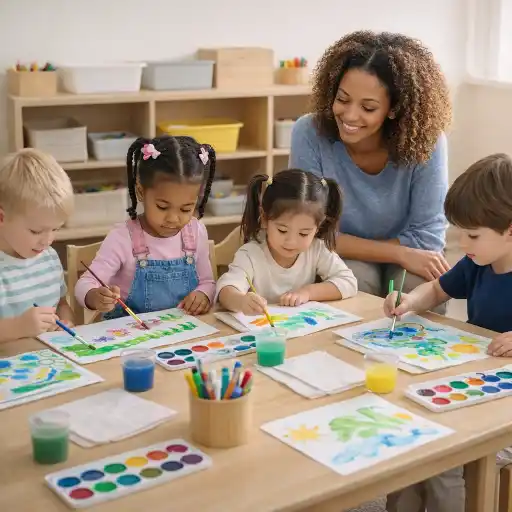
Art is a visible way for children to make choices, communicate ideas, and explore how materials work. When an activity offers one template and one expected result, children may focus on copying rather than discovering what they can do. Open-ended art shifts attention from matching a model to the experience of creating: a flower may be painted, collaged, assembled from loose parts, or imagined as something entirely different.
This matters for belonging. Children bring different interests, languages, sensory preferences, motor abilities, experiences, and ways of communicating. An invitation with multiple ways to participate communicates that those differences are welcome—not problems to correct. It also gives teachers a chance to notice each child’s strengths, such as careful arranging, bold color choices, sustained attention, or a thoughtful story.
Use the garden as an image of a classroom community: plants share a space without needing identical petals or stems. Children do not need to make the same flower to learn together. The goal is not to turn artwork into a lesson about who is different, but to create an everyday experience where individual expression and mutual respect are normal. This supports #belonging, #creativity, and confident participation.
How can providers set up an open-ended flower invitation?
Begin with a simple prompt such as, “Let’s make a garden where every flower can be its own kind.” Avoid displaying a finished sample for children to reproduce. Offer a manageable selection of accessible materials and let children choose what a flower might look like—or whether their creation will be a flower at all.
- Provide paper, crayons or washable paint, glue, and varied collage pieces such as tissue paper, yarn, cardboard shapes, and safe natural materials.
- Include different tool sizes and ways to make marks: broad brushes, stamps, sponges, dot markers, or adapted grips.
- Offer options to draw, arrange materials without glue, dictate an idea, point to a choice, or observe before joining.
- Prepare clear space for working and a predictable cleanup routine; check materials for age-appropriate safety and supervision.
💐 Invite children to choose materials and decide how their work develops, rather than directing where each petal, leaf, or stem belongs.
Adults can model safe tool use without modeling the final product. A brief demonstration—how to dab paint or press a collage piece—offers access while leaving the artistic decisions to the child. The Every Flower Is Different: Inclusive Garden Art and Counting Teaching Guide Buy Now $1.75 can support planning this kind of flexible invitation for preschool participation.
How can counting fit without turning art into a test?
Counting can grow naturally from the materials and children’s choices. Invite a child to count the pieces they decide to use, count the flowers in a shared garden mural, or compare how many leaves appear in two areas. The purpose is to explore quantity—not to require every child to add the same number of petals or produce a mathematically “correct” flower.
Keep number concepts concrete and conversational. Touch or point to one item at a time while counting, and let the child choose a response method: saying number words, pointing, moving objects, using fingers, or selecting a numeral card. If a child skips an item or counts an object twice, you can gently model a strategy: “Let’s touch each one once as we count.”
- Count a child’s chosen collage pieces together, without setting a required total.
- Ask, “How many flowers do you see in our garden?” and count the group’s creations.
- Use comparison language descriptively: “This side has more leaves; that side has fewer.”
- Offer an optional extension: “Would you like to add one more?”
Children may be at different points in their number understanding. Some will explore one-to-one counting; others may compare sets or identify numerals. An activity can hold those varied possibilities without ranking children. For more intentional math planning, Early Mathematics Through Play Buy Now $24.00 explores ways to make number sense and counting meaningful through hands-on experiences.
How can teachers support access and individual expression?
Inclusion is not about asking every child to participate in the same way. It is about identifying and reducing barriers so each child can take part meaningfully. Notice whether a tool is difficult to grip, the table is crowded, a texture feels uncomfortable, or a verbal instruction is hard to follow. Then adapt the materials, space, or communication supports while keeping the child’s choices central.
- Offer larger brushes, stabilized paper, glue sticks, pre-cut shapes, or a partner to assist with setup when useful.
- Use picture choices, gestures, visual steps, home-language words, or communication devices as appropriate.
- Provide a quieter work area or let children explore materials before touching them.
- Welcome children who choose to watch, work briefly, return later, or create without explaining their work.
Use descriptive, non-comparative language. Try “You chose three textures,” “I notice your marks go around the page,” or “You found a way to make the paper stay still.” These comments recognize decisions and strategies without judging the artwork against a classmate’s. Avoid assuming that a child’s art reveals a particular feeling or ability; observe and listen rather than interpreting for them.
Ask families about helpful tools, sensory preferences, or familiar ways their child communicates. Their knowledge can guide thoughtful adaptations, while the child remains the author of the work. Supporting #inclusion means ensuring that access is flexible and respect is consistent, not that every child’s participation looks identical.
What language and documentation help prevent comparison?
Children notice how adults talk about their work. Comments such as “This is the prettiest flower” or “Yours looks just like the example” can unintentionally introduce a hierarchy. Even well-meant comparisons may encourage children to seek approval by matching another person’s style. Instead, describe what you observe and invite the child’s meaning without requiring an explanation.
- Try: “You chose bright orange and made marks all around the page.”
- Try: “Tell me about a part you would like me to notice.”
- Try: “You can call it a flower, give it another name, or leave it untitled.”
- Avoid: “Who made the best one?” or “Why doesn’t yours look like the sample?”
Document process as well as the finished piece. A photograph of a child testing materials, a short quote, or an observation about a strategy can make learning visible to colleagues and families. For example: “Sam arranged yarn and paper circles, then counted four pieces while pointing to each one.” This note records what happened without rating the artwork.
Display children’s work thoughtfully. Give each piece space where possible, use the child’s chosen title or words, and avoid arranging work to imply a competition. Explain to families that the goal is exploration, choice, and early learning—not identical keepsakes. As you plan materials and supervision, remember that state requirements vary - check your state licensing agency.
How can directors make this practice consistent across classrooms?
Directors can help staff move from a one-time craft to a reliable, inclusive practice by aligning planning, materials, and reflection. Begin with a shared expectation: children’s work is not ranked by neatness, realism, or resemblance to an adult model. Then make it easy for teachers to offer open-ended choices by keeping a small, rotating collection of safe materials available and planning enough time for children to explore.
After an activity, invite staff to reflect briefly: Who had a way to participate? Which choices or mathematical ideas did children explore? What barrier did we notice, and what might we change next time? A short team discussion can turn observations into useful adjustments without making teachers feel they need elaborate displays or expensive supplies.
Common pitfalls include giving a sample that quietly becomes a required template, praising only the most recognizable work, insisting that all children explain their art, and setting a fixed count for every creation. Counter these patterns with open prompts, optional counting challenges, varied supports, and language that describes process. ChildCareEd’s Inclusive Lessons for Preschoolers Buy Now $16.00 can help providers think through flexible materials and lesson design for diverse learners.
Use family communication to make the learning visible: share a child’s words or a brief note about counting, material exploration, or problem-solving. Emphasize that different results are expected because children make different choices. A classroom garden becomes a shared project without making its flowers compete.
Conclusion: How can preschool art celebrate differences without comparison?
Preschool art can celebrate differences when providers offer an open invitation, accessible materials, meaningful choice, and language that honors each child’s process. A flower activity can invite expression and early counting without requiring identical shapes, colors, or quantities. Children can count what they choose, explore number ideas together, and communicate in different ways while making work that belongs to them.
The central practice is straightforward: replace comparison with curiosity. Describe what children do, listen to the meanings they share, adapt access thoughtfully, and document learning without ranking outcomes. When each child’s choices are respected, the classroom garden becomes a genuine community—many individual creations growing side by side.
Five ChildCareEd courses for continued learning
- 45 Hour Child Growth and Development
- 45 Hour Preschool Methods and Materials
- CDA Bridge Bundle: Preschool
- 45 Hour School Age Methods and Materials
- CDA Bridge Bundle: Family Child Care without Portfolio Review
- Art from the Heart for Preschoolers: Open Ended Art Projects that Build Self-Esteem
- CDA Bridge Bundle: Infant/Toddler without Portfolio Review
- CDA Bridge Bundle: Preschool without Portfolio Review
- Texas Director Credential
- 10 Ejemplos de Cómo la Cultura Influye en el Desarrollo Infantil
- Actividades de Fiesta para Niños de Preescolar y Primaria
- ¿Cuál es la Diferencia Entre la Crianza Respetuosa y la Crianza Permisiva?
- How Can Early Childhood Classrooms Celebrate Diversity and Inclusion?
- Celebrando la amistad en el cuidado infantil durante el Día de los Mejores Amigos
- How Can I Use Fun Math Activities for Preschoolers Every Day?
- How Can You Celebrate Black Culture and Music Effectively in Your Program?
- How can childcare programs celebrate the harvest season in ways that are inclusive, safe, and sensory-rich?
- How can leaf-themed art and science activities deepen learning in my child care program?
- Mawlid Around the World: How Kids Can Explore Different Traditions and Celebrations
- How Can We Celebrate Every Family and Create a Classroom Where Everyone Is Represented?
- How Can Child Care Programs Celebrate Hispanic Heritage Month Meaningfully?
- How Can “All About Me” Activities Build a Stronger Classroom Community?
- How Can Child Care Providers Integrate Counting into Seasonal Art Activities?
- How Can Child Care Programs Celebrate Juneteenth Through Respectful, Child-Centered Art?
- How Can Child Care Providers Make Christmas Classroom Activities Optional and Inclusive?
- What Should Teachers Do When Children Constantly Compare Their Work to Others?
- How Can Child Care Programs Plan a Halloween Celebration Where Food Is Optional?
- How Can Preschoolers Tell Evergreen Trees from Trees That Change Color?
- How Can Preschool Art Activities Celebrate Differences Without Comparing Children’s Work?
