When a child asks, “Is mine as good as hers?” the moment can become an opportunity to build confidence rather than rank children’s abilities. A focused course such as CDA Subject Area 3: Supporting Children’s Social and Emotional Development  Buy Now $80.00 can deepen your understanding of self-esteem, emotional development, and responsive classroom strategies while providing 10 hours of training. Read on for practical ways to respond to comparisons without dismissing children’s feelings or turning learning into a contest.
Why do young children compare their work?
Children compare drawings, block towers, handwriting, or finished projects for many reasons. They may be checking what is expected, seeking reassurance, noticing differences, or trying to understand their own growing abilities. Repeated comparison does not necessarily mean a child is vain or unkind; it can be a normal part of learning how people relate to one another.
Still, comparison can influence a child’s confidence and willingness to try. Research with preschoolers suggests that children may react differently when they believe a peer has done better, and those reactions can be shaped by how they interpret the comparison. Other research on self-esteem emphasizes the value of supportive relationships, achievable challenges, and effort-focused feedback. Teachers cannot remove every comparison, but they can shape the classroom climate in which children interpret it.
This matters because a child who sees every task as a contest may avoid challenging work, seek constant approval, or decide that a different-looking result is a wrong result. A child who feels secure can learn to notice difference without treating it as evidence of greater or lesser worth. Warm teacher-child relationships and intentional social-emotional teaching help children feel safe enough to ask questions, take risks, and keep learning.
When comparisons arise, first listen for what the child may be asking beneath the words: “Am I doing this right?”, “Will you notice my work?”, or “Can I do what my friend did?” Responding to that underlying need is often more useful than correcting the comparison itself.
How can teachers respond in the moment?
Start by acknowledging the child’s observation and feeling without agreeing that one piece of work is better. A calm, curious response communicates that the child has been heard while redirecting attention toward decisions, ideas, and learning.
- Reflect the question: “You’re wondering how your picture compares with Maya’s.”
- Ask an open question: “What do you notice about the choices you each made?”
- Describe the child’s process: “You chose a long blue line and then added circles beside it.”
- Offer reassurance without ranking: “There isn’t one right way to make this picture. You are making your own choices.”
- Invite a next step: “Is there something you want to add or change?”
Use specific encouragement rather than labels such as “the best,” “the prettiest,” or “the smartest.” A comment like “You kept trying different ways to connect the pieces” tells a child what they did and can do again. If the child appears upset, name the feeling gently—“You seem disappointed that your tower fell”—and offer support before asking them to reflect.
For a deeper professional-learning option, Teach with Respect ONLINE Buy Now $24.00 addresses respectful relationships and the distinction between praise and encouragement. The central move is to notice without ranking: acknowledge the child’s experience, describe observable effort or strategy, and keep the child in charge of what to do next.
How can feedback build confidence without creating competition?
Children benefit when feedback makes their actions and learning visible, rather than assigning a fixed value to their work. Instead of evaluating a product as “good” or “bad,” describe choices, effort, strategies, persistence, and discoveries. This approach can help children recognize what they are learning and develop a more self-directed sense of progress.
Try process-focused language such as:
- “You tested the bridge with two different blocks to see which one stayed up.”
- “You worked carefully to make the clay stand, and then you tried a wider base.”
- “You used the scissors with one hand and held the paper steady with the other.”
- “What part would you like to keep working on?”
These comments avoid implying that effort always produces the same outcome or that children should simply work harder. They identify real actions and invite reflection. As described in ChildCareEd’s discussion of praise and encouragement, descriptive feedback can help children focus on their process rather than fixating on whether they received an adult’s approval.
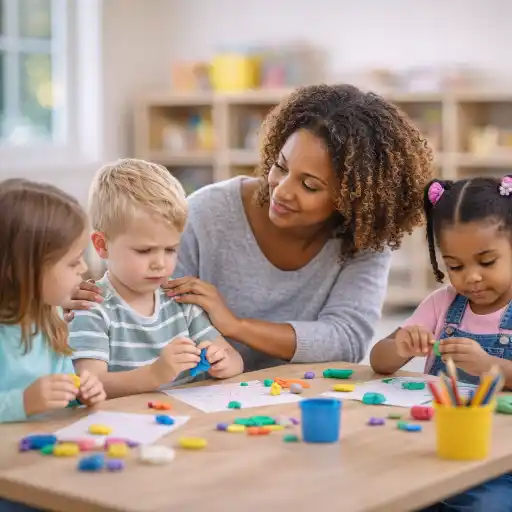
Be thoughtful about public displays and group feedback. A gallery walk can celebrate variety if children choose whether to display their work and adults describe differences without assigning awards. Avoid voting for favorites or using one child’s work as a model everyone else must copy. Celebrate a range of ideas and make room for children who prefer to keep their work private. Confidence grows through repeated experiences of being respected and capable—not through being declared the winner.
How can the classroom environment reduce unhelpful comparisons?
Some comparison is encouraged by the way activities are designed. Identical templates, visible “finished” examples, timed races, public charts, and praise directed mainly toward a few polished products can signal that children are being measured against one another. Reviewing the environment and activity structure can reduce unnecessary pressure while preserving opportunities to learn together.
For open-ended work, provide varied materials and invite children to make meaningful choices. Instead of displaying a sample craft for children to reproduce, introduce materials and demonstrate safe ways to use them. Children might draw, build, dictate an idea, use tactile materials, or observe before joining. In art, avoid implying that the finished product must look a particular way; the process can support expression and decision-making. ChildCareEd’s article on supporting children’s self-esteem likewise emphasizes child-led choices, accessible participation, and feedback about effort rather than the appearance of a finished piece.
- Offer enough materials, or plan turn-taking, so scarcity does not become a contest.
- Show a variety of examples from different people, cultures, and abilities without presenting one as the standard.
- Use private, individualized observations instead of public rankings or “top work” displays.
- Make tasks adaptable, with multiple ways to participate and demonstrate an idea.
- Observe who receives adult attention and encouragement, and broaden that attention intentionally.
These changes reflect inclusive, developmentally appropriate practice: educators respond to each child’s strengths, interests, experiences, and needs.
How should teachers respond to repeated or distressing comparisons?
If a child compares constantly, avoid assuming a single cause. The child may be looking for reassurance, uncertain about expectations, worried about mistakes, responding to classroom messages, or working through an individual learning need. Notice when the comparisons happen: during particular activities, around certain peers, after adult feedback, or when work is shared publicly. Brief, objective observations can help the team see patterns without labeling the child.
When the child says, “I’m bad at drawing,” respond with empathy and a small, realistic invitation: “It sounds like you’re frustrated. Would you like to try another tool, watch for a while, or tell me what you want your picture to show?” Give time and choices. Do not insist that the child share work publicly or disclose personal feelings. If the child repeatedly avoids activities or seems significantly distressed, discuss observations with colleagues and the family, beginning with the child’s strengths and asking what they notice at home.
Common pitfalls to avoid include:
- Counter-comparing: “But yours is better than his.” This keeps the ranking in place.
- Empty reassurance: “It’s perfect!” This may not address the child’s actual concern.
- Pressuring the child to share: choice and privacy matter.
- Assuming repeated comparison is a diagnosis or a fixed personality trait.
- Responding only to the words while overlooking classroom routines that invite ranking.
If concerns persist, collaborate with the family and appropriate program supports to agree on consistent, responsive strategies. Keep notes factual and protect children’s dignity. State requirements vary - check your state licensing agency when a concern raises questions about program procedures or required supports.
What can teachers say when children compare their work?
- “Hers is better than mine.” “You’re noticing that the pictures look different. What did you choose to do in yours?”
- “Is mine the best?” “I can tell you what I notice about your work. You used several shapes and kept adding details. What do you like about it?”
- “I can’t do it like him.” “You want to try that idea. Would you like to watch, ask for help, or try it in your own way?”
- “I’m finished, but hers is bigger.” “You each decided when your work felt finished. Would you like to add something, or are you ready for another activity?”
Keep scripts natural and adapt them to the child’s age, communication style, culture, and access needs. The aim is not to stop children from noticing peers; it is to help them interpret differences without reducing their own work or someone else’s to a score.
Conclusion: How can teachers help children move beyond comparison?
When children constantly compare their work to others, teachers can respond with warmth, curiosity, and practical guidance. Acknowledge feelings, describe a child’s own process, invite reflection, and avoid ranking. At the same time, design activities and displays that offer many ways to participate and do not define one product as the standard.
The main goal is not to make every child feel that their work is “the best.” It is to help each child experience belonging, agency, and growing competence. With consistent encouragement, inclusive environments, and respectful family partnerships, children can learn to appreciate differences while staying engaged in their own learning journey.
Explore five relevant ChildCareEd courses
- CDA Subject Area 3 Buy Now $80.00 — social-emotional development and self-esteem (10 hours).
- Teach with Respect ONLINE Buy Now $24.00 — respectful relationships and encouragement.
- Opportunity for Growth: Emotional Development Buy Now $16.00 — emotional development and social-emotional skills.
- Open Heart, Open Art Buy Now $16.00 — open-ended art and social-emotional expression.
- Supporting Children’s Independence Buy Now $24.00 — autonomy, confidence, and perseverance.
- 45 Hour Child Growth and Development
- CDA Home Visitor Subject Area 3 Part 3 Birth to 5
- CDA Home Visitor Subject Area 2 Part 3 Birth to 5
- Confidentiality Is a Must!
- Power of Art: Bldg Self-Esteem & Positive Behavior for ALL Abilities
- Birth to Five CDA Credential with Portfolio Review
- Pediatric RSV First Aid & CPR/AED
- 45 Hour School Age Methods and Materials
- 😫🧸 ¿Qué hacer cuando un bebé no quiere dormir la siesta en el aula?
- 👧 ¿Cómo iniciar y abrir una guardería en Texas? Lo que necesitas saber
- Qué capacitación se requiere para ser director de cuidado infantil en Texas?
- Recursos en Español sobre el Sueño Seguro del Bebé
- Capacitación en Salud y Seguridad Preventiva en Línea para Proveedores de Cuidado Infantil
- Regulaciones de Licenciamiento de Cuidado Infantil en California para Centros y Hogares de Cuidado Infantil Familiar
- ¿Cuál es la Diferencia Entre la Crianza Respetuosa y la Crianza Permisiva?
- Cómo Celebrar el Día Nacional del Kindergarten
- Lista para Guardería en Casa en Illinois: Cómo Iniciar una Guardería en el Hogar
- Lista para Guardería en Casa en California: Cómo Iniciar una Guardería en el Hogar
- Lista para Guardería en Casa en Texas: Cómo Iniciar una Guardería en el Hogar
- Retraso del Habla en la Guardería: Cómo Pueden Ayudar los Proveedores
- Cómo Ser Maestra de Preescolar en Dakota del Norte
- Cómo Ser Maestra de Preescolar en Wisconsin
- Capacitación Previa al Servicio para Proveedores de Cuidado Infantil en Dakota del Norte
- How Can Providers Teach Children to Notice When a Friend Needs Space?
- What Should You Review When a Preschool Day Feels Constantly Rushed?
- How Can Providers Respond When a Child Constantly Corrects Other Children’s Play?
- How Can Teachers Support Children Who Struggle to Make Decisions Independently?
- What Should Teachers Do When Children Constantly Compare Their Work to Others?
