When children feel known, valued, and invited to share their experiences, the classroom becomes more than a room—it becomes a community. Thoughtfully designed “All About Me” activities help providers build relationships, strengthen communication, and create belonging; for deeper guidance on supportive relationships and community building, explore Supporting Social Learning: Creating Classrooms that Care Buy Now $35.00, a practical course that can strengthen daily classroom practices and support professional learning hours.
Why do “All About Me” activities matter for classroom community?
“All About Me” experiences give children developmentally appropriate ways to communicate identity, preferences, relationships, and strengths. A child may draw a favorite food, identify the people in their home, demonstrate a familiar song, or choose a picture that represents how they play. Each contribution offers peers and educators a meaningful entry point for connection.
These activities also make belonging visible. Research on early peer relationships emphasizes that children need opportunities to interact, share interests, and experience acceptance. In practice, a carefully facilitated sharing activity can help children discover common interests while also learning that classmates may have different families, languages, abilities, traditions, and routines.
The goal is not to make every child perform publicly or disclose private information. The goal is to provide multiple, low-pressure ways to participate. When children can speak, draw, gesture, use photographs, or work alongside a trusted peer, participation becomes more equitable.
- Builds self-awareness and expressive language.
- Creates opportunities for empathy and perspective-taking.
- Provides teachers with insight into children’s interests and strengths.
- Establishes shared classroom knowledge that can support future play.
How can providers design activities that invite every child’s participation?
Begin with choice. A single worksheet may be useful for some children, but community building is stronger when children can select how they communicate. The All About Me: First Day of School Worksheet Buy Now $0.99 includes prompts about names, ages, favorite colors, food, play, and school experiences, along with space for drawing. Providers can adapt these prompts for oral storytelling, dictation, collage, or dramatic play.
Offer participation pathways that reflect different developmental levels and communication styles:
- 🖍️ Drawing or painting a self-portrait, favorite activity, or important person.
- Using photos, picture cards, objects, or symbols from home.
- Dictating a sentence while an adult writes the child’s words.
- Sharing with a partner before speaking to the larger group.
- Using gestures, home language, sign language, or an assistive communication system.
Preview the activity and model your own example without making yourself the center. Explain that children may share only what feels comfortable. For children who are quiet, new to the setting, or learning English, observation and gradual participation should be treated as valid engagement—not as a problem to correct.
How can identity activities become culturally responsive rather than stereotypical?
Culturally responsive practice begins with curiosity and family partnership. NAEYC describes the importance of recognizing and valuing children’s racial and cultural identities rather than pretending differences do not exist. An “All About Me” activity should therefore invite authentic family experiences without asking one child to represent an entire culture.
Use prompts that focus on everyday life:
- “Who helps you feel cared for?”
- “What languages do you hear or use?”
- “What do you enjoy doing with people in your home?”
- “What is something you would like your friends to know about you?”
- “What helps you feel comfortable at school?”
Representation should appear throughout the environment, not only during a special unit. Include books, dolls, dramatic-play materials, music, skin-tone art supplies, photographs, and family structures that reflect the children served. Avoid costumes, food displays, or crafts that reduce complex cultures to symbols. Ask families for guidance when sharing cultural artifacts, stories, music, or traditions, and make participation voluntary.
For additional professional learning, Strength in Differences: Cultural Diversity  Buy Now $24.00 can help providers develop culturally responsive communication and strategies for creating environments where children feel respected.
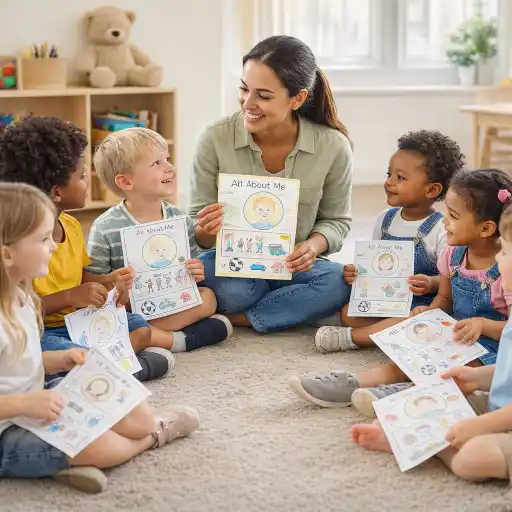
Which “All About Me” activities encourage cooperation and peer connection?
The most effective activities move beyond individual presentations and create something children build together. A class book can include one page per child, with each page combining a child’s drawing, words, photograph, or dictated message. Read the book repeatedly and invite children to notice similarities and differences respectfully.
Collaborative art is another strong option. Children can create individual identity tiles—each containing a name, drawing, color, or symbol—and combine them into a classroom mural. The message becomes clear: every child is unique, and every contribution is part of the community. Mixed-media work, collage, and open-ended art can also reduce pressure on children who do not yet feel confident drawing.
Try these cooperative extensions:
- Partner interviews: Children ask one prepared question, then introduce their partner.
- Interest groups: Children place symbols near shared interests such as blocks, music, animals, or outdoor play.
- Friendship web: Children pass yarn to classmates who share an interest, with adult support.
- Classroom “we” mural: Each child adds a handprint, drawing, or dictated statement about helping others.
- Family-and-home dramatic play: Children use inclusive props to recreate familiar routines and practice cooperation.
Keep groups small, model listening, and teach sentence frames such as “I noticed…,” “We both like…,” and “Tell me more.” These structures transform sharing into reciprocal conversation.
How can directors and teachers connect these activities to curriculum and assessment?
“All About Me” activities can support multiple learning domains when providers plan intentionally. Literacy develops as children name, dictate, listen, ask questions, and retell personal experiences. Fine-motor development is supported through drawing, cutting, gluing, and manipulating materials. Social-emotional learning appears as children identify strengths, recognize feelings, listen to peers, and practice cooperation.
Before beginning, identify two or three observable goals. For example:
- The child communicates one personal preference using speech, gesture, image, or another system.
- The child listens to a peer and identifies one shared or different experience.
- The child participates in a cooperative task with adult or peer support.
- The child recognizes their name, photograph, symbol, or personal work.
Document strengths through brief anecdotal notes, photographs of process, child quotes, and work samples. Do not assess children based on artistic realism, public speaking, family composition, or English proficiency. Instead, record the communication method the child used and the support that enabled participation.
Use observations to plan follow-up experiences. If several children show interest in cooking, create a pretend restaurant. If children mention languages spoken at home, add multilingual labels or greetings. If a child prefers animals, incorporate animal-related books, movement, or counting into future activities. This is how identity information becomes responsive curriculum rather than a one-time display.
What common mistakes should providers avoid?
Even well-intentioned activities can unintentionally exclude children. The first common mistake is requiring every child to share publicly. A child’s right to privacy and emotional safety should come before a teacher’s preferred format. Offer private sharing, small-group options, or nonverbal participation.
A second mistake is assuming that every child has the same family structure, access to photographs, or comfort discussing home life. Use broad language such as “the people who care for you” and provide classroom alternatives. Families should never have to explain sensitive circumstances in order for their child to participate.
Additional pitfalls include:
- Reducing identity to favorites: Include strengths, relationships, languages, feelings, and hopes—not only colors and foods.
- Using stereotypes: Teach about real experiences and invite family guidance instead of assigning cultural traits.
- Displaying materials without permission: Obtain consent before posting photographs, names, or family information.
- Comparing children: Celebrate individual contributions without ranking artwork, language, family size, or popularity.
- Leaving the activity on the wall: Revisit children’s work in books, play, conversations, and planning.
State requirements vary - check your state licensing agency for expectations related to photographs, family information, visitors, and documentation. Directors can support consistency by creating a simple participation and privacy procedure for staff.
Summary: How can “All About Me” activities build classroom community?
“All About Me” activities build community when they help children feel known while teaching peers to listen, appreciate differences, and find common ground. The strongest experiences are choice-based, culturally responsive, accessible, and connected to ongoing curriculum. They invite children to contribute in many ways rather than rewarding only confident speakers or skilled artists.
Start with one manageable experience: a partner interview, identity collage, class book, or collaborative mural. Gather family input, offer opt-in participation, document children’s strengths, and revisit their contributions throughout the year. When children see that their identities shape the classroom—not merely decorate it—they learn that belonging is something the community creates together.
For continued growth, providers may also explore From Play to Planning: Building Culturally Competent, Child-Centered Curriculum Buy Now $55.00, Building Equity: Inclusionary Practices in Preschool Buy Now $10.00, and Family Voices Matter: Tools for Meaningful Collaboration Buy Now $55.00.
Frequently Asked Questions
How often should we use “All About Me” activities?
Use them throughout the year, not only during the first week. Revisit identity, interests, relationships, and classroom belonging as children grow and new families join.
What if a child does not want to share?
Respect the child’s choice. Offer observation, drawing, partner sharing, or a classroom-created example as valid alternatives.
How can we include infants and toddlers?
Use photographs, familiar objects, mirrors, songs, gestures, and caregiver observations. Adults can narrate children’s responses and create simple individual books.
How can families participate?
Invite optional photos, short notes, audio recordings, songs, greetings, or objects. Provide translated communication and alternatives for families who cannot send materials.
Should children’s work be displayed?
Only with appropriate permission and sensitivity. Ask families about names and photographs, and provide private portfolios or classroom books when public display is not appropriate.
- Building Bridges for Dual Language Learners
- Teacher-Child Interactions for Stronger CLASS® Outcomes
- Building Bridges for Dual Language Learners: For Workforce Solutions
- Building Equity: Inclusionary Practices in Preschool
- TEAM: Together Everyone Achieves More
- 45 Hour Infant and Toddler Methods and Materials
- 45 Hour School Age Methods and Materials
- Creating Environments that Nurture Growth and Community
- Texas Director Credential
- Shoo, Germs! Don't Bother Me!
- CDA Certification en Español: Recursos y Consejos para Educadores Bilingües
- 👶 ¿Cuáles son las proporciones y grupos requeridos en Dakota del Norte? 🏫
- Curso de Comunicación de 9 Horas de Maryland
- Actividades de Motricidad Gruesa que Desarrollan el Equilibrio, la Coordinación y la Fuerza
- 10 Ejemplos de Cómo la Cultura Influye en el Desarrollo Infantil
- Proporciones de Cuidado Infantil y Tamaños de Grupo por Edad en Maryland (Guía Rápida para Centros y Hogares)
- Proporciones de Cuidado Infantil y Tamaños de Grupo por Edad en Virginia (Guía Rápida para Centros y Hogares)
- Retraso del Habla en la Guardería: Cómo Pueden Ayudar los Proveedores
- Cómo Trabajar en el Cuidado Infantil en Carolina del Norte: Requisitos y Pasos
- How can we celebrate diversity and inclusion in California early childhood classrooms?
- How can New York childcare workers in the Bronx find Spanish-language CEU courses?
- Celebrando la amistad en el cuidado infantil durante el Día de los Mejores Amigos
- Can Florida’s early learning push help infant teachers build stronger family partnerships?
- Made by Me! Labor Day Crafts for Preschoolers That Celebrate Hard Work
- Social Studies Activities for Toddlers: Start With Home, Helpers, and Their Little World
- How Can We Celebrate Every Family and Create a Classroom Where Everyone Is Represented?
- How Can “All About Me” Activities Build a Stronger Classroom Community?
- How Can Writing and Art Activities Help Children Name What They Appreciate?
- How Can Child Care Providers Make Family-Themed Writing Activities More Inclusive?
