Hispanic Heritage Month offers child care programs an opportunity to strengthen belonging through authentic stories, languages, music, and family knowledge—not a single day of decorations or stereotypes. Begin building practical skills with Building Bridges for Dual Language Learners Buy Now $25.00, which can help providers support home languages, engage multilingual families, and create more culturally responsive learning experiences.
Why does Hispanic Heritage Month matter in early childhood?
Observed in the United States from September 15 through October 15, Hispanic Heritage Month recognizes the histories, cultures, and contributions of people with roots in Spain, Mexico, the Caribbean, and Central and South America. The observance began as Hispanic Heritage Week in 1968 and expanded to a month in 1988. Its September start aligns with independence celebrations in several Latin American countries, including Costa Rica, El Salvador, Guatemala, Honduras, Nicaragua, Mexico, and Chile.
For young children, the goal is not to memorize countries or reproduce a festive image of “Hispanic culture.” The goal is to help children see families, languages, artists, leaders, and everyday experiences represented with accuracy and dignity. NAEYC’s anti-bias guidance emphasizes children’s right to develop positive identities while learning to recognize unfairness and value others.
Supporting home languages is also relational practice. Research summarized by the Indiana University Early Childhood Center describes multilingual environments as spaces that can honor identity, strengthen social-emotional development, and support learning for all children. Similarly, research on early intervention cautions that programs may unintentionally place family languages and cultures at risk when they fail to build on them.
How can programs plan celebrations that are authentic and developmentally appropriate?
Start with a clear purpose: representation, family partnership, language affirmation, anti-bias learning, or community connection. Then select a small number of experiences that children can revisit through play and conversation. The ChildCareEd guidance on Hispanic Heritage Month recommends focusing on real lives, family voice, and process rather than adult-directed performances.
- Choose books by Hispanic and Latine authors and illustrators that depict families, neighborhoods, creativity, history, and ordinary routines.
- Represent multiple regions and identities rather than presenting Mexico, Spain, or Latin America as interchangeable.
- Use specific language: name the country, community, tradition, or artist being explored.
- Invite participation without requiring children to disclose their heritage or perform for others.
- Repeat short experiences across several days so children can observe, question, and deepen their understanding.
For infants and toddlers, use songs, family photographs, familiar objects, and responsive interactions. Preschoolers may explore maps, stories, movement, art, and dramatic play. Directors can support consistency by creating a shared planning template with a learning goal, materials, family connection, safety consideration, and reflection question for every activity.
Which classroom activities invite meaningful exploration?
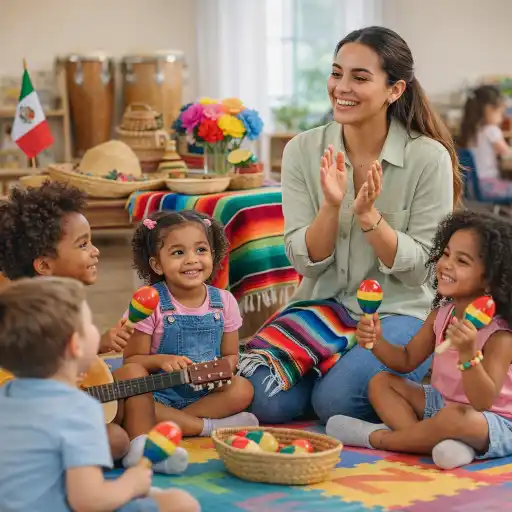
Effective activities connect culture to children’s developmental interests while avoiding caricature. A bilingual story can lead to puppet play, sequencing, vocabulary, and questions about family relationships. A music experience can include listening, clapping, movement, and comparing tempo—not simply labeling a song as “Latin.” ChildCareEd’s Latin rhythms and culture resource offers ideas for short, repeated music and movement invitations.
- 📚 Story studio: Read a bilingual picture book, then provide puppets, family figures, or props for children to retell the story.
- Music laboratory: Listen to recordings from distinct Latin American traditions and invite children to describe the beat, instruments, and feelings.
- Map and photo inquiry: Explore photographs of homes, landscapes, markets, schools, and community spaces from several countries.
- Open-ended art: Study the work of artists such as Frida Kahlo or Diego Rivera through child-friendly images, then invite children to create self-portraits, murals, or nature-inspired compositions.
- Food investigation: Examine ingredients, count, measure, smell, and describe foods with allergy-aware alternatives and family guidance.
- Lotería adaptation: Use large picture cards and familiar vocabulary, carefully reviewing images so outdated or harmful representations are not reproduced.
Use observation rather than a quiz to assess learning. Document children’s questions, new words, cooperation, representation in play, and ability to notice similarities and differences respectfully. Hashtags such as #belonging, #language, #families, #culture, and #inclusion can naturally organize digital documentation for staff reflection.
How can educators center families and home languages?
Families are partners and knowledge holders, not decorations for a themed event. Send a brief, translated invitation asking how families would like to participate and what should be represented. Offer flexible options: a recorded story, family photograph, favorite song, recipe narrative, book suggestion, or short classroom visit. Participation should always be voluntary.
- Ask families what names, terms, pronunciations, and cultural identities they prefer.
- Invite caregivers to contribute words for routines such as greeting, eating, cleaning up, and comforting.
- Provide bilingual signs, visual messages, or interpretation when possible.
- Return borrowed objects promptly and acknowledge contributors in the format they prefer.
- Connect families with libraries, cultural organizations, multilingual story times, and community artists.
Educators do not need to speak every home language to create a respectful environment. They can learn a few meaningful words, pronounce them carefully, use gestures and photographs, and invite children and families to correct them kindly. Avoid placing one child in the role of spokesperson for an entire culture. Home-language use should be encouraged throughout the year because it supports relationships, identity, and conceptual development.
Directors should also review enrollment forms, family communication systems, and classroom displays. Are Spanish-speaking families receiving the same information and opportunities to respond? Do books and dolls reflect the families actually enrolled? Are multiple Hispanic and Latine identities visible, including Afro-Latino, Indigenous, Caribbean, and multiracial experiences?
How can programs avoid stereotypes, tokenism, and cultural appropriation?
Good intentions do not automatically produce culturally responsive practice. A colorful display can still communicate a narrow or inaccurate message if it reduces a diverse group to food, costumes, flags, or one holiday. Before using a material, ask: Who created it? What community does it represent? Is the context explained? Would families recognize this as respectful?
- Avoid “one culture” language: Hispanic, Latino, Latine, and national identities are not interchangeable. Follow family preferences.
- Avoid costume play that turns identity into a prop: Choose books, music, artifacts, and creative work instead.
- Avoid forced representation: Never ask a child to explain where they are “really from” or to perform a family tradition.
- Avoid token timing: Integrate diverse authors, languages, and perspectives across the full program year.
- Avoid unexamined resources: Preview books, songs, games, and online materials for stereotypes, inaccurate history, or harmful imagery.
If discussing Día de los Muertos, explain that it is a family and community remembrance tradition with varied practices, rather than treating it as a costume theme. If exploring flags or independence days, connect them to specific countries and age-appropriate ideas about community and history. Food activities require allergy review, handwashing, supervision, choking-risk precautions, and compliance with program policy; state requirements vary - check your state licensing agency.
Staff reflection is essential. Ask educators to identify assumptions they may hold, consider whose voices are missing, and revise activities accordingly. ChildCareEd’s Diversity, Equity, and Inclusion in Education  Buy Now $16.00 course can support staff learning about bias, culturally responsive teaching, and inclusive classroom decisions.
How can directors sustain the learning beyond one month?
A successful celebration should change daily practice, not disappear when October 15 arrives. Use the month as an audit of curriculum, environment, communication, and family partnership. Review whether children encounter Hispanic and Latine authors, musicians, scientists, community leaders, and family structures throughout the year. For programs that draw on Montessori principles, September’s opportunities to build curiosity and community through nature exploration can complement this broader planning.
- Create a rotating multilingual library with books available in English and children’s home languages.
- Add family-approved words, photographs, and labels to everyday classroom routines.
- Include music and movement from varied traditions without assigning music to a single racial category.
- Build relationships with local libraries, cultural centers, museums, artists, and bilingual professionals.
- Use staff meetings to examine representation, bias, and children’s responses to curriculum.
- Invite family feedback through a short survey or informal conversation, then document changes made.
Choose two or three indicators of impact: increased family participation, broader use of home-language words, more inclusive dramatic play, children’s ability to ask respectful questions, or improved access to culturally relevant materials. Avoid measuring success by how elaborate the party looked. Meaningful change may be quiet: a child recognizing their family in a book, a caregiver feeling comfortable sharing a story, or a peer learning to greet a friend in their home language.
For additional professional learning, consider Cultures in the Classroom Buy Now $24.00, Mind’s Medicine: Music in Early Childhood Buy Now $16.00, and Strength in Differences: Cultural Diversity Buy Now $24.00. These courses address cultural representation, developmentally appropriate learning, music, and inclusive practice. Confirm course details and acceptance with your state licensing agency or professional registry before applying training toward a specific requirement.
Conclusion: What makes Hispanic Heritage Month meaningful in child care?
Child care programs celebrate Hispanic Heritage Month most meaningfully when they center relationships, accuracy, family voice, and children’s agency. Plan experiences around authentic books, home languages, music, art, stories, and everyday life; name specific communities rather than presenting a single generalized culture; and make participation flexible and emotionally safe.
The central question—how can programs celebrate Hispanic Heritage Month?—is answered through consistent practice: listen to families, examine materials, support multilingual development, connect activities to learning goals, and continue representation beyond the observance. A small bilingual greeting, a carefully selected book, or a family-informed song can become a powerful message that every child and family belongs.
Frequently asked questions
When is Hispanic Heritage Month?
In the United States, it is observed from September 15 through October 15.
Do educators need to speak Spanish?
No. Educators can use visuals, learn a few family-approved words, invite family guidance, and create opportunities for children to hear and use home languages.
Should programs hold a large fiesta?
Not necessarily. Small-group explorations are often calmer and more developmentally appropriate than a large performance. Follow family preferences and program policies.
How can we include food safely?
Ask families about traditions, review allergies, follow food-handling procedures, reduce choking risks, and offer non-food alternatives. State requirements vary - check your state licensing agency.
How do we prevent stereotypes?
Use specific, varied, community-created resources; avoid costumes and caricatures; preview materials; and never expect one child or family to represent everyone.
- CDA Certification en Español: Recursos y Consejos para Educadores Bilingües
- 👶 ¿Cuáles son las proporciones y grupos requeridos en Dakota del Norte? 🏫
- Recursos en Español sobre el Sueño Seguro del Bebé
- 10 Ejemplos de Cómo la Cultura Influye en el Desarrollo Infantil
- Actividades de Fiesta para Niños de Preescolar y Primaria
- Cómo Empezar una Guardería en Casa: Requisitos y Pasos
- Normas de Licenciamiento de Cuidado Infantil en Virginia para Centros Diurnos Infantiles y Hogares Diurnos Familiares
- Proporciones de Cuidado Infantil y Tamaños de Grupo por Edad en Maryland (Guía Rápida para Centros y Hogares)
- Proporciones de Cuidado Infantil y Tamaños de Grupo por Edad en Nueva Jersey (Guía Rápida para Centros y Hogares)
- Proporciones de Cuidado Infantil y Tamaños de Grupo por Edad en Virginia (Guía Rápida para Centros y Hogares)
- Lista para Guardería en Casa en Texas: Cómo Iniciar una Guardería en el Hogar
- Cómo Trabajar en el Cuidado Infantil en Carolina del Norte: Requisitos y Pasos
- Cómo Trabajar en el Cuidado Infantil en California: Requisitos y Pasos
- Celebrando la amistad en el cuidado infantil durante el Día de los Mejores Amigos
- Diversión fresca de verano: actividades del Día Nacional del Helado para niños
- Canciones, juegos y preguntas de círculo para niños
- Cómo simplificar la capacitación para sus empleados de daycare
- How Can Child Care Programs Celebrate Hispanic Heritage Month Meaningfully?
- How Can Preschools Celebrate Hispanic Heritage Month Meaningfully?
