A tree’s bark can be a child’s first invitation to slow down, look closely, and compare the natural world. With a simple texture investigation, you can build preschoolers’ vocabulary and scientific thinking while making outdoor time purposeful; Creating the Natural Outdoor Classroom  Buy Now $16.00 offers practical professional learning on designing nature-rich experiences with colors, sounds, and textures. Read on for a manageable way to turn a familiar tree into an engaging investigation—and consider the course as a next step for extending outdoor learning across your program.
Why does exploring bark matter in preschool?
Bark is more than the outside of a tree trunk: it offers young children a concrete subject for careful observation. As they encounter surfaces that are smooth, ridged, flaky, bumpy, or patterned, children practice noticing differences and describing evidence. These early habits—observing, comparing, asking questions, and revisiting ideas—are foundations for scientific reasoning.
Texture investigations also bring several learning domains together. Children use language to describe what they see and feel, use early math to sort or compare patterns, and develop fine-motor control while drawing or making a rubbing. Shared discoveries encourage children to listen to peers and explain their own ideas. The Eastern Connecticut State University tree investigation describes children comparing bark rubbings and explaining how one looked “bumpy” while another had thinner lines.
There is no need to turn this into a lecture about tree anatomy. A short, open-ended experience can help children feel that their observations matter. The goal is not to identify every tree species or reach one “right” answer; it is to support curiosity and build a relationship with the natural environment. A tree’s texture can prompt questions that lead to more visits, drawings, stories, and investigations.
How can you prepare a safe, inviting bark investigation?
Choose a tree that is accessible, stable, and easy to supervise. Before inviting children to explore, inspect the area for hazards, including unstable branches, sharp objects, traffic, animal waste, standing water, and unfamiliar plants or fungi. Check weather conditions and follow program procedures for outdoor play, allergies, handwashing, and active supervision. State requirements vary - check your state licensing agency.
Gather only a few simple materials so children can focus on what they notice:
- Clipboards or firm cardboard and plain paper.
- Chunky crayons with wrappers removed, used on their sides for rubbings.
- Magnifiers, if available, for looking closely without needing to touch.
- A notebook or field book to preserve children’s questions, drawings, and observations.
Introduce the investigation with an invitation rather than a quiz: “What do you notice about this tree’s coat?” Children may look, point, describe, sketch, or touch the bark if they are comfortable. Offer vocabulary—rough, smooth, ridged, cracked, flaky, damp—while welcoming children’s own words and home languages. Avoid peeling bark or removing living material. If direct contact is not suitable, photographs or an adult-selected piece of fallen bark can support close looking. Keep small natural objects away from children who may mouth them.
What can children notice through touch, sight, and comparison?
Begin with one tree and give children time to observe before offering labels. Ask open prompts such as “What does this surface look like?” “What do you notice with your fingertips?” and “Where do you see lines or bumps?” Children can compare bark at different points on the same trunk or look at two nearby trees. Invite them to describe rather than decide which bark is best or most interesting.
A bark rubbing makes texture visible on paper. Place paper against a safe, reachable section of the trunk and have a child rub the side of a crayon across it with gentle pressure. The lines and raised areas may appear as a pattern. Adult support may be needed to hold the paper securely or adjust the crayon grip. If rubbing directly on a tree is not appropriate, use a photograph for visual comparison or a piece of naturally shed bark selected and checked by an adult.
- Notice whether the surface looks smooth, grooved, scaly, cracked, or bumpy.
- Compare the direction, thickness, and spacing of lines in two rubbings.
- Look for differences in color, dampness, or visible marks without disturbing the tree.
- Invite children to match a rubbing to the tree it came from, using their observations as clues.
Children may describe texture differently, and that is useful. One child’s “scratchy” might be another’s “rough.” Repeat their words and add descriptive terms naturally, supporting both communication and #observation.
How can you connect bark exploration to science, math, language, and art?
A texture investigation can grow into a thoughtful, integrated curriculum without requiring separate lessons for every subject. In science, children notice that trees have different surface features and ask questions about what they observe. The National Park Service explains that bark covers a tree’s trunk and branches and helps protect the tree. For preschoolers, this idea can be introduced simply: bark is an outer covering that helps protect the tree, while the detailed biology can wait for children’s questions and readiness.
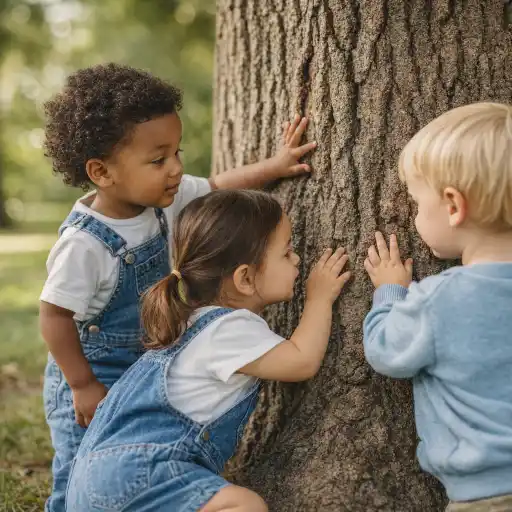
Math emerges as children compare rubbings, sort images, or describe one pattern as having more lines or larger gaps. Language grows when educators model precise words and record children’s descriptions. Art invites children to use marks, lines, and colors to represent what they saw. The Minnesota Department of Natural Resources’ early childhood environmental activities include exploring trees by touch and using words to describe textures, linking sensory noticing with movement and art.
- Science: Ask what children observe and what they wonder about the tree.
- Math: Sort rubbings by visible pattern or compare line spacing and shape.
- Language: Dictate a caption in a child’s words, then revisit it together.
- Art: Add drawings, colors, or other marks inspired by the bark’s surface.
Keep questions open: “What makes you think these rubbings are different?” “What could we look at next?” If a child suggests a cause, treat it as an idea to investigate rather than an established fact. This makes room for children’s reasoning while modeling how evidence can inform a conclusion.
How can you document the investigation and include every child?
Brief, descriptive documentation helps children return to their ideas and helps educators decide what to offer next. Record the date, tree or location, and one specific observation in children’s own words where possible. Add a rubbing, drawing, or photograph with the child’s permission and according to program privacy practices. For example: “On Wednesday, Ana traced a line on the trunk and said, ‘This one has little cracks.’” This is more useful than a general judgment about what a child knows.
Participation can take many forms. A child may observe from a seated position, use a magnifier, point to a feature, dictate a sentence, draw indoors from a photograph, or watch quietly before joining. Offer accessible routes and tools, visual choices, and home-language vocabulary. Touching bark, speaking in a group, or completing a rubbing should not be prerequisites for contributing.
Keep the experience child-centered and manageable:
- 📓 Let children help choose what to draw, record, or compare.
- Keep the group close enough for effective supervision and clear sightlines.
- Do not expect every child to describe texture in the same way or at the same pace.
- Respect the tree and surrounding habitat; observe without peeling bark or disturbing wildlife.
Revisit the same tree another day to see whether children notice something new. A CDA: Creating the Outdoor Classroom Buy Now $16.00 course may also be relevant to educators who want focused learning about planning and implementing outdoor environments; review course details to determine whether it fits your professional goals.
How can you extend the investigation beyond one activity?
Let children’s questions determine the next step. If they are interested in differences between trees, make a class display pairing bark rubbings with sketches or photographs. If the patterns capture their attention, invite them to create their own lines and textures with crayons, clay, or paint. A matching game can ask children to connect a rubbing to a tree using visible features rather than memorized names.
Consider returning to a selected tree over several visits. Children can compare records, add new words, and notice whether the surface looks different after rain or in changing light. The purpose is not to promise that bark itself will visibly change quickly; rather, repeat visits strengthen attention and help children build a record of what they actually see. The ChildCareEd article How Can Five Visits to the Same Tree Become a Preschool Investigation? offers ideas for sustaining an inquiry through repeated observation.
Share selected documentation with families, following your program’s privacy practices. A child’s drawing or quote can invite families to notice trees in their own neighborhood, making the investigation part of a wider connection to nature. For a printable companion, the Outdoor Classroom Toolkit Buy Now $1.50 includes nature activities and planning supports for educators.
As you plan, remember that state requirements vary - check your state licensing agency for applicable supervision, outdoor environment, and material guidance.
Conclusion: What can preschoolers learn from tree bark?
Preschoolers can explore the different “coats” of trees by observing, describing, comparing, and representing bark textures. A brief investigation can nurture scientific thinking, early math, language, art, and a sense of connection to the living environment. The educator’s role is to prepare a safe setting, provide simple tools, listen closely, and extend children’s questions without rushing toward a single expected answer.
Start with one accessible tree, invite children to notice its surface, and record a few of their observations. Offer touch as a choice, protect the tree, and make room for every child to participate in a way that works for them. When children return to their drawings and rubbings, they can see how careful looking helps them learn. Bark’s lines and textures may be small details, but for preschoolers they can open a wonderfully big investigation.
Further professional learning:
- Creating the Natural Outdoor Classroom Buy Now $16.00 — explores natural outdoor environments through sensory features such as colors, sounds, textures, and scents.
- Basic Science in Early Childhood — focuses on planning meaningful science experiences that support children’s inquiry and reasoning.
- CDA: Creating the Outdoor Classroom Buy Now $16.00 — addresses intentional planning and implementation of outdoor learning environments.
- Preschool Assessments & Observations Buy Now $24.00 — covers objective observation and using information to plan responsive experiences.
- 1,2,3, Eyes on Me: Classroom Safety Buy Now $32.00 — addresses safety practices and supervision, including outdoors.
- Creating the Natural Outdoor Classroom
- 45 Hour Child Growth and Development
- What Makes Me Special: An Overview of Autism and ADHD
- Children at the Wheel: Emergent Curriculum
- CDA Bridge Bundle: Family Child Care without Portfolio Review
- CDA Bridge Bundle: Infant/Toddler without Portfolio Review
- CDA Bridge Bundle: Preschool without Portfolio Review
- Texas Director Credential
- Building Early Science Foundations
- CDA Certification en Español: Recursos y Consejos para Educadores Bilingües
- 🥦✨ ¿Cómo apoyar a los niños selectivos a probar nuevos alimentos sin presión?
- 💛🧩 ¿Cómo puedo hacer que mi enseñanza sea inclusiva para los niños con autismo?
- ❄️ ¿Qué actividades al aire libre funcionan bien para los niños de Illinois en cada estación? 🌷🍂
- ¿Cómo explicar los colores a un niño ciego? Actividades con tacto, sonido y emociones
- Recursos en Español sobre el Sueño Seguro del Bebé
- 10 Ejemplos de Cómo la Cultura Influye en el Desarrollo Infantil
- Proporciones de Cuidado Infantil y Tamaños de Grupo por Edad en Maryland (Guía Rápida para Centros y Hogares)
- Proporciones de Cuidado Infantil y Tamaños de Grupo por Edad en Virginia (Guía Rápida para Centros y Hogares)
- Actividades de Otoño Fáciles para Preescolares esta Temporada
- Ejemplos de Crianza Respetuosa vs. Crianza Permisiva
- Las Mejores Ideas de Excursiones para Guarderías en Texas
- Cómo Ser Maestra de Preescolar en Virginia
- Celebrando la amistad en el cuidado infantil durante el Día de los Mejores Amigos
- Canciones, juegos y preguntas de círculo para niños
- ¿Faltan Materiales o Falta una Nueva Estrategia? Cómo Revisar los Rincones del Aula
- How Can Child Care Providers Bring Autumn Indoors Through Texture Hunts and Open-Ended Art?
- How Can Preschoolers Tell Evergreen Trees from Trees That Change Color?
- How Can Preschoolers Explore the Different Textures of Tree Bark?
