Juneteenth gives early childhood professionals an opportunity to help children explore freedom, fairness, family, and community through experiences they can understand. Begin with the Strength in Differences: Cultural Diversity  Buy Now $24.00 course to strengthen culturally responsive practice and support thoughtful classroom conversations; the three-hour training can deepen professional knowledge while you plan meaningful learning experiences. For a broader perspective on introducing cultural observances in early childhood settings, see this overview of Shavuot, Eid al-Adha, and Juneteenth.
For a practical, low-prep companion, explore the Juneteenth Dot Marker Workbook Buy Now $1.99, which connects fine-motor practice with images of freedom, joy, and community.
Why does Juneteenth belong in early childhood curriculum?
Juneteenth commemorates June 19, 1865, when federal troops arrived in Galveston, Texas, and General Order No. 3 announced the freedom of enslaved people in Texas. Although the Emancipation Proclamation had been issued in 1863, enforcement was delayed in Texas. Juneteenth therefore represents both emancipation and the long work communities undertook to claim, protect, and celebrate freedom. The National Education Association’s overview of teaching Juneteenth emphasizes that the holiday should be understood within the broader history and legacy of slavery in the United States.
For young children, the goal is not to provide an exhaustive history lesson or introduce graphic details. Instead, educators can center concrete concepts: people deserve freedom, families and communities show resilience, and fairness matters. Carefully selected stories, music, art, and conversation help children see Black history as part of the shared human story rather than as an occasional theme.
This work also supports belonging. Children benefit when classroom materials reflect the identities, histories, and cultural contributions of the people around them. Representation should continue throughout the year; Juneteenth can serve as a thoughtful entry point for examining whether books, dramatic-play materials, artwork, and family partnerships communicate that every child and family matters.
How can educators explain Juneteenth to young children?
Use language that is accurate, brief, concrete, and hopeful. A preschool explanation might be: “Juneteenth is a day when many people celebrate freedom. It helps us remember that Black people who had been enslaved learned they were free, and it reminds us that fairness matters.” This wording acknowledges history without asking young children to process more detail than they can developmentally manage.
If children ask questions, answer honestly and follow their lead. For example, if a child asks why people were not free, an educator might say, “Long ago, some people were forced to work without being allowed to make choices about their own lives. That was unfair. People worked and hoped for freedom, and Juneteenth remembers an important moment in that history.” Pause afterward and invite questions, drawing, movement, or quiet reflection.
Before the lesson, staff should agree on shared language and anticipate family questions. The National Museum of African American History and Culture’s children’s guide offers a useful model for honest, age-appropriate conversations that can continue beyond the holiday.
- Keep whole-group explanations short—often five to ten minutes is sufficient.
- Use picture books and visual supports rather than relying on abstract explanations.
- Validate children’s feelings without requiring them to speak publicly.
- Offer drawing, gesture, home-language responses, or dramatic play as alternative forms of participation.
Which activities are developmentally appropriate for infants, toddlers, and preschoolers?
Developmentally appropriate teaching begins with children’s developmental needs, not with a decorative product. Infants and toddlers can participate through warm interactions, music, family photographs, textured fabrics, and simple color or shape exploration. An educator might sing a repetitive freedom- or community-themed song, show photographs of families gathering, and narrate children’s actions: “You are touching the soft fabric. Families use many colors and patterns to celebrate.”
Preschoolers are ready for short stories, open-ended art, movement, and simple dramatic play. The ChildCareEd guide to Juneteenth history and activities recommends connecting experiences to objectives such as fine-motor development, narrative language, social-emotional learning, and family collaboration.
- 🎨 Community mural: Invite children to draw people, places, music, or acts of kindness that help a community feel connected.
- Paper quilt: Each child decorates a square with a family tradition, favorite color, or kindness promise; assemble the squares into a collective display.
- Music and movement: Use clapping, gentle percussion, call-and-response, and child-led movement to explore celebration and cooperation.
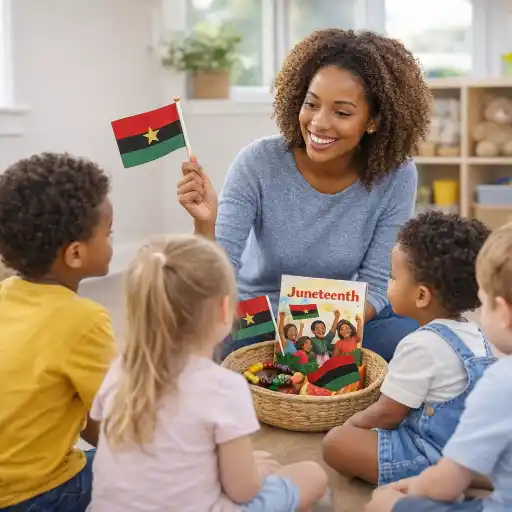
- Story basket: Pair a picture book with fabric, family-safe puppets, and open-ended prompts such as, “What helps this family feel together?”
- Dot-marker invitation: Use the Juneteenth Dot Marker Workbook Buy Now $1.99 for controlled grasp, hand-eye coordination, visual attention, and conversation about the images.
Model one possibility, then allow children to make choices. Label artwork with children’s own words so the focus remains on meaning and process rather than identical finished products.
How can the Juneteenth Dot Marker Workbook support learning without becoming a worksheet-only lesson?
The Juneteenth Dot Marker Workbook includes seven festive pages featuring a flag, raised fists, balloons, a heart, a sun, children holding hands, and a banner shape. Used thoughtfully, it can support fine-motor development while opening a broader conversation about freedom, joy, cooperation, and community. It should function as one invitation within a richer learning sequence—not as a substitute for stories, relationships, or cultural context.
Introduce one page at a time. Before children begin, show the image and ask an open question: “What do you notice?” or “What might these children be doing together?” Avoid assigning a fixed meaning to every symbol. Children may interpret the sun as warmth, the heart as caring, or the raised hands as strength; their ideas provide useful insight into their understanding.
- Connect: Read a short, high-quality picture book or share a simple explanation of Juneteenth.
- Create: Offer dot markers, crayons, or alternative tools such as cotton swabs and washable paint.
- Talk: Invite children to describe colors, shapes, feelings, and relationships in the image.
- Extend: Add the pages to a class book, display them beside dictated captions, or connect them to a collaborative mural.
Provide adaptations for children who need them: larger paper, thicker markers, hand-over-hand support only with consent, visual directions, extra time, or a non-mark-making option. Observe grip, pressure, persistence, and communication rather than judging whether children stay within outlines. The workbook is especially useful in a quiet center after a group discussion or as a bridge between literacy, art, and fine-motor learning.
How can programs partner with families and avoid common mistakes?
Families are essential partners in cultural learning. Invite participation without placing the responsibility for teaching Black history on Black children, families, or staff members. A short message might say, “Our class will explore Juneteenth through a story, art, music, and conversations about freedom and community. If your family would like to share a book, song, photograph, or tradition, participation is welcome but optional.” Offer multiple ways to contribute, including a written response, home-language recording, photograph, or take-home prompt.
Common mistakes are often understandable attempts to simplify a complex topic, but they can reduce Juneteenth to decoration or food. Avoid treating the holiday as a party without context, requiring every family to participate, using stereotypes, or presenting one family’s experience as universal. Instead, balance celebration with a brief historical explanation and make room for varied perspectives.
- Overloading children with facts: Choose one clear idea and revisit it through play.
- Focusing only on hardship: Include Black joy, creativity, family, resistance, achievement, and community care.
- Assuming all families observe Juneteenth in the same way: Ask, listen, and honor family choices.
- Using food as the primary activity: Offer art, music, books, and movement so participation is not dependent on eating.
- Ignoring safety and policy: For food, visitors, or events, state requirements vary - check your state licensing agency and follow allergy, supervision, and permission procedures.
Staff reflection matters. Before the lesson, discuss whose voices are represented, what assumptions may be present, and how educators will respond to difficult questions. The NAEYC discussion of race, racism, and young children reinforces the value of reflective, family-connected practice rather than avoidance.
Which professional-learning resources can strengthen this work?
Thoughtful Juneteenth teaching depends on more than a single activity. Staff benefit from professional learning that examines culture, bias, communication, curriculum planning, and family partnership. The most directly relevant option is Strength in Differences: Cultural Diversity Buy Now $24.00, a three-hour course addressing cultural competency, diverse perspectives, acceptance, and intercultural communication.
Programs may also consider these complementary ChildCareEd courses:
- Diversity, Equity, and Inclusion in Education Buy Now $16.00—supports reflection on bias and culturally responsive classroom strategies.
- From Play to Planning: Building Culturally Competent, Child-Centered Curriculum Buy Now $55.00—connects curriculum design, scaffolding, play, and anti-bias materials.
- Family Voices Matter: Tools for Meaningful Collaboration Buy Now $55.00—offers approaches for culturally and linguistically responsive family partnerships.
- Building Bridges for Dual Language Learners Buy Now $25.00—helps educators include home languages and strengthen communication with families.
Course acceptance for professional-development hours depends on state, registry, employer, and role. Confirm requirements with the relevant licensing or workforce agency before assuming a course satisfies a formal obligation.
Conclusion: What is the most respectful way to introduce Juneteenth?
The most respectful approach combines accurate, simple language with joyful, relationship-based learning. Explain Juneteenth as a celebration of freedom and a remembrance of an important moment in Black history; then help children explore the ideas through books, music, movement, art, and community experiences. Use the Juneteenth Dot Marker Workbook as a purposeful fine-motor invitation connected to conversation—not as a stand-alone holiday worksheet.
Plan across developmental levels, provide accessible choices, invite families without pressure, and reflect on whether classroom materials represent Black history and culture with dignity. When educators pair preparation with humility and curiosity, Juneteenth becomes more than a calendar event: it becomes an opportunity to cultivate #freedom, #belonging, #community, #culture, and #fairness in everyday early childhood practice.
- 45 Hour Preschool Methods and Materials
- Children at the Wheel: Emergent Curriculum
- CDA Bridge Bundle: Family Child Care without Portfolio Review
- CDA Bridge Bundle: Infant/Toddler without Portfolio Review
- CDA Bridge Bundle: Preschool without Portfolio Review
- Creating Environments that Nurture Growth and Community
- Creating Safe & Healthy Child Care Environments
- Building Bridges for Dual Language Learners
- Families, Communities, and Classrooms: Working Together for Children
- Rooted in History: Early Childhood
- Juneteenth History and Activities
- Celebrate Juneteenth in Baltimore
- CDA Certification en Español: Recursos y Consejos para Educadores Bilingües
- 😤💬 ¿Qué Le Digo a un Niño que Acaba de Morder a Otro?
- 👶 ¿Cuáles son las proporciones y grupos requeridos en Dakota del Norte? 🏫
- Celebrate Juneteenth with Kids: Songs, Stories, and Art
- Recursos en Español sobre el Sueño Seguro del Bebé
- Consejos de Supervisión Activa para Salones de Preescolar y el Juego al Aire Libre
- Cómo Trabajar en el Cuidado Infantil en Carolina del Norte: Requisitos y Pasos
- Cómo Ser Maestra de Preescolar en Illinois
- Teaching Kids About Juneteenth Through Activities and Crafts
- Juneteenth Activities for Kids: Crafts, Books, and Learning Ideas
- Cómo simplificar la capacitación para sus empleados de daycare
- How can child care programs honor Juneteenth in age-appropriate, respectful ways?
- How Can Early Childhood Programs Introduce Juneteenth in Developmentally Appropriate Ways?
- How Can Child Care Programs Celebrate Juneteenth Through Respectful, Child-Centered Art?
- How Can Coloring Pages Spark Meaningful Historical Conversations About Juneteenth?
- How Can Juneteenth Symbols Build Visual Memory in Young Children?
- How Can Meaningful Juneteenth Vocabulary Support Early Writers?
- How Can Drawing and Dictation Help Children Respond to Juneteenth?
