Halloween can feel festive and memorable without making food the centerpiece—or a condition of participation. Child care providers can build a safer, more inclusive celebration around play, creativity, movement, and choice; for a deeper foundation in preventing and responding to allergies, explore Elijah’s Law: Allergy Awareness Training  Buy Now $16.00. This focused training helps strengthen the knowledge and everyday practices that support children with food and other allergies.
Why does a food-optional celebration matter?
Food often appears in holiday plans almost by default: candy for games, snacks at activity stations, or a shared treat to end the party. Yet food-centered traditions can complicate participation for children with allergies, feeding challenges, medical needs, or family preferences. A celebration that does not depend on eating removes an avoidable barrier and allows children to join in through play and connection.
Food-free planning is not about making Halloween less joyful. It creates more room for meaningful experiences: making art, moving together, telling stories, and exploring seasonal ideas. These activities can support language, fine-motor coordination, problem-solving, and social learning while keeping the event welcoming to children who may not want or be able to eat party foods.
A planned celebration also helps staff and families know what to expect. Clear communication, purposeful choices, and an easy-to-follow schedule can reduce uncertainty and make supervision more manageable. ChildCareEd’s non-candy Halloween ideas for daycares offer additional practical inspiration.
- Make participation about shared experiences, not treats.
- Offer choices for children with different sensory, developmental, or cultural preferences.
- Review health plans and program procedures even when food is not planned; food may still be brought in inadvertently.
How can you design a simple, engaging celebration plan?
Start with a clear purpose: for example, children will practice cooperation, explore autumn colors, or create a shared classroom display. Then choose a small number of activities that fit your group’s ages, abilities, staffing, and available space. A handful of well-prepared options is usually easier to supervise than a room full of stations competing for attention.
Build a predictable schedule with a welcome, activity rotations, a movement break, and a calm closing. Picture cues or a simple visual schedule can help children anticipate transitions. Keep each activity brief enough to maintain interest, and allow extra time for children who need a slower pace. Assign staff roles ahead of time: identify who leads each station, who supports transitions, and who remains available to respond to individual needs.
- 🎨 Creative table: Invite children to make paper pumpkin faces, decorate paper-bag lanterns, or create a collaborative fall mural.
- Movement game: Try pumpkin bowling with soft balls and lightweight pins, or a freeze dance with child-friendly music.
- Story and language corner: Share a gentle seasonal story, then invite children to draw, act out, or describe a favorite part.
- Quiet choice: Offer books, simple puzzles, or a calm coloring activity for children who need a break from group energy.
For more ready-to-use activity ideas, adapt suggestions from Halloween classroom activities to your setting and the children you serve.
What food-free activities can build learning and connection?
Food-free does not mean learning-free. A Halloween theme can spark early math, science, literacy, creative expression, and social-emotional learning. Use everyday materials and open-ended prompts so children can participate in ways that match their interests and skills. The emphasis is on exploration and shared enjoyment, not producing identical projects.
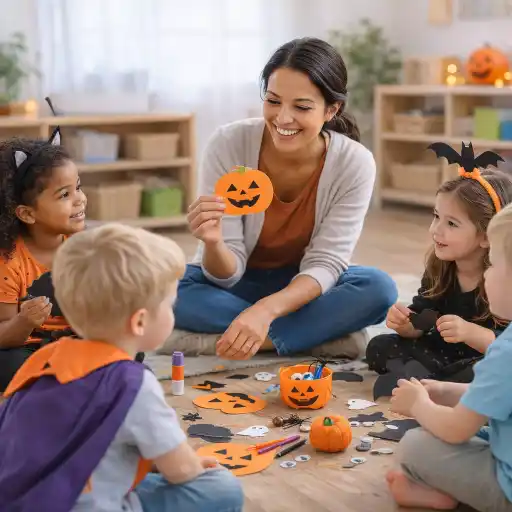
Try a pumpkin-counting station with paper shapes or large, age-appropriate manipulatives; a collage table with pre-cut shapes; or a “spider web” path made with painter’s tape for walking, hopping, or balancing. A sound-and-movement game can invite children to notice fast and slow rhythms, while a story prompt can encourage them to invent a friendly monster or describe a pretend autumn walk. Use reusable and washable materials where practical.
Before setting up sensory experiences, check the safety and suitability of every material. Some art supplies, doughs, sensory-bin fillers, and small props may contain allergens or create choking or ingestion risks. Follow children’s documented plans, supervision guidance, manufacturer age recommendations, and program rules. When possible, choose non-food sensory materials and provide a no-touch way to take part, such as observing, pointing, choosing a picture, or directing an adult.
- Invite counting, sorting, describing, comparing, and predicting during activities.
- Offer varied roles: children may create, observe, make choices, or help distribute materials.
- Choose gentle, non-frightening themes and let children decide how close they want to be to decorations or games.
Food-free sensory and craft ideas can be adapted from this resource on non-food Halloween sensory play.
How do you make the celebration inclusive and allergy-aware?
Inclusion begins before party day. Ask families about relevant health information and preferences through the program’s usual confidential processes. Tell families that food is not part of the planned celebration, and invite them to share concerns or accommodations privately. Avoid asking children to explain an allergy or speak for their family in front of peers.
A food-free plan reduces the number of food-related risks, but it does not replace an individual allergy plan or emergency readiness. Review current care instructions with the appropriate staff, make sure staff know how to follow program procedures, and keep any prescribed emergency medication accessible as directed. Check classroom materials and gifts, too: some sensory and craft products may contain food ingredients or allergens. For relevant health and safety requirements, state requirements vary - check your state licensing agency.
Plan for different sensory and access needs as well. Costumes should be optional, comfortable, and safe for movement; masks, loud sound effects, flashing lights, and crowded transitions can be overwhelming for some children. Make a calm space available without treating it as a consequence. Provide alternate ways to join activities, and affirm a child who chooses to observe or pass.
- Send families the schedule, activity overview, and reminder that food is optional and not being served.
- Use non-food participation tokens, such as stickers or classroom privileges, only when appropriate to your program’s policies and children’s ages.
- Keep health information private while ensuring relevant staff and substitutes know the procedures they need to follow.
For a broader allergy-preparedness refresher, consider ChildCareEd’s Allergies and Medication in Childcare Buy Now $16.00 course.
What common planning pitfalls should providers avoid?
Even a well-intentioned party can become stressful if the plan is too ambitious or if staff are left to improvise. Too many stations, long lines, unclear transitions, or complicated materials can make the day harder for children and adults. Choose a manageable activity set, prepare supplies in labeled containers, and test game instructions before the event. Keep a basic schedule visible to staff and children.
Another pitfall is assuming that every child enjoys Halloween in the same way. Some children may avoid costumes or spooky imagery, and some families may not observe the holiday. Frame the gathering as a seasonal or classroom community event when appropriate, make participation voluntary, and offer equivalent alternatives without singling anyone out. A child should not have to explain a family decision in order to feel included.
Finally, do not interpret “food-free” as “no safety planning needed.” Review the environment for small objects, costume hazards, trip risks, and materials that could be mouthed or touched. Confirm supervision coverage and communicate expectations with families and staff ahead of time. When you do include food despite the food-optional approach, use the child’s documented health plan and program procedures; never assume a food is safe based only on its appearance or a general label.
- Pitfall: Last-minute changes. Better approach: Share the plan early and identify a staff member who can answer questions.
- Pitfall: One activity that requires every child to touch, speak, or perform. Better approach: Offer observation, choice-making, and quiet alternatives.
- Pitfall: Treats or prizes that are not age-appropriate. Better approach: Check age guidance and choking warnings, and prioritize simple classroom experiences.
How can you bring the plan together for a joyful day?
A strong food-optional Halloween celebration does not need elaborate decorations or a packed schedule. Its quality comes from thoughtful preparation: a few developmentally appropriate activities, clear routines, attentive supervision, and genuine choices. When staff know their roles and families understand the plan, children can focus on what matters most—playing, creating, laughing, and being part of the group.
Use this quick planning sequence:
- Choose a welcoming theme and define one or two learning or community goals.
- Select a small set of food-free activities with options for different abilities and comfort levels.
- Check materials, spaces, costumes, and supervision plans for safety.
- Communicate the schedule and food-free approach to families in advance.
- Brief staff, review relevant allergy plans and emergency procedures, and prepare a calm alternative.
- After the event, reflect on which choices helped children participate and what you would adjust next time.
Conclusion: How can child care programs plan a Halloween celebration where food is optional? Center the event on play, creativity, movement, and belonging—not on snacks or candy. Keep the plan simple, offer flexible ways to participate, communicate clearly with families, and continue to follow each child’s health plan and applicable program procedures. For additional practical allergy knowledge, Elijah’s Law: Allergy Awareness Training Buy Now $16.00 offers focused learning on preventing and responding to allergies in child care.
Explore five relevant ChildCareEd courses
- Elijah’s Law: Allergy Awareness Training Buy Now $16.00
- Allergies and Medication in Childcare Buy Now $16.00
- Inclusive Lessons for Preschoolers Buy Now $16.00
- Effective Approaches for Autism and Inclusion Buy Now $55.00
- From Play to Planning: Building Culturally Competent, Child-Centered Curriculum Buy Now $55.00
References
- What are safe, engaging non-candy Halloween ideas for daycares?
- Seven Ways to Celebrate Halloween at Your Child Care Center
- Halloween Party Ideas for the Classroom
- How Can Child Care Providers Celebrate Fall Without Assuming Every Family Shares the Same Traditions?
- How can childcare programs celebrate the harvest season in ways that are inclusive, safe, and sensory-rich?
- Food Allergy Ally: Food Allergy-Safe Classroom Celebrations
- Child Care Policies for Food Allergy: Elijah’s Law Report for the U.S.
- Allergy Awareness & Elijah’s Law
- The Grinch Who Stole Snacks: How to Handle Holiday Food Allergies in Your Classroom
- Elijah’s Law: Allergy Awareness Training course information Buy Now $16.00
- Food Allergy Safety Toolkit: Forms, Checklists & Sorting Activity Buy Now $1.00
- Childcare Allergy Safety & Prevention: Checklists and Family Forms Buy Now $0.00
- Healthy Celebrations & Snack Alternatives
- How To: Hosting an Inclusive Halloween
- Inclusive Fall Celebrations in Early Education
- Halloween Sensory Play: 10 Non-Food Ideas
- Preschool Halloween Activities: Easy Science, Sensory & Art
- Halloween Classroom Activities Kids Will Go Batty For
- How can child care programs build effective food allergy awareness and emergency response plans?
- How to handle food allergies in child care
- Inclusive Lessons for Preschoolers course information Buy Now $16.00
- Basic Health & Safety and Breastfeeding Awareness
- Medication Administration and the Prevention of and Response to Food and Other Allergies in the Child Care Environment
- Nutrition Essentials for Child Care Providers
- Healthy Starts: Safety, Nutrition, and Wellness in Child Care
- Medication Administration and the Prevention of and Response to Food and Other Allergies in the Child Care Environment
- Texas Director Credential
- Bienvenido! Welcoming All Families
- Wellness in Action: Teaching Healthy Habits to Children
- Montessori Cultural Activities: Exploring the World Through Play and Learning
- CDA Certification en Español: Recursos y Consejos para Educadores Bilingües
- Cómo Abrir Una Quardería En Casa Sin Dinero?
- Recursos en Español sobre el Sueño Seguro del Bebé
- Cómo Empezar una Guardería en Casa: Requisitos y Pasos
- ¿Cómo solicito la licencia para una guardería en California?
- Regulaciones de Licenciamiento de Cuidado Infantil en California para Centros y Hogares de Cuidado Infantil Familiar
- Proporciones de Cuidado Infantil y Tamaños de Grupo por Edad en Virginia (Guía Rápida para Centros y Hogares)
- Lista para Guardería en Casa en Texas: Cómo Iniciar una Guardería en el Hogar
- Cómo Trabajar en el Cuidado Infantil en California: Requisitos y Pasos
- Capacitación CDA gratuita en Illinois
- Cómo simplificar la capacitación para sus empleados de daycare
- How can we create sensory-friendly costumes for every child?
- What are safe, engaging non-candy Halloween ideas for daycares?
- What Are Age-Appropriate Ways to Honor Latino Cultures in the Classroom?
- What Should You Ask Families Before a Classroom Winter Celebration?
- How Can You Plan October Classroom Activities for Children Who Do Not Celebrate Halloween?
- How Can Teachers Support Children’s Emotional Development During Halloween?
- How Can Child Care Providers Help Young Children Feel Safe Around Costumes and Masks?
- How Can You Plan a Fall Celebration That Welcomes Families with Different Holiday Beliefs?
- How Can Child Care Programs Plan a Halloween Celebration Where Food Is Optional?
