When preschoolers compare a green evergreen with a tree shedding autumn leaves, they are doing more than naming colors: they are learning to look closely, describe evidence, and ask questions. The Creating the Natural Outdoor Classroom  Buy Now $16.00 course offers practical guidance for bringing sensory-rich nature learning into your program, while Basic Science in Early Childhood Buy Now $25.00 can help you plan purposeful, play-based investigations. Explore these courses as a next step, then use the ideas below to turn local trees into a welcoming science experience.
Why is comparing trees a meaningful preschool investigation?
Tree comparison gives children a concrete way to explore similarities, differences, and seasonal change. Rather than starting with definitions to memorize, invite them to look at trees in their own outdoor space. One may keep its needles through the season; another may have broad leaves that change color and fall. The contrast creates an authentic reason to observe and talk.
This kind of inquiry is valuable because preschool science begins with noticing, wondering, comparing, and revisiting ideas. A child who says, “That tree has fewer leaves today,” is using evidence and quantity language. A child who says, “It looks the same,” has made a useful observation too. There is no need for a dramatic discovery at every visit.
Repeated experiences also support connection to place. Returning to a familiar tree helps children feel that the outdoors is part of their learning environment, not simply a place to run through. As a sustained classroom tree project illustrates, children’s questions and representations can guide a deeper investigation over time.
Keep the goal appropriately modest: help children notice features and share what they see. Accurate terminology can come after close looking, in meaningful context. This approach respects children’s ideas while building early habits of #science, #observation, #language, #comparison, and #curiosity.
What differences can children notice between evergreen and deciduous trees?
Begin with visible features, not a test of vocabulary. Many deciduous trees lose their broad leaves during a seasonal cycle, while many evergreens retain green leaves or needles for much of the year. These are helpful general patterns, not rules that describe every tree in every climate. Local species and weather shape what children will see.
Invite children to compare a few features side by side. If you have safe access to fallen leaves or adult-selected samples, children can observe shape, size, edges, veins, and texture. Evergreen needles can be compared by length, arrangement, and appearance without handling sharp or irritating plant parts. Looking at whole trees, bark, branches, cones, or the ground nearby adds further evidence. A science lesson on comparing deciduous and evergreen leaves similarly uses sorting and visible features to support basic tree identification.
- Leaves or needles: Are they broad, narrow, needle-like, attached, or on the ground?
- Color and quantity: What colors do children see, and are there more or fewer leaves than before?
- Branches and bark: What patterns, textures, or newly visible branches can they describe?
- Nearby ground: Are there fallen leaves, cones, seeds, or twigs beneath the tree?
Use open prompts such as “What do you notice?” and “How are these alike or different?” Accept pointing, drawing, gestures, and home-language words as meaningful responses. The practice of watching trees change over time can also help children compare new observations with earlier ones.
How can educators make comparison hands-on and playful?
A short routine can make tree study manageable while leaving room for children to lead. Choose two accessible trees, or compare one tree with an adult-selected photograph or fallen leaf sample. Invite children to look quietly first. Then ask what stands out and let them represent their thinking with words, gestures, a drawing, or a simple mark on a class chart.
Try a “same and different” walk. Pause at each tree and ask children to notice one feature at a time. Back indoors, they might sort large, safe samples or picture cards into groups according to a feature they choose. Let children explain their sorting rule: “These are pointy” or “These are red.” There may be multiple useful ways to group the same materials.
- Make two simple tree portraits, then invite children to add visible details to each.
- Sort photos or safe samples by broad leaves, needles, color, or shape.
- Count or compare fallen leaves using “more,” “fewer,” “same,” and “different.”
- Build a class comparison chart with children’s own words and drawings.
- 🍁 Revisit the same trees next week and look for one change—or confirm what stayed the same.
Keep activities tactile only when materials are safe and appropriate for your group. Use magnifiers, clipboards, crayons, picture cards, or photographs to support different ways of participating. The Project Learning Tree collection of leaf activities includes sorting, graphing, identification, art, and literacy ideas that can extend a simple comparison.
How can tree comparison support learning across domains?
One thoughtful outdoor experience can bring several learning areas together without feeling like a series of separate lessons. Children practice science as they observe and compare evidence. They use early math when they count leaves, sort by attributes, or describe which group has more. They develop language as they name features, listen to peers, and explain how they decided to sort.
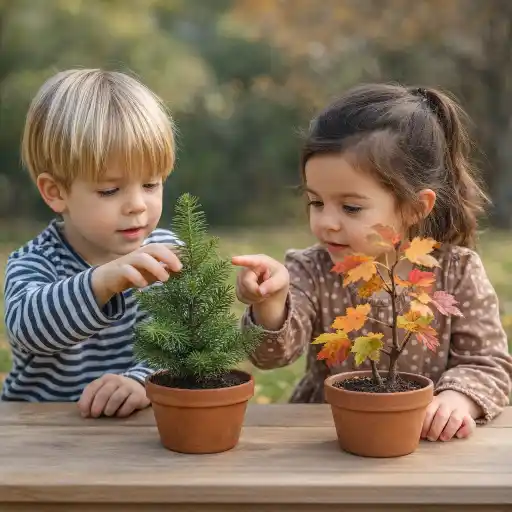
Art and representation offer another path into the investigation. Invite children to draw the two trees, create a leaf rubbing with adult support, or arrange pictures to show what they observed. The goal is not realistic artwork; it is to make children’s thinking visible. Later, compare the drawings with the trees and ask what details each child chose to include.
Build vocabulary naturally. Words such as evergreen, deciduous, needle, broad leaf, branch, attached, fallen, rough, and smooth become meaningful when children can connect them to what they see. Use precise language gently: if a child calls needles “leaves,” you can affirm the observation and model, “These narrow leaves are called needles.”
- Science: Observe features, ask questions, and describe evidence.
- Math: Count, sort, order, and compare amounts or sizes.
- Language: Share descriptions, learn vocabulary, and dictate observations.
- Creative expression: Draw, construct, or represent trees in different ways.
Keep the conversation open rather than turning it into a quiz. Research and educator resources such as Trees & Me: Activities for Exploring Nature with Young Children show how tree experiences can connect seasons, sensory exploration, art, movement, and early academic skills.
How can the experience stay safe, inclusive, and accurate?
Before going outside, inspect the route and observation area for traffic, sharp objects, unstable branches, animal waste, standing water, and unfamiliar plants or fungi. Maintain active supervision and follow your program’s procedures for weather, allergies, handwashing, and outdoor play. Do not let children taste unknown plants or handle unfamiliar materials without checking safety. State requirements vary - check your state licensing agency.
Participation can look different from child to child. Some children may want to touch a leaf; others may prefer to point, watch, photograph, draw indoors, or describe what they see from a seated position. Offer visual prompts, adaptive tools, accessible routes, and home-language words where helpful. A child does not need to speak in a group or touch a natural object to contribute a meaningful observation.
Be precise about the science. “Evergreen” describes trees that generally retain green foliage through the year, while “deciduous” describes trees that shed leaves seasonally. Many evergreen trees are conifers, but the terms are not interchangeable: conifers bear cones, and not every evergreen is a conifer. Preschoolers do not need a technical lecture; educators can model accurate language without overloading the experience.
- Use photographs or adult-selected samples when collecting natural objects is unsafe or not permitted.
- Avoid small seeds, nuts, and other potential choking hazards with children who may mouth objects.
- Observe living trees and wildlife respectfully; do not break branches or disturb habitats.
- Welcome “I’m not sure” as a valid starting point for further noticing.
These precautions protect children while preserving the wonder of the investigation. Nature-rich spaces can be designed for access and participation, as discussed in the Nature in Early Childhood toolkit.
How can documentation help children revisit their discoveries?
Brief documentation makes children’s thinking available for the next visit and helps staff plan meaningful follow-up. Record the date, a short child quote, and a drawing or photograph when appropriate. For example: “On Monday, Lila pointed to the evergreen and said, ‘It still has all its green parts.’” This captures what the child noticed without making a broad judgment about what she understands.
Use records as invitations to revisit evidence. Put two dated tree drawings side by side and ask what appears the same or different. If children have been comparing leaf shapes, offer a sorting tray or picture cards. If their attention turns to fallen leaves, return later to see whether the ground or tree has changed. Documentation is useful when it helps educators respond to children’s interests, not when it becomes paperwork for its own sake.
A resource such as the Fall Nature Picture Identification Guide Buy Now $1.50 can provide visual prompts for conversations about autumn finds. The sellable Fall Tree Comparison Field Guide can likewise serve as a practical companion for organizing children’s side-by-side noticing of evergreen and changing-color trees; adapt its use to your group’s age, access, and safety needs.
Share selected observations with families to extend the conversation beyond the program. A simple note—“We compared a tree that keeps its needles with one that is losing leaves”—invites families to notice nearby trees together. Repeatedly looking, recording, and returning helps young learners understand that seasonal change is something they can observe over time.
Conclusion: How can preschoolers notice differences among trees?
Preschoolers learn to compare evergreen and changing-color trees when educators give them time to look closely, describe visible features, and revisit their observations. Focus on leaves or needles, color, branches, bark, and the ground beneath each tree. Invite children to sort, draw, count, talk, and ask questions without demanding one fixed answer.
Keep the experience safe and flexible, use accurate language in small doses, and document children’s own observations so the investigation can continue. A local tree can become a dependable science partner: each visit offers another chance to notice what is alike, what is different, and what children wonder about next.
- CDA Preschool Credential with Portfolio Review
- What Makes Me Special: An Overview of Autism and ADHD
- From Tantrums to Triumphs: Equipping Preschoolers with Self-Regulation Skills
- Our School Age Family Tree: Children, Staff, & Parents
- CDA Bridge Bundle: Preschool
- CDA Bridge Bundle: Family Child Care without Portfolio Review
- Art from the Heart for Preschoolers: Open Ended Art Projects that Build Self-Esteem
- CDA Bridge Bundle: Infant/Toddler without Portfolio Review
- CDA Bridge Bundle: Preschool without Portfolio Review
- CDA Certification en Español: Recursos y Consejos para Educadores Bilingües
- 🥦✨ ¿Cómo apoyar a los niños selectivos a probar nuevos alimentos sin presión?
- Apoyo en Español para Capacitaciones Grupales Presenciales y por Zoom en Cursos Selectos
- ¿Cuáles son las mejores actividades del Día de la Tierra para niños en casa o en el aula?
- 10 Ejemplos de Cómo la Cultura Influye en el Desarrollo Infantil
- Proporciones de Cuidado Infantil y Tamaños de Grupo por Edad en Maryland (Guía Rápida para Centros y Hogares)
- Proporciones de Cuidado Infantil y Tamaños de Grupo por Edad en Virginia (Guía Rápida para Centros y Hogares)
- Actividades de Otoño Fáciles para Preescolares esta Temporada
- Cómo Trabajar en el Cuidado Infantil en Carolina del Norte: Requisitos y Pasos
- Calabazas, hojas y manzanas: actividades de otoño para preescolares
- Celebrando la amistad en el cuidado infantil durante el Día de los Mejores Amigos
- Canciones, juegos y preguntas de círculo para niños
- Cómo simplificar la capacitación para sus empleados de daycare
- Rainy Fall Day? 12 Indoor Activities Preschoolers Won’t Want to Stop
- Fall Detectives: 10 Questions Pre-K Kids Can Investigate This Season
- What Should You Keep in the Classroom After Halloween Ends?
- What Can Preschoolers Learn by Watching Trees Change Throughout the Fall?
- Why Can Observing the Same Tree Teach Preschoolers More Than a Nature Walk?
- How Can Five Visits to the Same Tree Become a Preschool Investigation?
- How Can Preschoolers Tell Evergreen Trees from Trees That Change Color?
