Everyday routines and play are filled with opportunities to strengthen children’s understanding of numbers, quantities, patterns, comparisons, and relationships. Child care providers can build early number sense by counting children during transitions, comparing block towers, sorting classroom materials, sharing snacks, noticing patterns, and asking simple questions such as “How many?” “Which has more?” or “What comes next?” This article gives directors and providers practical, research-informed ways to turn ordinary moments into meaningful math learning through brief, scaffolded interactions, accessible materials, and family partnerships. The goal is to make math feel playful, useful, and natural rather than dependent on worksheets or formal drills.
To strengthen these practices, explore ChildCareEd’s self-paced online course Math Foundations in Early Childhood  Buy Now $16.00. The course provides hands-on strategies for integrating numbers, problem-solving, exploration, and developmentally appropriate math activities into everyday teaching and play. Educators can use these strategies to create small, repeated learning moments that gradually build children’s mathematical confidence and understanding.
What is number sense and why does it matter?
Number sense refers to the flexible, intuitive understanding of numbers—magnitude, subitizing, one-to-one correspondence, ordering, and mental strategies. Why it matters:
- 🔢 Strong early number sense predicts later math achievement; early interventions narrow gaps (see play-based intervention research at Narrowing the Early Mathematics Gap).
- 🗣️ Math talk builds language and reasoning: children who explain strategies show larger gains (Teacher-Child Math Interactions).
- 🎯 Number sense is versatile—supports counting, measurement, patterning, and problem solving; see practical framing in Mathematical Skill Development.
Why it matters:
1) Early, playful math moments build confidence and reduce later math anxiety. 2) Play-oriented approaches promote deep conceptual learning more effectively than worksheets alone (Math in Early Childhood).
Use these core hashtags to flag resources and plans: #numberSense #playbased #preschoolers #earlychildhood #math
How can I turn daily routines and play into short math moments?
Routines are predictable opportunities for math. Use 1–3 minute interactions and keep them consistent. Examples you can implement today (and adapt):
- 🍎 Snack time counting
- 1) Ask: “We need four apple slices — how many more do we need?”
- 2) Use physical pieces for 1:1 correspondence (see Counting Fun for Preschoolers).
- 🧤 Dressing, cubbies, clean-up
- 1) Sort mittens by size/color and ask which pile has more/fewer.
- 2) Give a target: “Put 5 blocks in the box.”
- 🚶 Transitions and outdoors
- 1) Count steps to the gate; compare who is first/last.
- 2) Nature scavenger hunts: tally and graph items collected.
Research and practice show these short, context-rich moments increase number learning when teachers use targeted questions and follow the child’s lead; see classroom examples in North Dakota: Number Sense in Routines and evidence from play-focused studies (systematic review of math games).
What activities work best by age (infants, toddlers, preschool)?
Choose materials and language appropriate to developmental levels. Use brief, repeated practice embedded in play rather than formal lessons. For another classroom-ready approach, explore adding math to the early childhood classroom, including playful number-recognition activities such as number fishing.
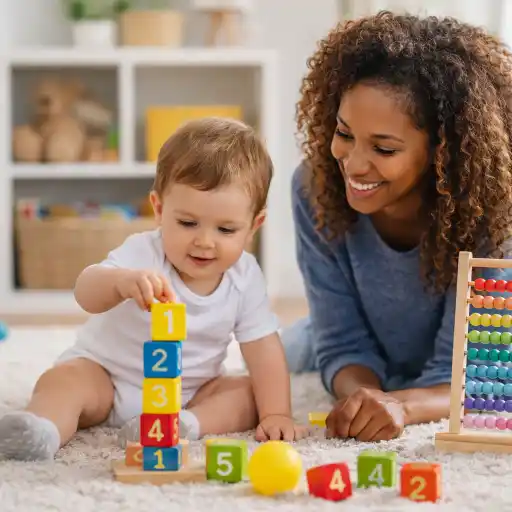
- Infants (0–18 months)
- 🔹 Sensory bins with big vs. small objects; name sizes and say simple counts during handling. See infant/toddler lesson examples at Math Lesson Plan for Infants/Toddlers Buy Now $0.00.
- 🔸 Counting rhymes at diaper changes or during feeding to build number words.
- Toddlers (18–36 months)
- 🍪 Snack counting with manipulatives; sort objects by color/size.
- 🔹 Simple matching games: find the same number of items as pictured.
- Preschoolers (3–5 years)
- 🧩 Roll-and-cover, ten-frames, subitizing games, and storybook math. ChildCareEd offers many printable roll-and-graph and themed mats in its activity library (Math Foundations resources).
- 🎲 Open-ended building: compare heights, make sets, and prompt estimation (“Which tower looks like 6?”).
Tip: rotate materials weekly to maintain novelty and always scaffold with math talk—ask “How many?” “Which is more?” “How do you know?” Research confirms teacher-child math talk supports gains (Teacher-Child Math Interactions).
How do I plan, observe, and assess number sense without extra paperwork?
Keep documentation brief, purposeful, and tied to play. Use a 4-step loop that fits into daily practice:
- 🔎 Observe: watch natural play and routines; note 1–2 specific behaviors (e.g., "counts to 7 with 1:1 correspondence").
- 🗂️ Plan: set a weekly tiny goal for the group (3–10 minute activities, 2–3 times a week).
- 🧠 Teach: scaffold with targeted questions and models; use manipulatives and storybooks (math through stories research supports this).
- ✍️ Check: brief play-based checks—ask a child to show a number on a ten-frame or to make a set of 5 items; record a one-line note or photo.
Keep records to one line per child per week or a quick photo in a folder. State requirements vary - check your state licensing agency when deciding on formal documentation. If you need training or structured curricula, consider ChildCareEd's courses such as Math Foundations in Early Childhood Buy Now $16.00 or short courses like No Such Thing as Boring Math (course page).
What common mistakes should I avoid, how can families help, and FAQs?
Common mistakes and fixes (quick list):
- ⚠️ Mistake: Over-reliance on worksheets. Fix: prioritize hands-on play, stories, and games (Math in Early Childhood).
- ⚠️ Mistake: Introducing too many new words at once. Fix: teach 2–3 math words (e.g., more/fewer, first/last) and repeat them in routines.
- ⚠️ Mistake: Skipping observation. Fix: use short, regular play-based checks to tailor next steps.
Partnering with families (practical steps):
- 📣 Send one simple home activity weekly (count stairs, match socks, snack counting).
- 👪 Host a math-play night where families try roll-and-graph games and storybook math; use ChildCareEd printables as take-home models (Counting Fun).
- 💬 Share language prompts families can use: “How many?” “Which group has more?”
FAQ (brief):
- Q: When should I start math? A: From infancy—math talk during care routines builds early foundations.
- Q: Are worksheets acceptable? A: Sparingly; prioritize manipulatives, play, and conversation.
- Q: How often to check skills? A: Short, play-based checks every 2–4 weeks are realistic and informative.
- Q: Where to get ready-to-use materials? A: See ChildCareEd’s activity library and free PDFs (Math Foundations resources).
Final encouragement: small, joyful math moments embedded in routines add up. By using play, targeted questions, and brief observations, you create a strong #numberSense foundation in your #preschoolers program. For research-informed approaches to teacher-child interactions during play, see this video study and the systematic review on math games (Journal of Numerical Cognition).
Conclusion
Everyday play and routines give you countless low-burden chances to strengthen number sense. Use short, scaffolded interactions, age-appropriate materials, and consistent math talk. Observe briefly, plan one tiny goal at a time, and invite families to join the fun. With small changes—counting snacks, comparing collections, reading number-rich stories—you’ll help children develop confidence and a flexible understanding of numbers that supports long-term success. For practical templates, printables, and training, explore ChildCareEd’s resources and courses linked throughout this article.
- Early Mathematics Through Play
- CDA Home Visitor Subject Area 3 Part 3 Birth to 5
- CDA Home Visitor Subject Area 2 Part 3 Birth to 5
- Emergent Learning & Development
- Moving About the Classroom: Effective Transitions for Everyday
- Creating Environments that Nurture Growth and Community
- Texas Director Credential
- Access for All: Inclusion and the ADA
- CDA Infants/Toddlers: Stages of Development
- Everyday Safety: Creating Healthy Environments
- Mathematical Skill Development
- 🎉STEM-sational Fun: How Can You Spark Preschoolers’ Curiosity with Engaging STEM Activities? 🔬🧪🔢
- 10 Ejemplos de Cómo la Cultura Influye en el Desarrollo Infantil
- Canciones, juegos y preguntas de círculo para niños
- How can I use simple math activities for preschoolers every day?
- How can North Dakota child care providers build number sense in everyday routines?
- How can preschool classrooms effectively support early math skills?
- How can everyday play build number sense in young children?
- How can preschool programs intentionally support early math skills every day?
- How can I teach early math through everyday routines?
- How Do I Introduce Measurement to Young Children?
- How Do You Explain Ego to a Child Without Making It Sound Like a Bad Thing?
- How Can Preschool Math Become Meaningful, Playful, and Part of Every Day?
- How Do Light vs. Heavy Activities Build Early Measurement Skills?
- How Can Even vs. Odd Sorting Introduce Early Number Sense?
- How Can Early Math Activities Build Young Children’s Mathematical Thinking?
- How Can Short, Focused Practice Build Subtraction Fluency Within 10?
- How Can Addition Review Feel Purposeful and Engaging for Young Children?
- How Can Independent Practice Connect Numerals and Number Words?
