When the last block is put away or the snack bowl is empty, children encounter a powerful mathematical idea: none left. Build on these everyday moments with Early Mathematics Through Play Buy Now $24.00, a course that offers practical strategies for teaching number sense and other math concepts through routines and hands-on exploration; explore it alongside the activities below to strengthen your classroom practice.
Why does zero deserve intentional attention?
Children often learn to count visible objects before they understand that a collection can contain zero objects. The idea is deceptively complex: zero describes an empty set, is represented by the symbol 0, and functions as a number in a sequence. A child may understand “all gone” without yet connecting that familiar phrase to the mathematical word zero or its written symbol.
Research on preschoolers suggests that children may use empty sets in practical number tasks even while they remain unsure whether zero is a number. Language also matters: a child who hesitates when asked to “give zero” may respond successfully to “give none.” These differences are useful information for educators, not a reason to assume a child is not ready to learn.
Intentional conversations about empty collections help make mathematical thinking visible and give children language for what they notice. They also lay groundwork for later learning about subtraction, number order, and place value. NAEYC’s discussion of intentional instruction and playful early math experiences reinforces the value of connecting concepts with meaningful activities.
How can everyday routines make “none” visible?
Start with familiar situations in which children can see a collection change. During snack, for example, count the blueberries in a small bowl, then notice together when the bowl is empty. During cleanup, look into a basket after the blocks have been put away. Name what children observe and connect several expressions: “It is empty. There are none left. There are zero blocks.”
Keep the tone curious rather than turning every moment into a quiz. Try describing what happened first, then invite children to add their ideas. Repeating the same words across routines supports understanding without requiring a separate lesson each time.
- At snack: “There were three crackers. We ate them all. How many are left?”
- At cleanup: “Let’s look in the basket. Are there any cars inside?”
- At arrival: “How many friends are wearing rain boots today?” If none, model: “Zero friends are wearing rain boots.”
- In dramatic play: use empty food containers and ask what is inside, allowing children to answer “nothing,” “none,” or “zero.”
Offer objects children can safely handle and inspect. For infants and toddlers, use large, age-appropriate materials and close supervision; avoid small loose parts with children who may mouth objects. These everyday experiences build the groundwork for #number concepts and help children connect words with what they can observe.
What hands-on activities help children explore empty sets?
Simple, repeatable activities give children a chance to compare an empty collection with one that contains objects. A set of cups, baskets, toy animals, or large counters can become a small-group investigation. Invite children to make predictions, check what is inside, and describe what they find. Keep the focus on reasoning and conversation, not speed or worksheet completion.
- Empty-container search: Place several safe containers around a table. Leave some empty and put one or two large objects in others. Children inspect each container and sort it into “empty” or “has something.” Introduce the numeral 0 after the meaning is clear.
- Fill and empty: Give each child a container and a small set of large, safe objects. Fill it, count together, then remove every object. Say, “Now there are zero objects inside.” Repeat with different quantities.
- Zero spot on a frame: Show a simple five-frame with no counters, then add counters one at a time. Talk about how the empty frame shows zero and how each added counter changes the amount.
- 🔎 Zero detective: Look for empty spaces in the classroom—a basket with no balls, a shelf with no books—and let children explain what is absent.
As children grow comfortable, compare zero with one, then with other small quantities. Ask open questions such as “How do you know this container is empty?” and “What changed when we put one block in?” Linking the concrete collection to the numeral gradually supports #reasoning and representation. Activity packs such as ChildCareEd’s Zero and Something Math Activity Pack can provide additional structured practice alongside these open-ended explorations.
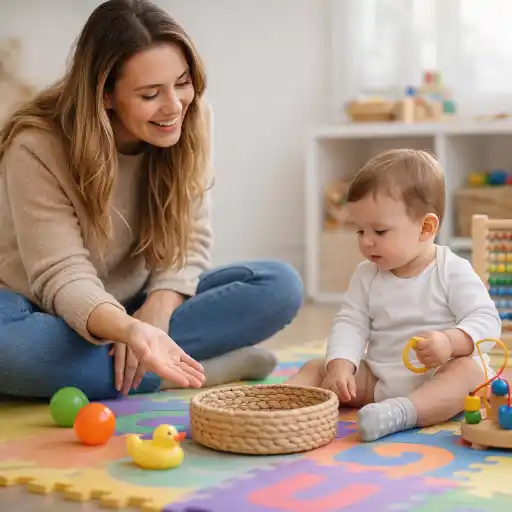
How should educators connect zero, language, and the symbol 0?
Children may understand the idea before they use the conventional math vocabulary. Treat words such as “none,” “nothing,” “empty,” and “all gone” as valuable starting points, then model the mathematical connection naturally: “Right, there are none left—zero cookies.” Avoid insisting that a child repeat “zero” before continuing the play; consistent modeling offers a low-pressure bridge from everyday speech to mathematical language.
Once children can describe an empty collection, show the symbol 0 beside it. Match symbol and quantity using cards, drawings, or a simple number path that begins at zero. For example, place a card with 0 beside an empty basket, and a card with 1 beside a basket with one object. Invite children to match, explain, or choose between the representations. Some children may recognize the symbol before they fully understand its meaning, so continue to connect it to real collections.
Use clear, short prompts. “Give the puppet zero blocks” may be less accessible than “Give the puppet no blocks.” After the child responds, restate the action using both forms: “You gave the puppet none—zero blocks.” Research summarized by DREME notes that some preschoolers respond more successfully to “no” or “any” language than to a direct request involving the word zero. Thoughtful #language scaffolding respects children’s current understanding while extending it.
What misconceptions and teaching pitfalls should providers avoid?
Zero can invite misunderstandings because it represents absence while still functioning as a number. Rather than correcting children abruptly, listen for the idea behind their response and offer a concrete example. If a child says an empty bowl has “nothing,” affirm the observation and add the mathematical term: “Yes, nothing is in the bowl. It has zero pieces of fruit.”
- Assuming counting fluency means zero is understood: A child may recite the counting sequence but need further experience connecting zero to an empty set.
- Teaching the symbol first: Tracing 0 can support numeral recognition, but it cannot replace hands-on experiences with empty collections.
- Using “zero” as a test word: If a child struggles with the term, try “none” or “no objects” and model the connection calmly.
- Moving too quickly to place value or equations: First help children make sense of zero as none; introduce more abstract uses when they are ready.
- Expecting identical progress: Children’s language, prior experiences, and developmental pathways differ. Observe their strategies and adjust support.
Document brief observations rather than relying on a single correct answer: note whether a child identifies an empty container, uses “none,” recognizes 0, or matches the numeral to a collection. These details help educators choose a helpful next step. Keep activities accessible through objects, pictures, gestures, spoken language, or a child’s home language whenever possible. Small adjustments can make #play-based math welcoming to more learners.
How can providers extend learning and reflect on progress?
After children explore empty collections, revisit the idea in new contexts. A short number story can make the change clear: “There were four toy ducks in the pond. They all went to the barn. How many are still in the pond?” Use toys or drawings so children can act out the situation before connecting it with an equation such as 4 − 4 = 0. Another day, show that adding zero objects leaves the original collection unchanged, but avoid rushing into formal operations if the concrete idea is still developing.
Observe what children do and say across several experiences. Do they notice when expected objects are missing? Can they distinguish an empty set from a set of one? Do they use “none” or “zero,” and can they connect the word to the symbol? A wrong or unexpected response can reveal how a child is interpreting the question, so offer another representation or rephrase the prompt before drawing conclusions.
Directors can support consistent practice by keeping a small set of reusable materials available and inviting staff to share observations during team planning. A brief reflection might include one child’s strategy and one possible extension—for instance, add a 0 card to a container-matching activity. Providers seeking a broader foundation can explore Early Mathematics Through Play Buy Now $24.00, which addresses number sense, counting, early operations, and ways to incorporate math across routines and play. Training and licensing expectations differ; state requirements vary—check your state licensing agency.
Conclusion: How can we help children understand that “there are none” is zero?
Teaching zero begins with experiences children can see and describe: an empty plate, a cleared basket, or a container with nothing inside. Providers can build meaning by using accessible words such as “none” and “empty,” modeling “zero,” and gradually connecting real collections with the numeral 0. Hands-on games and short conversations are effective when they are repeated, playful, and responsive to each child’s thinking.
Remember the core teaching moves: show the empty set, name it in everyday and mathematical language, connect it to the symbol, and observe what children understand before extending the challenge. Progress may look different from child to child, and that is expected. With steady, supportive opportunities, children can discover that “there are none” is not a dead end—it is a meaningful mathematical idea and the beginning of deeper number learning.
Explore related professional learning:

- 45 Hour Child Growth and Development
- Early Mathematics Through Play
- 45 Hour Preschool Methods and Materials
- Play with Purpose: Supporting Children with Autism
- No Such Thing as Boring Math
- Texas Director Credential
- Enhancing STEM Education for Infants and Toddlers
- Every Moment Matters: Schedules and Transitions
- CDA Certification en Español: Recursos y Consejos para Educadores Bilingües
- Cómo Abrir Una Quardería En Casa Sin Dinero?
- Requisitos Para Ser Maestra Principal En Un Daycare: Lo Que Necesitas Para Empezar
- Capacitación en Salud y Seguridad Preventiva en Línea para Proveedores de Cuidado Infantil
- Regulaciones de Licenciamiento de Cuidado Infantil en California para Centros y Hogares de Cuidado Infantil Familiar
- Normas de Licenciamiento de Cuidado Infantil en Virginia para Centros Diurnos Infantiles y Hogares Diurnos Familiares
- Proporciones de Cuidado Infantil y Tamaños de Grupo por Edad en Maryland (Guía Rápida para Centros y Hogares)
- Proporciones de Cuidado Infantil y Tamaños de Grupo por Edad en Nueva Jersey (Guía Rápida para Centros y Hogares)
- Proporciones de Cuidado Infantil y Tamaños de Grupo por Edad en Virginia (Guía Rápida para Centros y Hogares)
- Lista para Guardería en Casa en Texas: Cómo Iniciar una Guardería en el Hogar
- Cómo Trabajar en el Cuidado Infantil en Carolina del Norte: Requisitos y Pasos
- Cómo Trabajar en el Cuidado Infantil en California: Requisitos y Pasos
- Cómo Trabajar en el Cuidado Infantil en Wisconsin: Requisitos y Pasos
- Cómo Ser Maestra de Preescolar en Maryland
- Capacitación Previa al Servicio para Proveedores de Cuidado Infantil en Virginia
- Cómo Ser Maestra de Preescolar en Virginia
- Capacitación CDA gratuita en Illinois
- Celebrando la amistad en el cuidado infantil durante el Día de los Mejores Amigos
- Cómo simplificar la capacitación para sus empleados de daycare
- How Can Child Care Providers Teach Zero Through Empty Collections?
