Preschool mathematics flourishes when children can touch, compare, build, talk, and wonder—not simply complete worksheets. The Early Mathematics Through Play Buy Now $24.00 course can help providers strengthen classroom practice with developmentally appropriate strategies for counting, number sense, patterns, geometry, measurement, and reasoning while earning a certificate after completing the course requirements.
Why does preschool math matter beyond counting?
Young children encounter mathematics whenever they decide whether one block tower is taller, determine how many cups are needed at snack, or notice that a song repeats the same rhythm. These experiences develop #numberSense, spatial reasoning, language, persistence, and problem-solving. Head Start’s preschool mathematics goals include number names and quantities, comparison, early operations, patterns, measurement, shapes, and spatial relationships, offering a useful framework for planning balanced experiences (Head Start preschool mathematics goals).
Early math is also an equity issue. Children do not lack ability because they have had fewer opportunities to explore quantities or shapes; they may simply need more intentional access to rich materials and responsive adult interaction. NAEYC describes children as active mathematical thinkers who learn through stacking, filling, sorting, measuring, and solving meaningful problems (making math meaningful).
For directors, a math-rich program does not require an expensive new curriculum. It requires shared expectations, accessible materials, and a staff culture that recognizes mathematical thinking throughout the day.
Which preschool math concepts should educators prioritize?
Prioritize a coherent progression rather than rushing children toward formal arithmetic. Children benefit from repeated opportunities to connect concrete actions, mathematical language, drawings, and eventually numerals. The following strands provide a practical planning map:
- Number sense and counting: one-to-one correspondence, cardinality, subitizing small groups, and recognizing numerals.
- Comparison and operations: more, fewer, equal, adding to, taking away, and sharing.
- Patterns and data: repeating sequences, sorting by attributes, tallying, and representing results.
- Geometry and spatial reasoning: identifying, composing, transforming, and describing shapes and positions.
- Measurement: comparing length, weight, capacity, temperature, and time with informal tools.
Illinois Early Learning’s overview of the big ideas of early math emphasizes sets, patterns, number sense, counting, operations, measurement, spatial relationships, shape, and data analysis (mathematical thinking across the preschool curriculum). This broad view helps teachers avoid defining math as “number work” alone.
Use observation to determine the next step. If a child recites numbers but does not coordinate one number word with each object, provide smaller collections and model pointing. If a child counts accurately, invite comparison or “one more” problems. Progression should be responsive, not identical for every child.
How can routines become daily math instruction?
Routines provide frequency, relevance, and predictability. A one-minute interaction repeated across several days can be more meaningful than an isolated worksheet lesson. Use a simple cycle: observe, name the concept, pose a question, and document what you learned.
- At arrival, graph attendance with name cards and ask, “How many children are here today?”
- At snack, distribute one plate or piece of fruit to each child and discuss equal shares.
- During transitions, count steps, claps, or children while using first, next, and last.
- During cleanup, sort materials by type, color, size, or classroom location.
- At the sensory table, compare full, empty, heavier, lighter, more, and less.
- In the block area, compare towers and use words such as taller, shorter, wider, behind, and beside.
Math talk is the bridge between action and concept. Ask open questions such as “What do you notice?”, “How could we find out?”, and “How do you know?” Avoid turning every interaction into a test. When children offer an incorrect answer, invite another strategy: “Let’s check by touching each object as we count.”
The NAEYC mathematics resources and DREME’s free teacher materials (DREME for Teachers) offer additional ideas for embedding mathematics into play and routines.
What hands-on activities work across preschool ages?
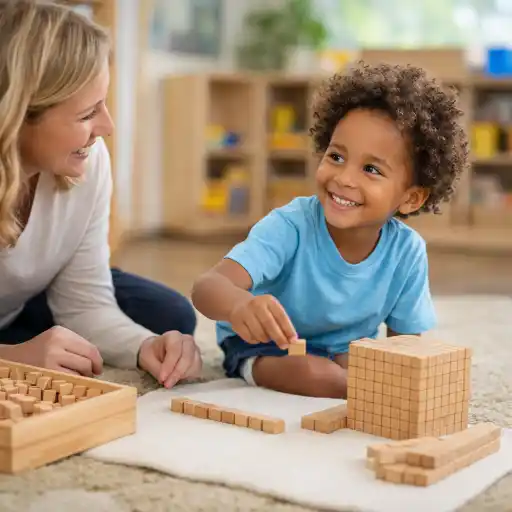
Developmentally appropriate math activities are active, brief, repeatable, and adaptable. Materials should invite more than one solution and allow children to represent thinking in different ways.
- Young toddlers: offer large objects to fill and dump, stack, nest, match, and compare. Narrate “in,” “out,” “big,” “small,” and “more.” Avoid small parts that create choking hazards.
- Three-year-olds: count snack pieces, sort buttons or natural objects with supervision, match dot cards to collections, and play simple roll-and-cover games.
- Four-year-olds: build shape pictures, create repeating bead or movement patterns, measure tables with blocks, and solve story problems with props.
- Five-year-olds: use ten-frames, number puzzles, measurement stations, simple graphs, and “how many more?” situations with manipulatives.
🎲 A dice-and-graph game can combine counting, one-to-one correspondence, data representation, turn-taking, and conversation in one short experience. Children might roll, place a counter on a matching column, and compare which column has more. The goal is not speed; it is helping children explain what they see.
Use classroom materials creatively: cardboard tubes for sorting, scarves for patterns, blocks for measurement, containers for capacity, and picture books for mathematical language. ChildCareEd’s Math Foundations resources include free materials such as Counting & Skip-Counting with Bead Chains and Math Mittens.
How can teachers assess preschool math without overtesting?
Assessment should inform teaching, not interrupt children’s play. Observe what children do spontaneously, then offer a brief prompt that reveals their thinking. Record specific behavior rather than a vague judgment such as “understands numbers.”
- Observation note: “During snack, Maya counted six crackers, touching each once, and stated that the last number told how many.”
- Short probe: “Can you make a group with five counters?” or “Which tower is taller? How can we check?”
- Work sample: photograph a block structure, graph, pattern, or drawing and record the child’s explanation.
- Planning response: identify one next step, such as moving from counting five objects to comparing two collections.
The REL Teaching Math to Young Children Toolkit recommends developmental progressions, daily mathematics, progress monitoring, and teaching children to view their world mathematically (Teaching Math to Young Children Toolkit). A practical classroom rhythm is to collect one meaningful observation per child each week and conduct a brief play-based check every few weeks.
Common mistakes include relying on worksheets, introducing too much vocabulary at once, correcting without asking children to reason, and using one pace for the entire group. Choose two or three target words, repeat them in context, and differentiate materials or prompts. State requirements vary - check your state licensing agency when determining documentation or training expectations. Educators who are new to the classroom may also find these practical tips for teaching preschool helpful for handling mistakes and everyday frustrations.
How can directors and families sustain a math-friendly culture?
Consistency across adults matters. Directors can select one program goal each month—such as comparing quantities to five—and identify three routines where teachers will practice it. A small math shelf with counters, blocks, dice, ten-frames, measuring tools, shape pieces, and clipboards can support spontaneous learning without extensive preparation.
- Use weekly team huddles to share one child observation and one instructional question.
- Post mathematical language near centers so staff can use consistent terms.
- Invite teachers to photograph children’s strategies and discuss possible next steps.
- Provide professional learning such as Math Foundations in Early Childhood
 Buy Now $16.00 to deepen staff knowledge and expand hands-on planning.
 - For staff serving younger children, consider Enhancing STEM Education for Infants and Toddlers Buy Now $16.00, which includes strategies for integrating early mathematics into daily care.
Families can reinforce learning through ordinary activities: count stairs, sort laundry, compare grocery quantities, notice shapes on signs, or measure ingredients. Send one short suggestion at a time, such as “At dinner, ask your child which plate has more peas and how they know.” Honor home languages and familiar cultural materials; children can reason mathematically even while developing English.
Summary: What makes preschool math effective?
Preschool math becomes meaningful when it is visible, playful, relational, and connected to children’s real questions. The essential answer is not to add longer lessons, but to use intentional interactions throughout the day.
- Prioritize number sense, comparison, operations, patterns, measurement, geometry, spatial reasoning, and data.
- Embed short prompts into arrival, snack, transitions, centers, outdoor play, and cleanup.
- Use manipulatives, stories, movement, and open-ended questions rather than worksheets alone.
- Observe specific strategies and use brief notes to plan the next step.
- Build shared staff practices and invite families into low-preparation math experiences.
Every time a child compares two towers, distributes cups fairly, or explains a pattern, that child is developing mathematical identity and competence. Your calm, curious responses help children see themselves as capable mathematicians.
Additional course options: No Such Thing as Boring Math Buy Now $24.00 supports play-based mathematical exploration, while Letter & Number Planning in Child Care Buy Now $24.00 connects numeracy and literacy planning.
- 45 Hour Child Growth and Development
- CDA Preschool Credential
- Early Mathematics Through Play
- CDA Preschool Credential with Portfolio Review
- 45 Hour Preschool Methods and Materials
- CDA Bridge Bundle: Preschool
- CDA Bridge Bundle: Preschool without Portfolio Review
- No Such Thing as Boring Math
- Texas Director Credential
- ¿Cuáles son las mejores actividades del Día de la Tierra para niños en casa o en el aula?
- Normas de Licenciamiento de Cuidado Infantil en Virginia para Centros Diurnos Infantiles y Hogares Diurnos Familiares
- Celebrando la amistad en el cuidado infantil durante el Día de los Mejores Amigos
- How Can I Use Fun Math Activities for Preschoolers Every Day?
- How can I use simple math activities for preschoolers every day?
- Count It, Sort It, Find It! Fall Math Games for Preschoolers
- Can You Build a Leaf Bridge? Fall STEM Challenges for Pre-K
- How Can Cut, Sort, and Glue Activities Strengthen Early Learners’ Development?
- How Can Preschool Math Become Meaningful, Playful, and Part of Every Day?
- What Are the Best Print-and-Play Activities for Substitute Teachers?
- How Can Child Care Providers Build Strong Early Math Skills Every Day?
- Which Printable Activities Belong in Every Preschool Classroom?
- How Can Early Math Activities Build Young Children’s Mathematical Thinking?
- How Can Cleanup Time Become a Lesson in Sorting, Counting, and Teamwork?
- How Can You Teach Numbers to Ten with Ten-Frames and Visual Models?
- How Can Concrete Models Help Children Understand Subtraction Before Worksheets?
- How Can Patterned Practice Help Young Children Master Subtraction Facts?
- How Can Child Care Programs Protect Preschool Playtime When the Schedule Gets Crowded?
- How Can Teachers Turn Everyday Play Into Learning Opportunities?
- How Can Toddler Classroom Jobs Build Early Math Beyond Counting?
