Children are already doing math when they fill a cup, line up cars, or decide who has more crackers—your classroom can turn these moments into meaningful learning without costly kits. Explore Early Mathematics Through Play Buy Now $24.00 for practical strategies to connect counting, patterns, geometry, and measurement with daily routines; Math Foundations in Early Childhood  Buy Now $16.00 offers another focused path for strengthening hands-on classroom practice. Read on for low-preparation ideas and ways to notice the mathematical thinking children already bring.
Why are everyday objects powerful tools for early math?
Young children make sense of mathematics by acting on real things. A spoon, cardboard tube, pinecone, or set of blocks can be counted, compared, grouped, arranged, measured, and transformed. Because these materials are familiar and concrete, they help children connect abstract ideas—such as quantity, shape, and size—to experiences they can see and touch.
Everyday objects also invite agency. Unlike a toy with one prescribed use, an open-ended object may become part of a tower, a pretend meal, a sorting collection, or a pattern. Children can test ideas, notice results, and revise their plans. This exploration supports reasoning, language, persistence, and collaboration alongside early math knowledge.
Providers do not need to turn every play episode into a formal lesson. The goal is to notice the math already present, name it naturally, and offer a question that extends thinking. The What Works Clearinghouse recommends daily math instruction integrated across the school day, with teaching that builds on children’s developing understanding. Consistent, responsive moments often have more value than occasional complicated activities.
Think of materials as invitations rather than answers. A muffin tin can prompt one-to-one matching; a collection of leaves can invite sorting by shape or size; cups and water can make capacity visible. The key is purposeful observation, appropriate vocabulary, and enough time for children to explore.
Which common materials support different math concepts?
Start with objects already available in the program, then select materials that are safe, washable when needed, and appropriate for children’s ages and abilities. A small, thoughtfully chosen collection can support a wide range of ideas.
- Counting and number sense: Use large blocks, toy animals, socks, or serving items. Invite children to count each object once, match a quantity to a numeral, or compare two groups.
- Sorting and classification: Offer leaves, fabric pieces, large lids, or blocks that differ in color, shape, texture, or size. Ask, “How else could we group these?”
- Patterns: Arrange large objects in a repeating sequence—such as smooth/rough or red/blue—and invite children to continue or invent a pattern.
- Geometry and spatial thinking: Use boxes, tubes, blocks, and containers to build, fit, stack, and describe positions such as beside, under, inside, and above.
- Measurement: Compare objects directly or use same-sized blocks, footsteps, cups, or pieces of yarn as informal measuring units.
- Data: Sort children’s observations—such as which outdoor object they found most interesting—and represent the results with marks, pictures, or a simple class graph.
These examples align with the early math “big ideas” described by the Illinois Early Learning Project: sets, patterns, number, counting, operations, measurement, spatial relationships, shape, and data analysis. Reusing the same materials in new ways lets children revisit concepts and deepen their strategies instead of constantly starting over.
How can providers build math into routines and play?
Daily routines are reliable settings for brief math conversations. At snack, children can count pieces, distribute one item to each person, or compare which plate has more. During cleanup, they can sort materials by type or size. On a walk to the playground, count steps, look for shapes, or compare which route is longer.
At play centers, follow children’s interests. If children are building, ask how they might make a bridge longer or keep a tower balanced. At the sensory table, offer cups and scoops and use words such as full, empty, more, less, and equal. Stanford’s DREME Math Moments resource highlights how short interactions during mealtime, transitions, cleanup, and play can make math part of the whole day.
Try a simple adult interaction cycle:
- Notice: Describe what the child is doing without judging it: “You placed the large lids in one group.”
- Name: Add one or two useful terms: “These are wider; those are narrower.”
- Ask: Invite the child to explain or extend: “What do you notice?” or “Can you find another way?”
- Wait: Give time for children to think, respond, and try again.
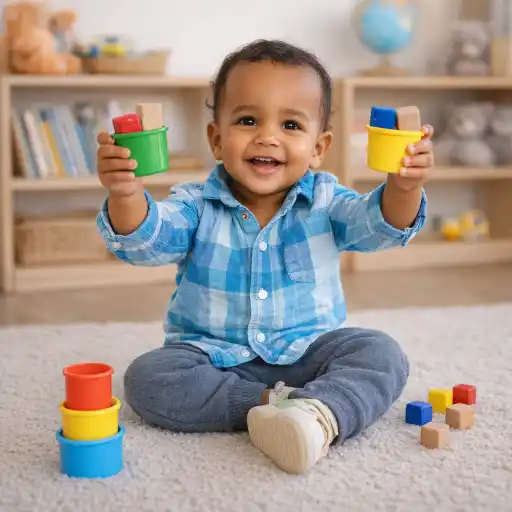
For infants and toddlers, narrate simple comparisons and spatial relationships during play and caregiving routines. For preschoolers, add predictions, drawings, numerals, or a simple graph when these representations fit their readiness. Keep the interaction playful; children do not need to produce a single expected answer to be learning.
How can open-ended activities make math visible?
Open-ended invitations let children use ordinary objects to explore several ideas at once. For example, place large natural objects and a few baskets on a table. Children may sort them, count a collection, compare sizes, make a repeating arrangement, or design a structure. Observe what emerges before deciding which concept to highlight.
- 🧱 Build and compare: Offer blocks or sturdy boxes. Ask children to make a structure taller, wider, or more stable than another, then describe how they know.
- Fill and pour: Provide age-appropriate cups, bowls, and scoops at a supervised water or sensory station. Compare capacity and count scoops.
- Sort and re-sort: Invite children to organize large objects by one feature, then challenge them to find a different sorting rule.
- Make a pattern: Use fabric squares, large blocks, or natural items to create, continue, or change a sequence.
- Measure with a unit: Use identical blocks or footsteps to measure a book, table, or path; discuss why consistent units make comparisons clearer.
The NAEYC discussion of early math play illustrates how even infants and toddlers explore quantity, shape, comparison, and spatial relationships through ordinary objects and movement. With young children, the process matters more than a finished product: touching, arranging, filling, dumping, and trying again are meaningful mathematical actions.
Adapt invitations to provide different entry points. Offer larger objects for easier grasping, visual examples where useful, and opportunities to participate through pointing, movement, home-language conversation, or collaboration. Check materials for hazards and supervise closely; avoid small parts with children who may mouth objects. Everyday does not mean automatically safe, so follow program procedures and applicable requirements.
How can providers observe learning and avoid common pitfalls?
Assessment can be woven into play without interrupting it. Watch how a child approaches a task, listen to the words they use, and record a brief note about the strategy. For example: “Sorted lids by color, then noticed two groups had the same number.” This tells you more than a note that simply says the child completed an activity.
- Observe strategies: Does the child touch each item while counting, compare by lining objects up, or use a repeated sequence?
- Capture evidence: Save a short observation, a child’s explanation, a drawing, or a photograph of a construction, following program privacy practices.
- Plan a next step: Offer a little more support, repeat the experience, or add a manageable challenge based on what you noticed.
- Partner with families: Share a simple connection, such as sorting laundry, counting steps, or comparing containers during cooking.
Common pitfalls include turning play into a quiz, correcting every mistake immediately, introducing too many new terms at once, or expecting every child to use the same strategy. Instead, ask open questions such as “How did you figure that out?” and treat errors as useful information about a child’s current thinking. The What Works Clearinghouse emphasizes progress monitoring and building instruction on what children know.
Equity also matters. Everyday materials should reflect children’s interests, cultures, and communities; explanations in a child’s home language are valuable mathematical thinking. Ensure that children with disabilities can access the materials and participate meaningfully. State requirements vary - check your state licensing agency when aligning curriculum, assessment, or training documentation.
Conclusion: How can everyday objects strengthen early math learning?
Child care providers can support early math by making ordinary materials available, noticing the concepts children explore, and adding concise language and thoughtful questions. Blocks, containers, fabric, natural objects, and routine items can all help children investigate counting, sorting, patterns, geometry, measurement, and data—without costly supplies or a separate long lesson.
Begin with one idea this week. Choose a familiar routine, prepare a few safe objects, and observe how children use them. Ask what they notice, document one strategy, and use that observation to plan what comes next. When providers treat children’s everyday discoveries as worthy of attention, math becomes visible, meaningful, and joyful.
For a more structured professional learning experience, explore these English-language ChildCareEd courses:
- Early Mathematics Through Play Buy Now $24.00 — strategies for integrating early math into play, routines, and hands-on exploration.
- Math Foundations in Early Childhood Buy Now $16.00 — practical foundations for creating a math-friendly environment.
- No Such Thing as Boring Math Buy Now $24.00 — play-based ideas for making math engaging and developmentally appropriate.
- Enhancing STEM Education for Infants and Toddlers Buy Now $16.00 — approaches to integrating math and exploration with younger children.
- Letter & Number Planning in Child Care Buy Now $24.00 — planning developmentally appropriate math and literacy activities.
- Moving About the Classroom: Effective Transitions for Everyday
- CDA Home Visitor Subject Area 3 Part 3 Birth to 5
- CDA Bridge Bundle: Preschool
- CDA Bridge Bundle: Family Child Care
- CDA Bridge Bundle: Family Child Care without Portfolio Review
- CDA Bridge Bundle: Infant/Toddler without Portfolio Review
- CDA Bridge Bundle: Preschool without Portfolio Review
- CDA Bridge Bundle: Infant/Toddler
- Enhancing STEM Education for Infants and Toddlers
- Mathematical Skill Development
- Proporciones de Cuidado Infantil y Tamaños de Grupo por Edad en Virginia (Guía Rápida para Centros y Hogares)
- How can North Dakota child care providers build number sense in everyday routines?
- How can everyday play build number sense in young children?
- How Can I Use Everyday Materials for Meaningful STEM Exploration in My Preschool Classroom?
- Count It, Sort It, Find It! Fall Math Games for Preschoolers
- How Can Even vs. Odd Sorting Introduce Early Number Sense?
- How Can Child Care Providers Build Strong Early Math Skills Every Day?
- How Can Hands-On Sorting Support Math and Language Together?
- How Can Early Math Activities Build Young Children’s Mathematical Thinking?
- How Can Independent Practice Connect Numerals and Number Words?
- What Are Simple Ways to Build Early Math Skills During Daily Classroom Routines?
- How Can Toddler Classroom Jobs Build Early Math Beyond Counting?
- What Low-Cost Preschool Materials Still Meet Your Learning Goals?
- How Can Low-Cost Preschool Materials Still Meet Your Learning Goals?
- Why Does Big Not Always Mean Heavy in Preschool?
- What Are Simple Ways to Help Children Notice Patterns in Everyday Activities?
- How Can Child Care Providers Use Everyday Objects to Support Early Math Learning?
