Strong early math instruction is not a separate subject added to the preschool day; it can be intentionally woven into routines, play, conversations, and relationships. This practical guide helps child care providers and directors understand which early math concepts to introduce, when to build on children’s skills, how to monitor progress with minimal paperwork, and how to partner with families. Brief, frequent, and playful experiences with numbers, patterns, measurement, shapes, and spatial relationships can strengthen children’s problem-solving, language, self-regulation, and readiness for later learning. Providers can deepen these practices through ChildCareEd’s self-paced online course Math Foundations in Early Childhood  Buy Now $16.00, which offers hands-on strategies for integrating math into everyday teaching through play, exploration, and developmentally appropriate activities. This article centers practical steps educators can use immediately to promote #math, #counting, #play, #preschool, and #assessment.
1) What early math skills should we prioritize in our program?
Think progression and depth, not speed. Use a few priority strands and let learning trajectories guide pacing (see Clements & Sarama). Consider these core strands to target:
- Number sense: 1–1 correspondence, rational counting, subitizing. See play-based guidance in ChildCareEd's skills guide.
- Comparing & cardinality: more/fewer, equal, before/after.
- Geometry & spatial thinking: shapes, position words, building and transformation.
- Measurement: nonstandard measures (blocks, scoops) and vocabulary (longer, heavier).
- Patterns & data: simple repeating patterns, sorting, graphing results from games.
1–2 concrete takeaways for teachers:
- Observe to choose the next step — use short checklists rather than long tests (examples on Math Foundations resources).
- Prioritize conceptual play over isolated drills; play and standards align (see Math in Early Childhood).
2) How do I embed math into daily routines and play without extra prep?
Make math part of what you already do. Short moments (3–10 minutes) repeated across the day add up. Practical strategies:
- 🔹 Circle and transition routines: count chairs, steps, or claps; ask “Which group has more?”
- 🔸 Snack and mealtime math: count crackers, share halves, sort plates by color — ideas in How can I use simple math activities every day?.
- 🎲 Center math: rotate one small, ready-to-use activity weekly (roll-and-graph, number puzzles). ChildCareEd has free PDFs such as Hibernating Bear Flip & Cover Buy Now $0.00 and Dreidel Roll & Graph Buy Now $0.00.
- ➡️ Story & book integration: emphasize counting, shapes, and spatial language in read-alouds; pair with a simple hands-on follow-up.
Short planning tip: pick 1 weekly goal and 3 built-in moments to practice it (arrival, snack, free play). State requirements vary - check your state licensing agency.
3) What activities and materials work best by age and developmental level?
Match materials to children’s motor and attention skills. Use manipulatives that invite exploration and conversation. Examples by age:
- Infants & toddlers (0–2):
- 🔹 Sensory bins with large counters to compare size and quantity (no small parts for under-3). Refer to infant lesson starters in ChildCareEd. For programs using Montessori-inspired materials, see Math and Montessori for practical guidance on toddler-appropriate, hands-on math materials and lessons.
- 🔸 Stacking and nested toys to explore order and size vocabulary.
- Three-year-olds:
- 🍪 Snack-counting games and simple roll-and-cover boards (see free roll-and-graph PDFs on ChildCareEd).
- 🎯 Sorting trays for color/shape classification.
- Four-year-olds:
- 🍕 Shape crafts (pizza shapes) and block-building challenges for spatial language.
- 🧩 Ten-frames and simple story-problems with props.
- Five-year-olds:
- 🔢 Place-value play (bundles of sticks), measurement stations, and number puzzles.
- 📊 Small-group graphing after a dice game; see seasonal activities like Dreidel Roll & Graph Buy Now $0.00.
Why these work: manipulatives support representational thinking shown in research (learning trajectories, Clements & Sarama). Keep activities short, scaffold language, and repeat.
4) How can we check progress, avoid common mistakes, and involve families?
Use quick, play-based assessment and avoid pitfalls that reduce engagement.
- Assessment strategies (low-burden):
- 📝 One-line observation notes after a focused activity (e.g., “Sam counts to 8 with 1:1 correspondence”).
- 🎯 Short task-based checks: ask a child to match a numeral to a dot-card or complete a 5-piece number puzzle.
- 📈 Quick work samples: a photographed block structure with child description or a roll-and-graph result saved weekly.
- Common mistakes and fixes:
- ⚠️ Mistake: Relying on worksheets. Fix: favor manipulatives and conversation — see Math in Early Childhood.
- ⚠️ Mistake: Introducing too many new terms at once. Fix: teach 2–3 words and scaffold them across routines.
- ⚠️ Mistake: One-size-fits-all pacing. Fix: observe and teach within children's zones of proximal development (learning trajectories).
- Partnering with families:
- 📣 Send micro-suggestions: one simple home activity (count stairs, sort socks) after a shared game — see family engagement resources in Math Foundations resources.
- 👪 Host a brief math-play evening or share a take-home roll-and-graph to model play-based learning.
Note: For formal assessment tools consult approved instruments (e.g., publishers like Pearson Early Childhood assessments). Also remember: state requirements vary - check your state licensing agency.
5) How do we build staff capacity and sustain a math-friendly classroom culture?
Sustainable change blends teacher learning, accessible resources, and a culture that values math talk. Practical steps:
- Professional learning:
- 🧑🏫 Enroll staff in short targeted courses (e.g., Math Foundations in Early Childhood Buy Now $16.00 or the free No Such Thing as Boring Math course).
- 📚 Use learning-trajectories texts for deeper study (Clements & Sarama) and translate big ideas into weekly practice goals.
- 🧑🏫 Enroll staff in short targeted courses (e.g., Math Foundations in Early Childhood
- Classroom supports:
- 📦 Keep a math shelf stocked with 4–6 ready-to-use games (roll-and-graph, matching cards, ten-frames). ChildCareEd offers many free PDFs (#math-concepts).
- 🔁 Routine check-ins: weekly team huddle to share observations and switch center materials.
- Family & equity focus:
- 🤝 Use culturally responsive materials and invite families to contribute counting objects or games; see family engagement resources on ChildCareEd.
- 📣 Celebrate small gains publicly (class graphs, “math moments” board) to normalize progress and reduce anxiety.
Evidence summary: games and play-based routines reliably boost early numeracy when adults prompt math talk and scaffold reasoning (systematic reviews and program evaluations summarized in the literature, e.g., DePascale & Ramani).
Conclusion: What can you do Monday morning?
1. Choose one weekly math goal (example: counting to 10 with 1:1 correspondence). 2. Slot three built-in moments to practice (arrival, snack, free play). 3. Swap one center game weekly from your math shelf and take one 30–60 second observation note per child. 4. Share one simple home activity with families this week and invite feedback.
Small, consistent, play-based moves create a classroom where children build robust mathematical thinking. For ready-to-use games, PDFs, and staff training, prioritize ChildCareEd's lesson library and courses referenced throughout this article.
FAQ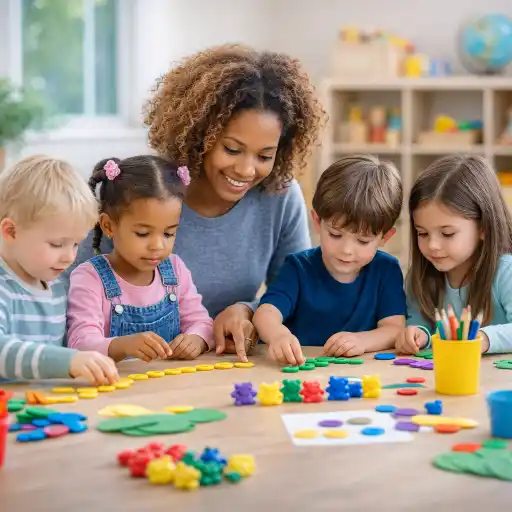
- Q: When should I start teaching number concepts? — A: Immediately; counting in routines supports infants’ and toddlers’ emerging number sense (ChildCareEd everyday math).
- Q: Are worksheets ever okay? — A: Sparingly and only when they reinforce a hands-on experience; prioritize manipulatives and conversation.
- Q: How often should I assess? — A: Brief play-based checks every 2–4 weeks give useful signals without heavy documentation.
- Q: How can families support math at home? — A: Share micro-activities (counting stairs, sorting laundry, roll-and-graph games) and model math talk; see family engagement PDFs on ChildCareEd.
- Q: Where can staff learn more? — A: Consider short online courses like Math Foundations Buy Now $16.00 and programmatic texts such as Clements & Sarama.
You are doing the everyday work that makes big differences. Keep it playful, observe closely, and celebrate growth.
- 45 Hour Child Growth and Development
- Early Mathematics Through Play
- 45 Hour Preschool Methods and Materials
- Math Foundations in Early Childhood
- CDA Bridge Bundle: Preschool without Portfolio Review
- No Such Thing as Boring Math
- Texas Director Credential
- Building Vocabulary
- Enhancing STEM Education for Infants and Toddlers
- Teaching Math to Young Children
- Creating Your Own Galaxies
- Mathematical Skill Development
- Tiny Tots, Big Learning: Crafting Curriculums for the Littlest Learners!
- CDA Certification en Español: Recursos y Consejos para Educadores Bilingües
- 🎉STEM-sational Fun: How Can You Spark Preschoolers’ Curiosity with Engaging STEM Activities? 🔬🧪🔢
- How Do Art Activities Support Cognitive Growth in North Dakota Preschoolers?
- Celebrando la amistad en el cuidado infantil durante el Día de los Mejores Amigos
- How Can I Use Fun Math Activities for Preschoolers Every Day?
- How can I use simple math activities for preschoolers every day?
- How can preschool programs intentionally support early math skills every day?
- How Can Preschool Programs Best Prepare Children for Kindergarten?
- How Can I Help Children Understand Shapes and Patterns?
- Can Block Play Build Children's Spatial Skills?
- Count It, Sort It, Find It! Fall Math Games for Preschoolers
- What Should a 3-Year-Old Be Learning at Preschool?
- How Can Ocean Animal I Spy Combine Counting, Visual Scanning, and Ocean Science?
- How Can Child Care Providers Integrate Counting into Seasonal Art Activities?
- What Should Child Care Providers Prioritize When Preschool Readiness Goals Compete for Time?
