Want measurement to feel like playful discovery, not a worksheet? Introducing measurement through everyday play helps children build spatial reasoning, comparison language, and early #number sense — skills that support later #math learning and classroom confidence. A practical next step is to explore ChildCareEd’s Math Foundations in Early Childhood  Buy Now $16.00, a short, practical course that shows how to weave measurement into routines, centers, and sensory play. For infant/toddler strategies, also consider Enhancing STEM Education for Infants and Toddlers Buy Now $16.00 to expand measurement practice for the youngest learners.
Why should we teach measurement to young children?
Measurement is not just about numbers — it’s a gateway to reasoning, comparison, and vocabulary. When children measure and compare they learn to observe, estimate, and justify choices (for example, “this block is longer than that one because it needs three cubes to match”). Early measurement experiences strengthen informal math thinking and support emergent literacy by encouraging explanation and math talk. Use of consistent words (longer/shorter, heavier/lighter, full/empty) builds a shared classroom language that supports self-regulation and problem solving.
Why it matters: measurement experiences develop spatial thinking and executive function that predict later achievement. Embed measurement in play, snack time, and art to make the learning continuous and meaningful. Remember: state requirements vary - check your state licensing agency.
Key ideas to highlight: #measurement, #preschool, #math, #play, #assessment.
When and in what sequence should we introduce measurement vocabulary and concepts?
Young children benefit from a progression that starts with comparison and nonstandard units and moves toward standard units over several months or years. Start tiny and repeat often:
- Infants & toddlers: focus on comparative language (big/little, more/less) using large tactile objects and sensory bins; modeling is essential.
- Age 3: introduce nonstandard units (blocks, paperclips, hands) for length and counting as children measure play items for 1:1 correspondence.
- Age 4: practice ordering (shortest to longest), measuring with rulers introduced as a class routine, and exploring capacity with cups and scoops.
- Age 5 / Pre-K: combine nonstandard and standard units, discuss which unit makes sense, and introduce simple estimation and comparison tasks.
Teach one or two words per week and scaffold with routines: measure a backpack at arrival, compare two block towers at center time, or estimate how many scoops fill a sensory tray. Observe first, then decide the next step for each child. For detailed guidance on progression and integration, see ChildCareEd’s practical overviews like What Preschool Math Skills Should I Teach and When?.
What hands-on activities and materials work best by age?
Choose materials that invite conversation and repetition. Rotate simple, safe supplies and create a small measurement shelf so teachers can swap activities weekly. Examples that scale by age:
- Infants/Toddlers: sensory tubs with large scoops and big counters; cloth ribbons labeled long/short.
- Three-year-olds: nonstandard measurement tubs (paperclips, linking cubes); snack counting and measuring fruit slices.
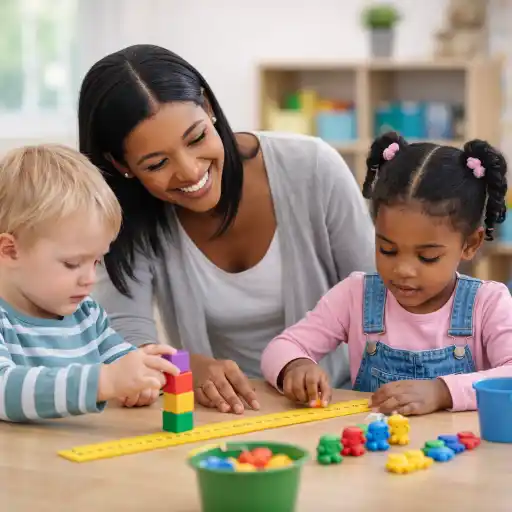
- Four-year-olds: measuring stations with rulers and laminated recording sheets; block-building challenges that require a specific length.
- Five-year-olds: comparative experiments (which ramp makes the car go farther?), estimation jars, and simple data collection (graphing how many cubes long each child’s shoe is).
Practical seasonal and printable activities save prep time — for example, use the Measuring Gingerbread activity Buy Now $0.00 as part of a holiday math center. Other low-cost ideas: LEGO measurement (count how many studs tall), pasta rulers, yarn for “wrap and measure” tasks, and balance scales for weight comparisons. Keep materials clearly labeled and safe for the age group.
How do I assess progress, partner with families, and avoid common mistakes?
Assessment should be lightweight and embedded in play. Use brief observation notes, photo samples, and one small task per child every 2–4 weeks. Examples of low-burden checks:
- Ask a child to measure a toy with cubes and count aloud while you note the behavior.
- Record a short video of a child ordering three objects; annotate a one-line outcome.
- Keep a simple portfolio photo (e.g., child’s measuring strip) to show growth over months.
Partner with families by sending a single-sentence home activity: "Tonight count the steps to your front door and record the number." Encourage family math nights where simple measurement games are modeled. For training on observation and translating notes into goals, consider Tracking Progress, Shaping Futures Buy Now $55.00.
Common mistakes and how to avoid them:
- ⚠️ Relying on worksheets too early — keep activities tactile and conversational.
- ⚠️ Teaching too many terms at once — introduce 1–2 words and revisit them across routines.
- ⚠️ Using inappropriate materials (small choking hazards) — match supplies to licensing rules and ages; state requirements vary - check your state licensing agency.
How can I build staff skill and make measurement part of everyday practice?
Sustainable practice depends on simple tools, shared goals, and short professional learning. Steps you can take this week:
- Pick one weekly goal (e.g., compare lengths using linking cubes) and identify three built-in moments to practice it (arrival, snack, free play).
- Maintain a small, labeled math shelf with 4–6 ready-to-use items and swap one resource weekly.
- Use short team huddles (5–10 minutes) to share observations and plan next steps.
Professional learning options on ChildCareEd can expand teachers’ confidence: try No Such Thing as Boring Math Buy Now $24.00 for play-based lesson ideas and Building Early Science Foundations Buy Now $16.00 to connect measurement to inquiry. A Monday-morning micro-plan: set a measuring tray, demonstrate one short task (2–3 minutes), observe 3 children, and note one next-step per child. Repeating this habit builds competence and consistency.
Conclusion: What should you do next?
Start small and be intentional. Teach a couple of measurement words, add a measurement station, and use nonstandard units first — then introduce standard tools when children are ready. Use lightweight assessment to track growth and share one simple home activity with families. Practical professional learning (for example, Math Foundations in Early Childhood Buy Now $16.00 and its companion courses) will accelerate classroom change and teacher confidence.
Main takeaways: embed #measurement in routines, choose safe manipulatives, observe before introducing new challenges, and sustain practice through short staff habits. Children learn measurement best when adults make it meaningful, tactile, and conversational — measurement becomes a daily language of exploration rather than a one-time lesson.
FAQ (short):
- Q: When should we start measurement? A: From infancy — start with comparison words in routines.
- Q: How much documentation is needed? A: Short check-ins every 2–4 weeks are usually enough.
- Q: Are nonstandard units valid? A: Yes — they build understanding of measurement before standard units make sense.
- Q: Where to learn more? A: See the ChildCareEd courses linked above for practical, playable strategies.
- Early Mathematics Through Play
- CDA Home Visitor Subject Area 3 Part 3 Birth to 5
- CDA Home Visitor Subject Area 2 Part 3 Birth to 5
- 45 Hour Preschool Methods and Materials
- Building Early Science Foundations
- Pediatric RSV First Aid & CPR/AED
- Art from the Heart for Preschoolers: Open Ended Art Projects that Build Self-Esteem
- Texas Director Credential
- Montessori Cultural Activities: Exploring the World Through Play and Learning
- Mathematical Skill Development
- 🔍 ¿Qué ves cuando observas a un niño aprender?
- Capacitación en Salud y Seguridad Preventiva en Línea para Proveedores de Cuidado Infantil
- Lista para Abrir una Guardería en Casa en Virginia: Cómo Empezar
- Lista para Abrir una Guardería en Casa en Carolina del Norte: Cómo Empezar
- Cómo Celebrar el Día Nacional del Kindergarten
- Lista para Guardería en Casa en Illinois: Cómo Iniciar una Guardería en el Hogar
- Lista para Guardería en Casa en Texas: Cómo Iniciar una Guardería en el Hogar
- Canciones, juegos y preguntas de círculo para niños
- Cómo simplificar la capacitación para sus empleados de daycare
- How can blocks, water play, cooking, and outdoor exploration introduce STEM to young children?
- How can I introduce STEM concepts in early childhood?
- Can Block Play Build Children's Spatial Skills?
- How Do I Introduce Measurement to Young Children?
- Pumpkin Math Without the Worksheets: Hands-On Pre-K Learning
- Fall Detectives: 10 Questions Pre-K Kids Can Investigate This Season
- How Do Light vs. Heavy Activities Build Early Measurement Skills?
- Can a Floor-Sized City Fit on a Table? Exploring Scale Through Reconstruction
